
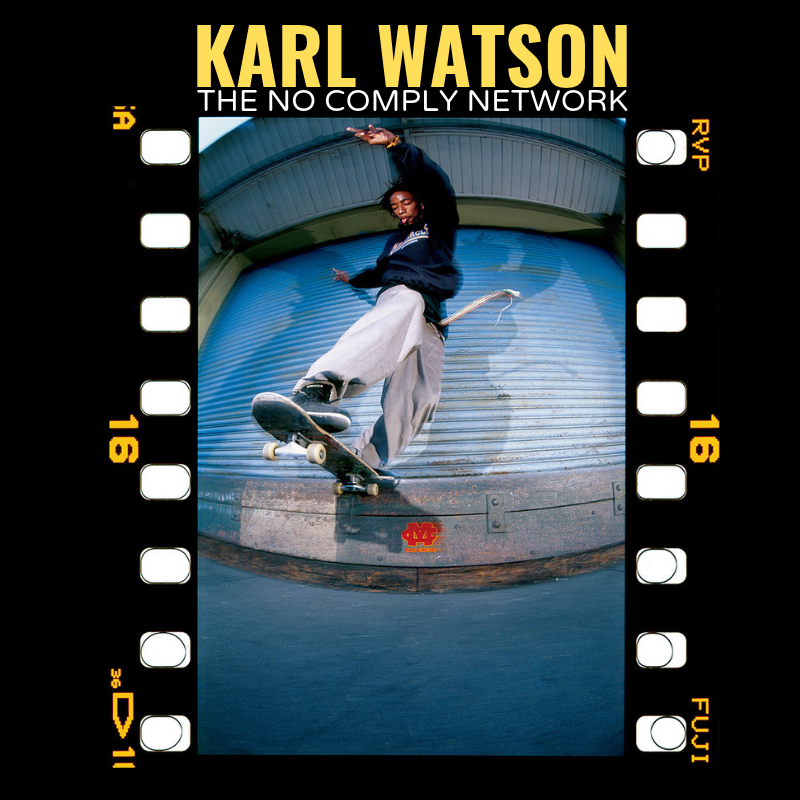
Karl Watson’s unique, stylish skateboarding shifted street skating in a new direction that we’re all still rolling down today.
Whether you’ve got his unforgettable Frontside Noseslide 270 Out on Hubba Hideout on loop, figuring out how he made it look so smooth, his library of ledge moves, or one of the countless tech lines he put down at basically every single iconic spot in San Francisco, his impact on how skaters approach different things to shred is equally as immeasurable.
So after meeting Karl and chatting to him about his skating and work with Adidas Skateboarding, we were hyped to hit him up after we discovered he was down to join The No Comply Network and have a chat about his skating, parts, and creative projects in collaboration with Henry Jones to get his thoughts on them all.
Alongside the backstories of a series of sick moves he’s put down on his board, we also found out Karl has been making art for a very long time too.
Read Karl Watson’s interview for his perspectives on what it was like growing up skating SF, Oakland, how his environment defined his dope skate style, Tommy Guerrero, his early days at EMB, Nick Lockman, Mike York, Mike Carroll, James Kelch, Pier 7, World, his lost Love Child part, Third and Army, his Hubba Hideout Noseslide 270, The origin of the phrase ‘Pretzel Out’, Stevie Williams, why he thinks skateboarding and creativity are inseparable, his art, thoughts on innovation in skating, work with Henry on their trilogy of illustrated skateboarding books for Kids, My First Skateboard, Jonas Meets Jack and A New Spot to Skate, LRG, Anthony Claravall, Where’s My Money Chico, his part in Expeditions Alone, and his favourite skaters, styles, videos and spots of all-time and more.
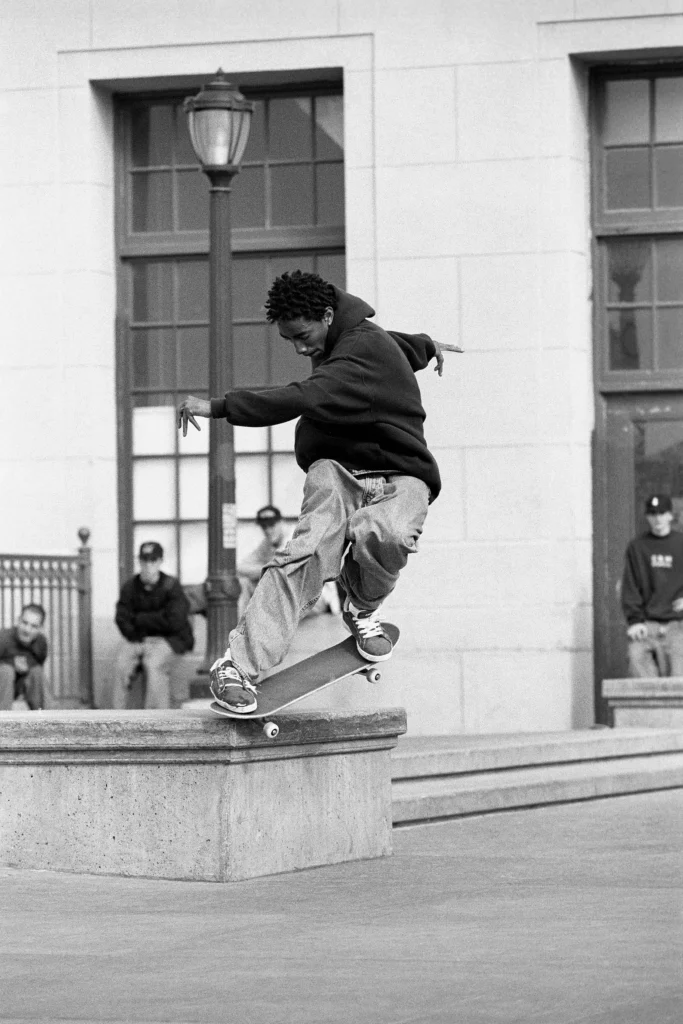
Nollie 180 Crooks Across, Pier 7: Shot by Bryce Kanights
What’s your full name?
Karl Steven Watson.
What do you do day to day now, Karl? I heard you’re one of the Adidas team managers in the US?
Yes. I got brought on to help Paul Shier out because he was overwhelmed and he needed some assistance. So I came in under Shier.
I’ve been working at Adidas for 9 years now, and it’s a blessing because I get to do what I do best, noticing the abilities in skaters, believing in them, and giving them an opportunity.
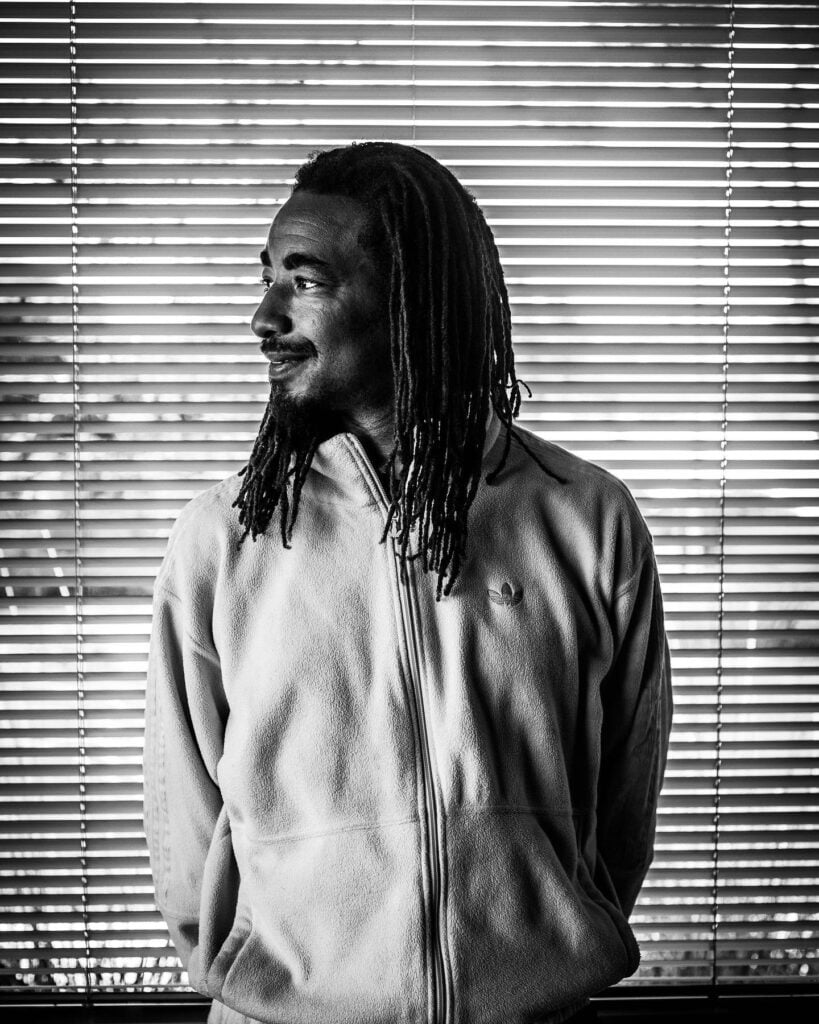
Karl Watson: Shot by Jaime Owens
Right. So where did you grow up?
I was born in Oakland, and then I lived in Oakland off of 35th Avenue, on a little street called Abbey Street. Abbey and Allendale, it was a one-block street that had all of these families, all of these kids. It was the best experience because so many different families lived there and that’s where I first discovered skateboarding.
How did you first get on a board?
My dad brought a skateboard there for the neighbourhood kids and eventually, I was able to use it later on in the day because everyone was so much bigger than me. I lived there until I was about 9 years old. Then, once I turned 9, I moved into the city with my mom and her girlfriend.
Right
My parents got married right out of high school. They were high school sweethearts, and then my mom left my dad because she realised she was a lesbian. It was definitely an interesting experience growing up because once I moved to the city, my eyes were opened.
Living in Oakland was super cool too because it felt very country; it was super safe. I could be outside until 1AM in the morning, playing and just having fun. It was safe in that little neighbourhood, but in the city, it was a world of excitement. My mom had all these friends that were super cool. She was in a community that was different, especially for a kid coming from Oakland.
So you could already skate a bit but how did you discover that skateboarding had its own industry and culture?
So, in Oakland, when I was introduced to the skateboard, it was a banana board, and I would only ride the skateboard down the ramp of the driveway and then curve onto the sidewalk. At that time, I learned my stance, and I learned how to balance on a skateboard.
Once I moved to the city, I saw other aspects of skateboarding. I saw people Ollieing up the curbs. I saw different crews skating around. It just looked like an amazing thing to do, and then I would see this Ninja Skateboard complete outside of this store in the Tenderloin.
When I was a kid, my mother and I would take the bus; we would pass it, and I would always see this board. They had it in front of the store, and I just wanted it so bad. So I asked for it, and for Christmas of 1987, I got my first skateboard, and at that time I was living with my mom and her girlfriend.
We were living in a good neighbourhood. It was like the Haight Street area, but in the city; you can go two blocks, and you’re in a completely different zone. You have mansions, and two blocks down and you’re in the hood.
We lived adjacent to the hood, and all the friends I met were because I was used to hanging out with the neighbourhood kids. I wasn’t scared to approach kids, so I made a lot of friends with the kids who lived in the nearby projects.
I would hang out with them, and they would get into a lot of trouble. I was just kind of an innocent little kid, kind of an innocent bystander. Then my mom noticed that the main kid I’d be hanging out with, who introduced me to all the other kids, got in a lot of trouble. He got arrested for being in a stolen car at 13; it was pretty gnarly.
My mom was like, “There’s no way in hell I’m gonna allow you to go down this path!”.
So, we moved over to Hayes and Stanyan, a really nice area right across from Golden Gate Park. It was a really beautiful location, and in that area, when I had my skateboard – I didn’t use it much back at the old neighbourhood – but when we moved to the new place, I was bored. There were no kids. So one day I used my skateboard to skate back to the old neighbourhood, and in between that house and the old neighbourhood, I ended up meeting Nick Lockman.
Who’s Nick Lockman?
Meeting Nick Lockman was integral to me being where I am now. It’s interesting because, to rewind a little bit, in the days hanging out with those kids that were doing bad things around the community, we ended up seeing Little Nick and his friend trying to do tricks off of a launch ramp.
I didn’t have my board. I was just on a bike with those other guys, and we were watching Nick and his friends, and for the first time, these guys were quiet. Silent. They were pensively watching what was going on. They were really very intrigued by the skateboard, and so I thought, oh, this little kid, he just tried to do it. Nick tried to do something. He fell off his board, and then I laughed at him because I thought, oh, this is my chance. I’m a little scrawny kid, and this kid’s even smaller than me.
But what I didn’t realise was that this kid had way more heart than me. I laughed at him and little Nick, picked up his board, and started charging at me to hit me with his board, and his father saw it from inside and came out and, stopped it, and if it weren’t for that, I would have been so embarrassed because I didn’t know how to fight and I didn’t want to fight. This little kid had so much fury; he was ready, and I would have been embarrassed. Those kids would have made fun of me forever.
But the reason he recognised me a year later, when I was skating from one neighbourhood to the next, is because his dad heard the call of the wild, the wheels going down the sidewalk. Nick heard the call of the wild, the wheels going click, click, click down the sidewalk.
They look out the window. His father, Mike, said, “Hey, that’s that kid!”
He thought to himself, now he’s alone, and he has a skateboard. So he said “Hey, Nick, invite him in!”.
So I hit the corner, Nick is bored out of his mind, sitting in the window. He said, “Hey, do you want to come in?”
He literally invited me into his house, and right at that moment, I was introduced to the world of skateboarding. He had all these magazines, all of these videos, so many old skateboards, all the cool clothes. Jimmy Z this, Concrete Jungle that. Nick was fully in the know about everything that was cool about skateboarding at the time.
What was the first magazine or video you saw that Nick had that he showed that you still remember now?
The main thing that I remember from that time was Animal Chin. The Search for Animal Chin was the video of the time, and it was so exciting, the whole storyline. Nick introduced me to Sam Smythe. Nick and Sam were best friends, and it took him about three months or so to prepare me to meet Sam.
When I met Sam, we hit it off, and then it took even longer for them to bring me down to the Embarcadero. I had to learn the etiquette because these kids were connected. Nick and Sam were very connected with the Embarcadero crew, and they wanted to make sure I wasn’t going to embarrass them or something.
I don’t know if they were wondering if I was going to be good enough, and yeah, when they first brought me down, man, I totally made a fool of myself. I was so excited that I finally got to the promised land of the Embarcadero, and the first trick I tried to do was an Early Grab. An early Frontside Grab off of the stage, and I did a nosedive and fell really hard and I just lay there in pain.
Then James Kelch came over, picked me up by my shirt like a little ragdoll, and brought me over to the wave. He said something like, “You’ll be good, little dude”.
Right then and there, I knew that I was accepted because the mayor himself, James Kelch, came to my rescue and set me aside, and that was that, the rest is history!
He was looking out for you, saw you might be hurte
But I think he touched on something, the trying aspect. If I didn’t try, if he didn’t notice I was willing to take risks, they wouldn’t have respected me.
How big was the stage? Like a 3-4 ft high drop?
Yeah, 3 and a half feet, something like that, exactly.
How old were you?
12
That’s nearly your head height at that age. I remember seeing a clip of you nailing a dope Backside 360 down a 3-stair at EMB and, you’re wearing that Burger King hat, that was sick. Jacob Rosenberg filmed it; how did that go down?
So, on that morning I went to Burger King, and I loved the Breakfast Muffin, or, any kind of breakfast at a fast food place at the time. I was so into it when I was younger. I got my little breakfast, and then I asked for one of those. I knew I was going to meet Jacob Rosenberg at Embarcadero, and I got that little Burger King crown hat, as I thought it’d be funny to rock it in the video.
I went there fully pumped, just ready to go, feeling comfortable on my board because I only rode that Think Skateboards deck. I had over 100 of them, the same shape. It was called Safe as Milk. Funny graphic.
But, yeah, I was definitely comfortable with that trick and honestly, about a year before that, I had just learned how to Ollie. It took me a year to learn how to Ollie, from 11 to 12, and when I turned 12, my mother and I moved into this apartment on Haight and Divisadero. It was 234B Divisadero, and when we went and checked out the apartment together, something very magical happened.
What happened?
At that point, I could barely Ollie. I just figured out how to do that and although I felt like I was a horrible skater I loved it. I loved skate culture. I loved my new friends. I loved the freedom of skateboarding.
So we’re checking out this new apartment, and my mom is talking to the landlord in the front room. I went to check out my room, and on the back of the door of my room was the only thing that had been left in the entire apartment.
What was it?
When I saw this thing hanging on the back of the door, I grabbed it down. I immediately knew what it was, and I said to myself, I’m going to be a pro skater one day.
So the apartment that we were checking out, it turned out that Tommy Guerrero had lived there right before me, and the item I held in my hand and had that epiphany moment with was the drum with the stick and the string with the two little balls on the end that was in The Search for Animal Chin video. It was in Animal Chin, and it was in my room with a blue Thrasher sticker around it.
That’s insane. That’s great. That’s such a crazy connection that I didn’t know you and Tommy shared
I know. Yeah. I knew it from that moment. There was a knowing. But really quick, going back to the Back 360, kind of. That apartment we moved into, because Tommy used to live there, Rip Grip packages would randomly get sent there. Rip Grip packages in Tommy’s name were regularly delivered to the house.
Did you ever crack them open and put them on your board?
But at that time, Rip Grip was becoming obsolete because people weren’t doing Early Grabs anymore. We were starting to slide on our noses. We stopped doing the launch ramp tricks.
But those boxes never got opened. But my backyard was concrete. The whole backyard was concrete, except for the perimeter, which was soil that they left open for the trees and plants.
I was able to practice my ass off in that backyard. It was a blessing moving into that apartment because I learned so many tricks on my own, skating by myself, and then I would bring my tricks to the Embarcadero. They weren’t the best, but they were the fundamentals. Kickflips, all of the fundamentals, I learned alone in my backyard.
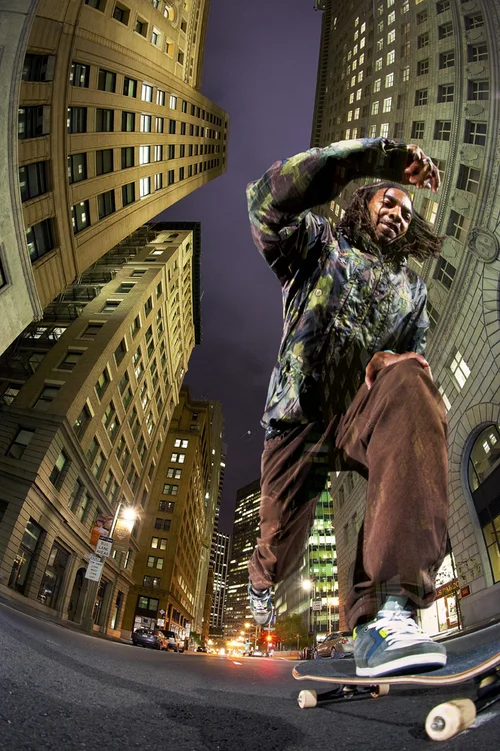
Karl, Pushing: Shot by Kyle Camarillo
Sick! What skate videos did you have on rotation the most when you started?
Animal Chin was definitely one of them.
Who had your favourite part in Search for Animal Chin?
We watched the whole movie. It was like a movie. I think my favourite part was when they finally found that ramp with the spine, that huge ramp. Those guys, I still admire all those individuals. Like, seriously, I see Tommy to this day, and I fan out on him, you know? Mike McGill, Tony, all those dudes are so sick; they’re the heroes. That video did a number on me. Honestly, it was the catalyst for me falling in love with skating.
That’s rad to have that connection with Tommy, previously living in your house too.
True.
What kind of magazines were you reading at this point, or were you more into videos?
I was definitely less into magazines. We would look at them all together when they’d come out as a group and awe and oh over certain things, but we were really living it.
Skateboarding was in a state of flux at that time. We were transitioning from launch ramp skating and other types of Early Grabs and pool skating to street style skating, and it was a very powerful time because we didn’t realise what was happening, but we were creating modern-day street style skating.
All of the things that we changed, such as the boards, we were making the nose bigger. We would drill back our front truck to make it bigger so we could utilise the nose. The full cab shoe was too tall, but we liked the way it fit, so we would cut down the full cab shoe and then put duct tape around it, and that’s what gave them the idea to make the half cab, which is still around today. So many changes around that time were because of our crew, and then Mike Vallely came out with the double kick. That was it. We adopted that. We loved that one.
But I’ll bring up something very important, pertaining to the transition from the popsicle to the double kick style skating with a skateboard with the bigger nose. Before we had noses, we didn’t really utilise the nose. There was no Nollie, no Switch skating, and once the nose got a little bigger, we were able to put it to use.
I remember the first Switch-style skating trick, and I remember that came about before we had the nose; that was what we called at the time “The Chinese Ollie”. The Chinese Ollie was rolling and doing a little bump off a crack, but on your front wheel. That was the very first Nollie before we got proper noses, and once the noses came, we already kind of had that feeling to want to do something off our nose. That’s when we started skating Switch and Nollie.
Who were you skating with at EMB the most?
There were so many amazing people that would go to EMB daily. We never had to call each other. Embarcadero was our home pretty much. We had a payphone at the Embarcadero for people to call into, and every single day, you never asked your friends where you’re going or what time you’re going. We would always be there. People like Mike Carroll, Jovonte Turner, Henry Sanchez, Lavar McBride, Sam Smythe, Marcus McBride, and The Corner Kids.
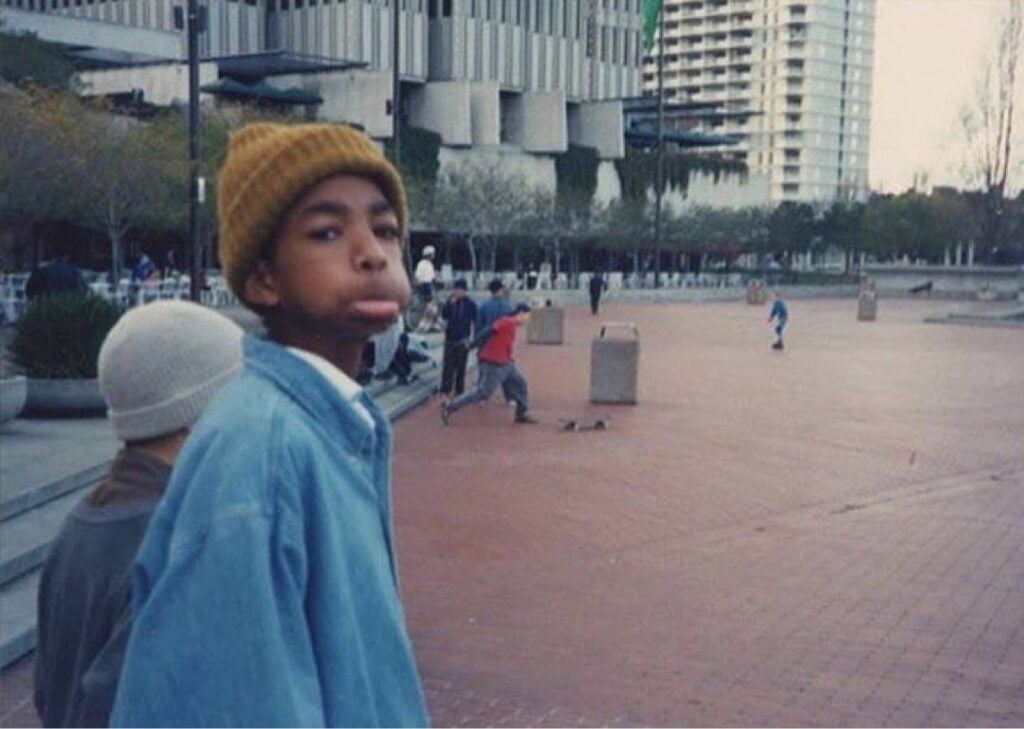
Karl at EMB: Shot by James Norton
You had all these different groups of people that would be there. Wing Ding and people would always be coming from out of town, and I love meeting those people. So whenever I saw somebody coming, especially from a different country, from Europe or Asia, wherever they’re coming from, I didn’t care if they had a skateboard. I wanted to meet them. The further away they were from where I’m from, the more I was interested in them. I was more interested in them.
That’s how I got the reputation of being an ambassador of skateboarding. It happened there; it started very early on. Whenever people say I’m the nicest guy in skateboarding, like they’ll say stuff like that, it’s because of my very early interactions, up to my interactions nowadays with people that I love so much and, all skaters, no matter what you look like.
Yeah, that happened really early on. I love meeting people from all around. We had our crew, we had all those names I mentioned, but then meeting people travelling from different countries to come visit us was the best thing ever.
Oh, definitely. I think there’s no better way to learn about the world and people than actually meeting those people. How many people did you meet?
Thousands, for sure.
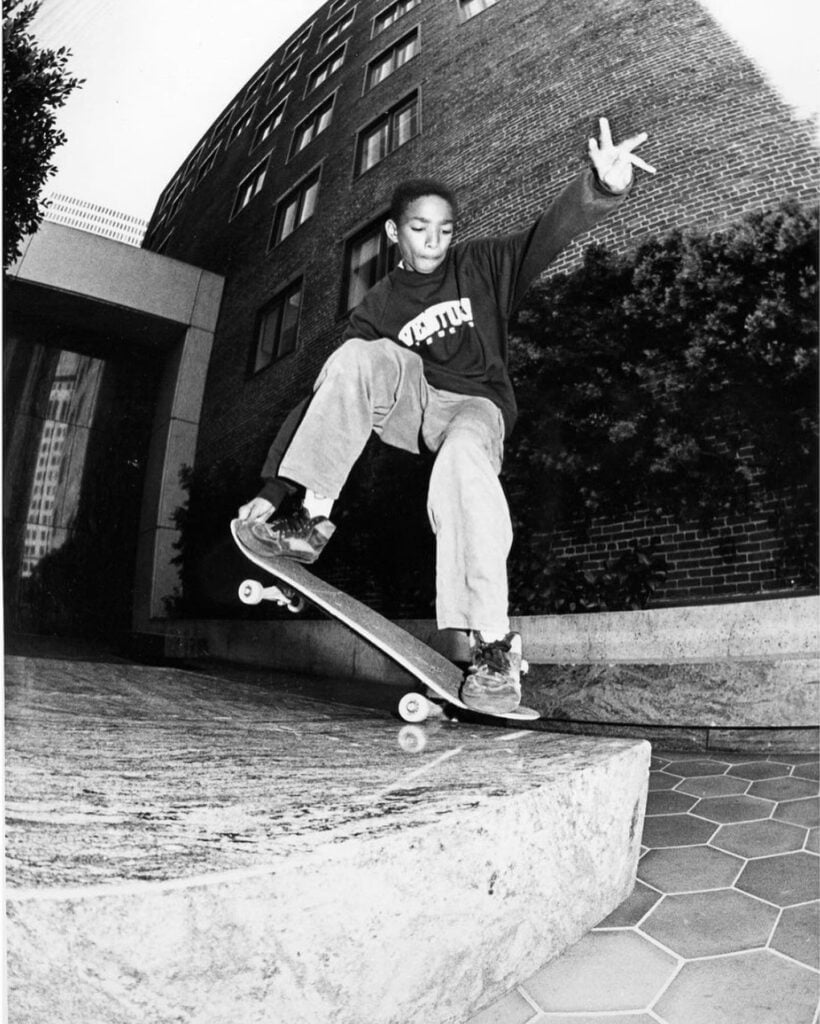
Frontside Nosegrind, Brown Marble: Shot by Luke Ogden
I bet a lot of those skaters remembered you for sure, and you must have had a strong impact on a lot of skaters who were probably feeling a bit intimidated and scared, and you were probably the first person who made them feel at home.
That is exactly it, my friend. I would see that they were intimidated. They’d be on the perimeter of the Embarcadero, and I would see these individuals, scared to come onto the spot. So I would go there and act as if I knew them. I’d greet these groups of individuals and say, “Hey, act as if you know me; give me a high five!” and stuff like that, because then I knew their stuff was safe.
Even though I was meeting them for the first time, I would speak to them directly. I would make immediate friends that way because I didn’t want them to have their camera or their board stolen because these guys were vultures. A lot of the dudes there that didn’t skate that kinda hung around us were just vultures, man.
I was a safeguard in a way for the community because I cared about them having a good time and a good impression when it came to their experience at Embarcadero.
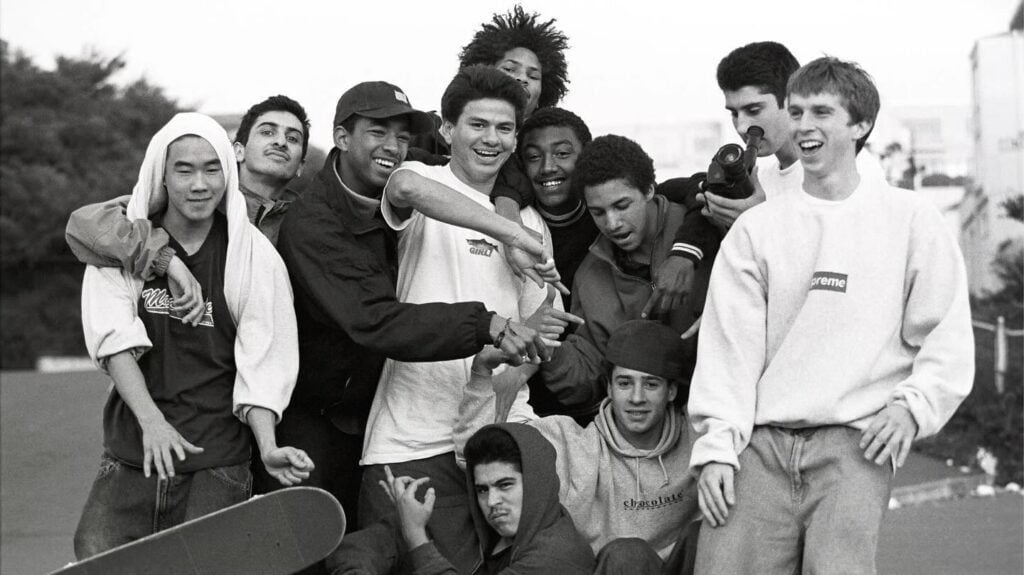
Karl and the EMB Crew: Shot by Bryce Kanights
Who was your first sponsor?
I was lucky that I was associated with the EMB crew because back then I really didn’t look very good on the board. I didn’t really bend my knees; I was super straight-legged, and I just didn’t look very good on the board.
But being a young kid connected to Sam and Nick, it really helped me to get my first sponsor, which was Dogtown. They put us on Dogtown, and then that ended up being Think Skateboards.
Having Greg Carroll believe in me was the fuel for me becoming a better skater, and then having Keith Cochrane tell me, like, hey, you don’t bend your knees enough. You got to bend your knees, like, very bluntly.
I was so offended, but then looking at myself, like, in kind of understanding that he was right, and then once I tried to bend my knees a little bit more, I realised I had more control in my landing and also in my approach, and so that was very fundamental, man. Like having the belief of Greg Carroll and then having, like, the brutal truth of Keith Cochran, who was the owner of Think. So that was a very integral turning point in my skating career.
I mean, sometimes, you know, you can be as subtle as you want, but sometimes you just kind of need to hear the truth, and you don’t need it to be sugarcoated. It’s just good to have somebody you can say those things to. But it’s funny to hear because most people would associate you with having an elastic, flexible style, you crouch a lot on your board! So you did a complete 180 on that!
That’s interesting, right? Because once he brought that up, brought that to my attention, it wasn’t that I changed my style. It was, like, oh, this is enhancing my abilities and it made it so I could actually skate properly.
That back 360 you’re talking about, you see how straight-legged I landed?
I was limited in my abilities because of my perception of how to move my body, just barely bending my knees.
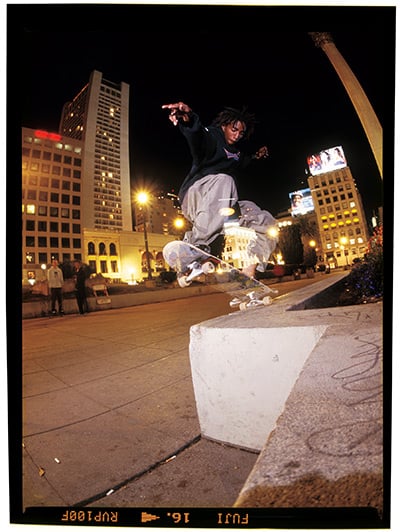
Switch FS 5-0, Union Square, SF: Shot by Mike Blabac
So hearing that helped you to carve your signature style
Definitely.
You were surrounded by amazing skaters at EMB, but was it only the skaters there that inspired you at the time, or were you looking further afield?
It’s a really good question. Since the Embarcadero at the time was, so popular, and we were also in the state of flux as, the skateboarding community, we were shifting. There was a power shift, and also everything was changing, all the tricks, to street skating.
Since the Embarcadero was a nebula, it was a nebula of skateboarding tricks and skate style. This is where things were born. I would see new tricks being created every single day, NBDs, every single day, you know.
I didn’t really have to look outside of my crew for inspiration but we did look over to the guys in LA. The guys in LA were inspirational; the guys in New York were inspirational because those were the very established crews, and then some European skaters too- some of the French skaters and especially once we got over to Pier 7, that’s when we started really connecting with people from other countries because the power structure was different. It became more of an inviting environment because it was run by the younger guys of EMB, in a way.
I was very adamant about us being cool to the people and picking up our trash and stuff like that, just kind of annoyed probably about that stuff and being respectful to the people walking by, and I hated seeing somebody bump into an old lady and not say sorry or something. If I saw some rude behaviour, I would always be like, hey man, you gotta say something; I would go to the person and apologise on their behalf too. So instead of complaining about it, I would show them, hey, this is how you do it. I don’t know, I mean, I’m not a perfect person.
Who was the first skate brand to pay you for your skating?
Well, my first money from skateboarding came from World Industries. When I was 14, they flew me and some of the crew members, some of our crew, out to LA, and we got to stay at the warehouse for the summer.
We lived at the freaking skate park, and it was just crazy. Mike York was the first one in our little kid crew to make it big. Like, he was so advanced with his Tre Flips, just everything. His skating was so tasteful; at the time, he got the cover of Thrasher when we were so young, and he really got the shine. I think that inspired a lot of us to make it happen for ourselves too.
But yeah, World Industries was the first to pay us a little bit of money, and that $100 per month actually went a long way, because things were a lot cheaper back then. That was my very first taste of getting paid, and then after that, I think it was, let’s see, might have been Profile or something like that.
We were getting paid from skating the whole time because there was a financial ecosystem at Embarcadero and Pier 7. Every single day, if we didn’t have money, which we usually didn’t, we would sell skateboard products.
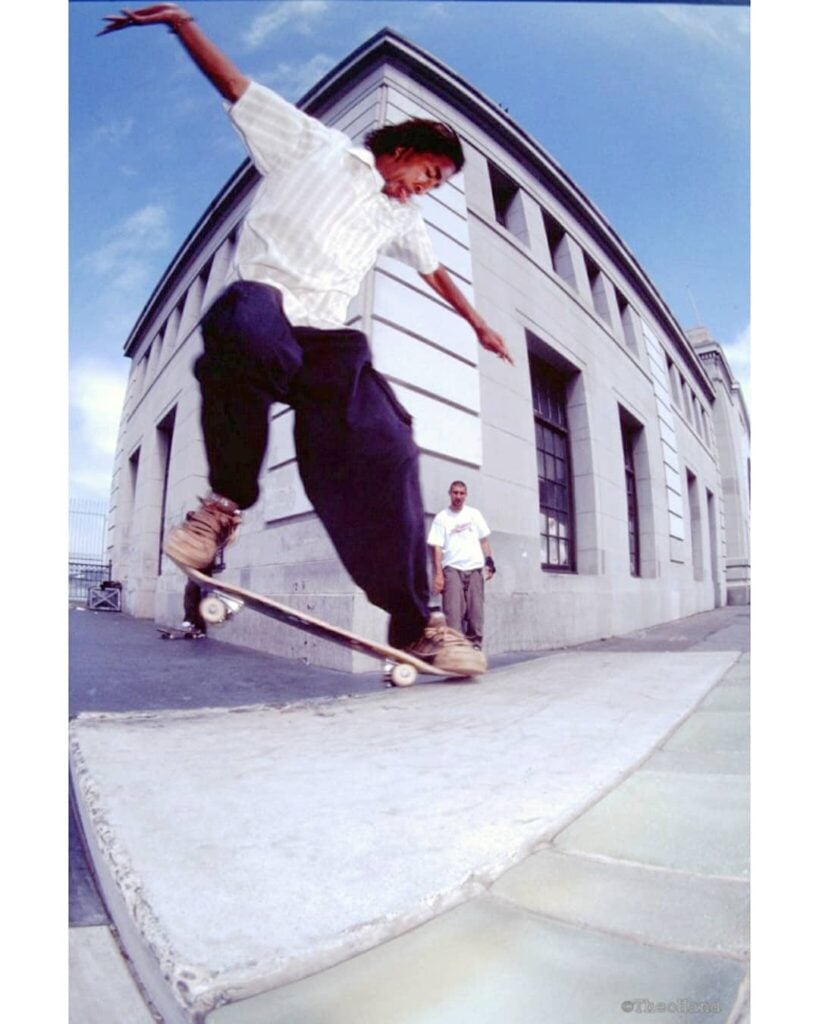
Frontside Crooks: Shot by Theo Hand
We would sell an old board, depending on its condition, for $20 to $25; wheels were $15, and a new board was $40, whatever. We were always selling our product to get by and, yeah, that was interesting, and then when I finally turned pro, my first pro check was $800 a month. I felt so rich. Yeah, that was crazy.
Did World Industries turn you pro?
That’s funny. This is a good question. I did feel like I was really in a good place. We were filming for the Love Child video. I filmed all these tricks, man. Switch 180 5-0, Switch Back Tail Pop over on the Santa Monica curbs. Just different stuff. I was skating with Rodney. I was staying at his house, really connecting, and then the Love Child video came out, and I wasn’t in the video; it was like the biggest blow to me as a kid, because I got the video of my package. I brought that video over to Lavar’s house.
There were 11 of us all together watching it. Then I’m thinking, oh my God, maybe my footage is in the credits, but it wasn’t, and not having any representation whatsoever, even though I was getting paid and clearly I was on the team, was so devastating. That was the catalyst for me. I really went inside, and I could have either become very depressed and completely thrown it all away and become a different person, or use that as motivation to prove them wrong.
Why did World not use your footage in Love Child?
I never got any answers as to why they made that decision, but I attributed their decision to me not having a good style that didn’t fit them.
I was just thinking, okay, it’s probably me. I beat myself up a little bit over it, and then I was on a mission to become more of a unique skater. Even though I was already on that path and thinking outside of the box, I thought, okay, I need to be more creative. I elaborated on the lane I created for myself by making up tricks and stuff. I wanted to be more exciting and more powerful too, so I started skating faster and becoming a stronger skater. That was really when I was doing well at Pier 7. I just became more of a powerful skater, and then down the road, I had one of those moments you asked me about early on, but it was after the fact.
Rodney Mullen was watching me skate from across the street one day at Pier 7, and I was really in my flow, going very fast, skating as powerful and creative at the same time as I could. He happened to be watching from across the street. This is after everything; I didn’t ride for World anymore. I was super bummed about the video. He came over and said, Karl, man, you’re ripping, man; if you ever need anything, I got your back. Fully genuine freaking Rodney Mullen. Oh my God, I love him to this day, and I felt super confident about that.
At that time, I was on Profile, I think, or something, or Clean. I don’t know what skateboard company I was on. But something did happen with that company I was riding for, and I hit him up, and he never got back to me. I was like, ah man, words are, you know, it’s… just skateboarding. The industry can be frivolous.
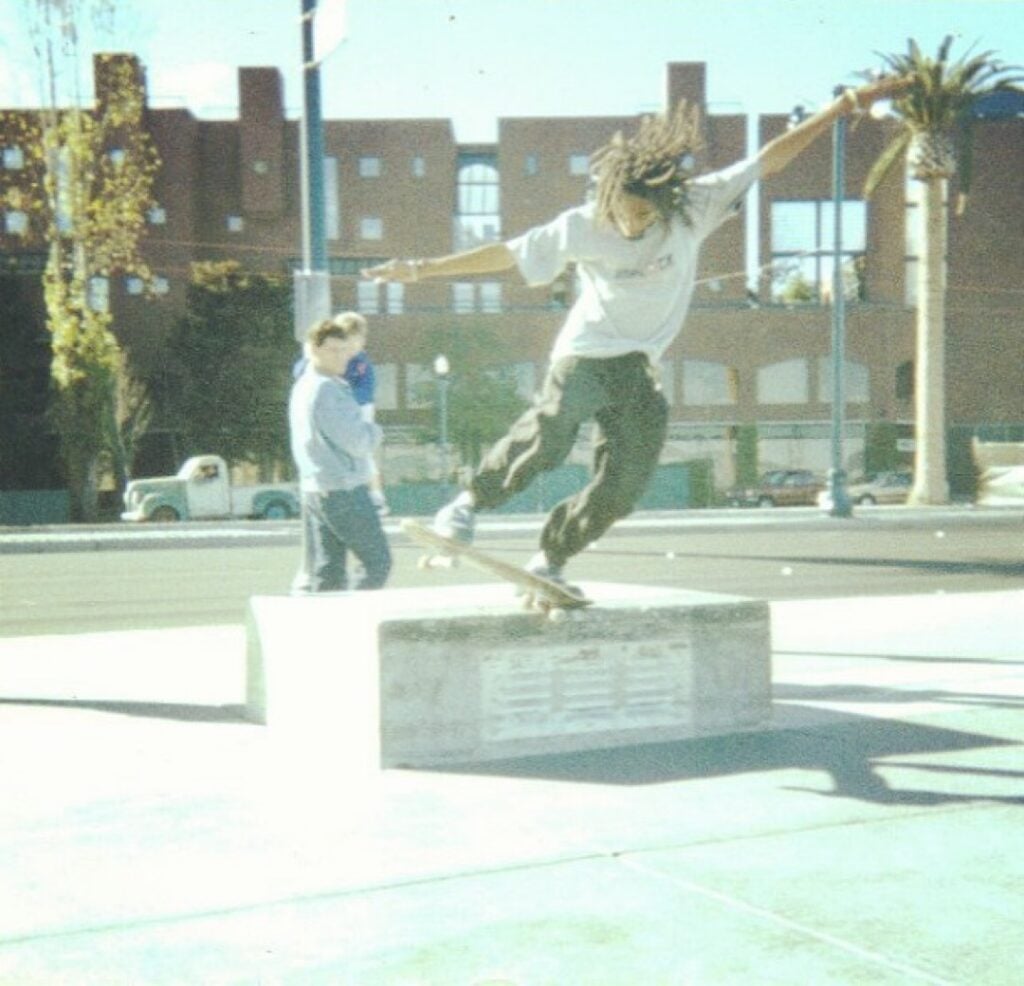
Switch BS 5-0, Pier 7: Shot by Stephen Sen Tent
What’s your favourite thing about skating Pier 7?
So after the Embarcadero, I don’t know if there’s a clip still online of me doing it at the Embarcadero over the 3 stairs. It’s a Nollie Inward Heel. I’m really young. It was around the time I finally learned how to like bend my knees correctly.
That was when I started skating better, and then around that time is when we segued over to Pier 7 because we kept getting kicked out of the Embarcadero. When I first saw Pier 7, I was like, this is not even a spot. Like, what is this little 2-stair thing? We have the Embarcadero over there that has everything for us, like waves, ledges, stairs, big stairs, stages to jump off of. There were places to eat food, places to sit and watch.
Ay first Pier 7 was lackluster, but we ended up making the most out of it, and that’s when we all started skating more manuals and then just doing the shorter ledge tricks and doing stuff over the pads and stuff like that, so we improvised and evolved our skating on the spot.
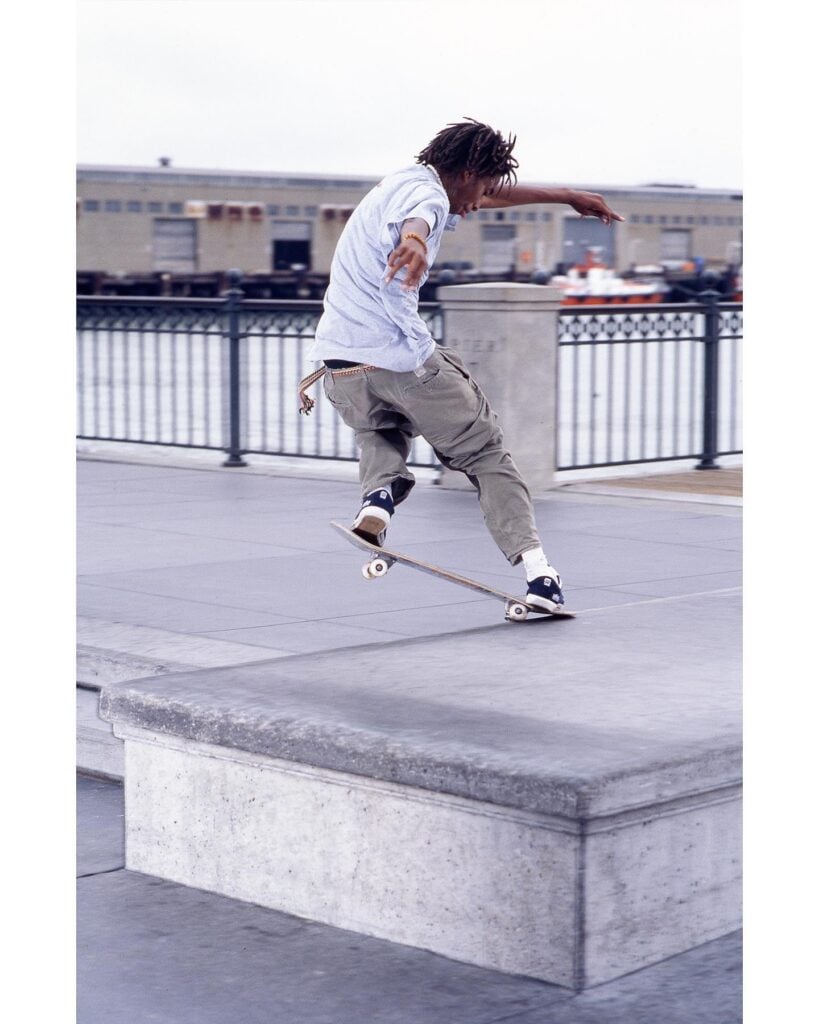
Nollie 180 Crooks Up, Pier 7: Shot by Luke Ogden
I’ve never seen anyone else get as banging a clip or a photo on that one little block at Pier 7, but you got a bunch
Oh yeah, people never really skated that block that I did the Nollie 180 Switch Crook on, now I think about. You’re right, actually. It’s funny you say that.
But a lot of your sickest footage was at Third and Army. At what point did you and everybody else start skating there?
Okay, so in my memory, the discovery of Pier 7, the migration to Pier 7, and the discovery of Third and Army were simultaneous.
But in other people’s memory, it was Pier 7 first and then Third and Army. For me, they were at the same exact time. The cool thing about Third and Army was that it attracted people from all over. It attracted the whole industry because it had something for everybody. Pier 7 was very niche even though it was a popular skate spot. Not a lot of noteworthy skaters skated there, outside of the people who enjoyed that kind of skating.
Third and Army was an incredible place for me personally because it goes back to my childhood. I really liked to learn tricks alone and dive in with no distraction, and that’s how I created the most breakthroughs in my skating, just kind of skating alone and figuring out the equation of the trick. Having access to Third and Army was amazing because I could go there early in the morning by myself and learn tricks when nobody was there.
I loved skating at Third and Army, and the ledges were low, so it was like skating a curb in a way. It kind of felt like we were cheating. I mainly appreciated Third and Army for that reason: the fact that the ledges really allowed us to have fun on them.
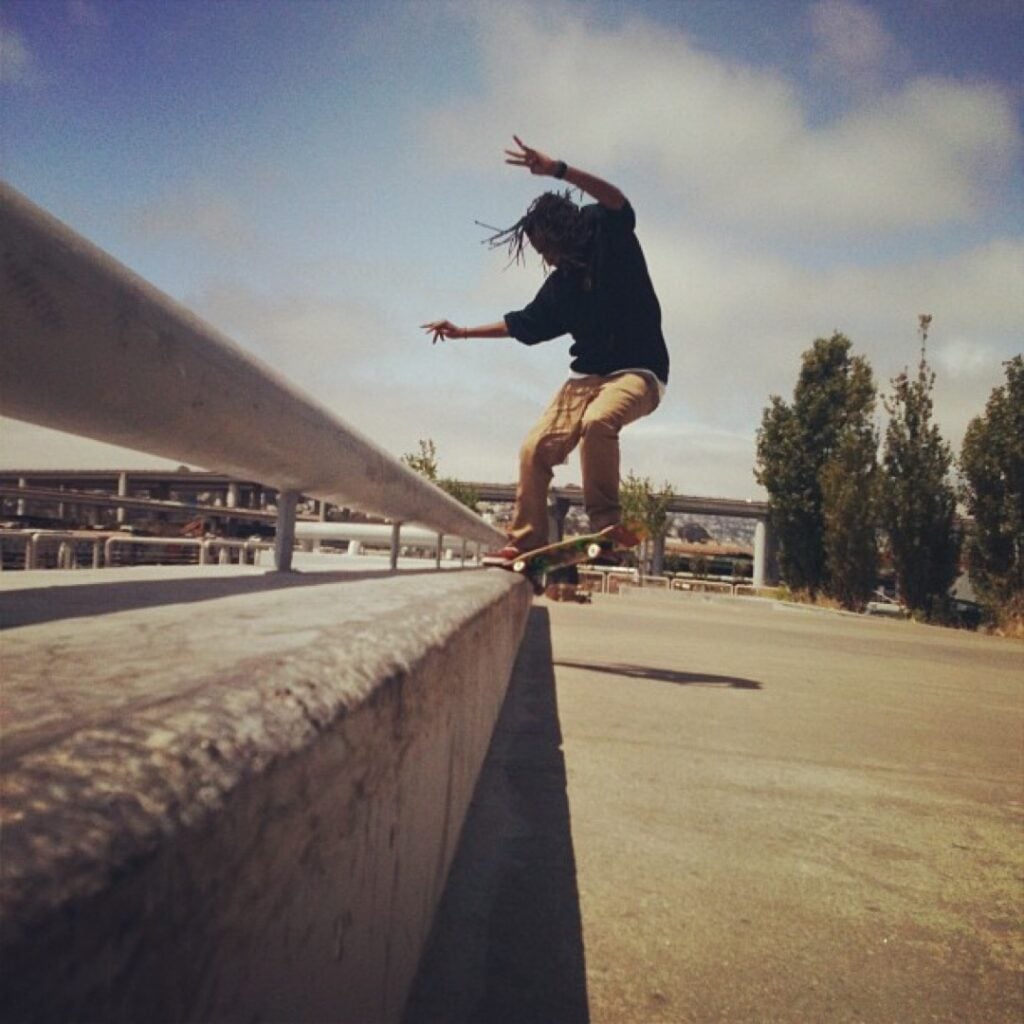
Switch Front Crooks, Third and Army: Shot by Tadashi Shibuya
Did you change your skating so you could skate Third and Army for longer, or do you think by sessioning there for longer you just adapted your skating to the spot?
Well, that’s a good question. So that goes back to when the skateboard itself was evolving. As the skateboard evolved and we got the bigger noses, we innately just started skating Nollie and Switch, and I preferred skating Switch. It felt more natural to me for some reason. But then one summer I twisted my ankle, my right ankle, so I wasn’t able to do any Kickflip tricks, but I could still skate, and that’s when I really started improving my Switch skating, and that was at the Embarcadero.
What’s the story behind your Bigger Flip down the two at Wallenberg? That was way ahead of its time!
Yeah, I made that one up. It was the Tre Flip Back 180. That was the only way I could do that trick, by thinking about doing a Tre Flip and then turning back 180 after the fact. I was so psyched on that trick. That was the very first one ever done on the street, not on a hip, you know? I had never seen anybody even do it on a hip back then. I was really stoked on that trick, and I’m happy you brought it up because it was a really big one for me. Doing it over that one block at Wallenberg off the two. That was a pretty big deal for me.
Do you remember what video that was in?
It was first shown in the Expedition video, and then in an S1 insole video. So it was in 2 different videos.
Man, that’s crazy how tricks and stuff would go into different video projects. In Birmingham, there’s a huge double set at a spot there called Fastlands. Mike Manzoori was the first person to Ollie it, and that Ollie he did is in two different videos. It’s his ender in two different videos.
Oh, wow. That’s crazy. Oh my God. I don’t feel bad anymore. Yeah, I don’t think anyone really questioned it when I did it, but it was, yeah, I’m surprised nobody, nobody ripped me a new one for that one, you know?
You did a lot of tricks before anyone else. Nollie Front Boards. Nollie Feebles. Front Nose to Tailslide and so many others, did you feel like you were innovating when you were when you were doing all of those?
Absolutely. thank you for bringing this up. So my innovation in skateboarding always started through inspiration, moments of silence alone, or even sometimes with friends – like the Front Nose 270 definitely was inspired by a certain person, but usually being receptive to the inspiration that’s here in the universal field.
I would literally just be given these ideas to do tricks that were slightly different that nobody had ever even thought about. I never wanted to go too far out of the perimeter of what was accepted, what was cool, like, because we’re so picky. I’m very picky myself.
We’re all picky when it comes to, what we like with skateboarding. Especially when it pertains to innovating and introducing new tricks. So with the Nollie Front Board, I was like, man, I have never seen. it I was like, Nollie 50-50, just think Nollie 50-50 and put it to a Frontside Board.
I did it at a trade show in 1999, bumped to a little flat bar, and then Nollie Front Feeble. These are like fun things. It was like, oh, that’s cool, let me just try that. So all these little things were just ideas of doing stuff that was slightly different than what was already being done.
How did your Front Nose 270 Out the Hard Way at Hubba Hideout go down?
One day we’re at Pier 7, and it was just me, Stevie Williams, and one other skater I think called Eli. Stevie was talking about tricks; he was very innovative, and he’s an incredible skater and human, Stevie is for sure. He was like, what if I did a Switch Backside Tailslide and then kept the rotation going and turned it all the way around.
When he said that, I took that home with me and I thought, I really like that. What if you just did a Front Nose and then turned it around that way?
The next day I learned it on the ledge at Pier 7, and I was so stoked on that trick, and then the reaction was so grand from my peer group that I decided not to film it on the ledge, and I decided to introduce that trick at Hubba Hideout first before I ever showed it anywhere else, and then I tried it.
How did that first attempt at Hubba go down?
Then one night we were filming for a Transworld video. I was with Anthony Van Engelen. He was trying to Switch Front Crook it. I was trying the Front Nose 270. We had the generator, the lights, and Ty Evans was filming. I slipped out; I bailed. They put that in one of their videos where they showed a lot of the almost-made tricks.
But then I did it after, so that is the story of the Front Nose 270.
Why didn’t you want to show it before you did it there?
It was mainly because of the response from my peers. They were so stoked, and they’re like, whoa, what the hell? They were so flabbergasted by that maneuver to the point that I was like I have to actually showcase this at a spot that is globally recognised and also has had many, many tricks done on it. So this is a new trick for the spot and for the community.
Every single time I see somebody do a trick the hard way, you just call it the Watson way or a Pretzel Out. A pretzel is a wrapped-up salted snack that’s all twisted, and that’s where people got that association from. It’s a unique name. But when was the first time that you started to hear people call it that?
The very first time I heard the term Pretzel Out was a huge moment in my life because I was on a tour. Maybe Japan or something, and on video, it just came on about Hubba Hideout. I had been interviewed about the spot, and I didn’t think that I was going to be mentioned because so many crazy tricks had been done there.
I said, my favourite trick was Eric Koston’s Back Noseblunt. I described that, and then toward the end of that video, Eric Koston said my name. I was setting up a board on this tour, and he said my name. Watson. The Frontside Noseslide Pretzel Out. That was impressive, and I was like, oh my God. Eric Koston said my name, for one. That was insane at the time, and the fact that he said I was impressive- I literally cried tears of joy. It was insane because that was a big deal, and then for him to name the trick, so that was the very first time Pretzel was ever mentioned, and it has stuck to this day. Yeah, it came from Eric himself.
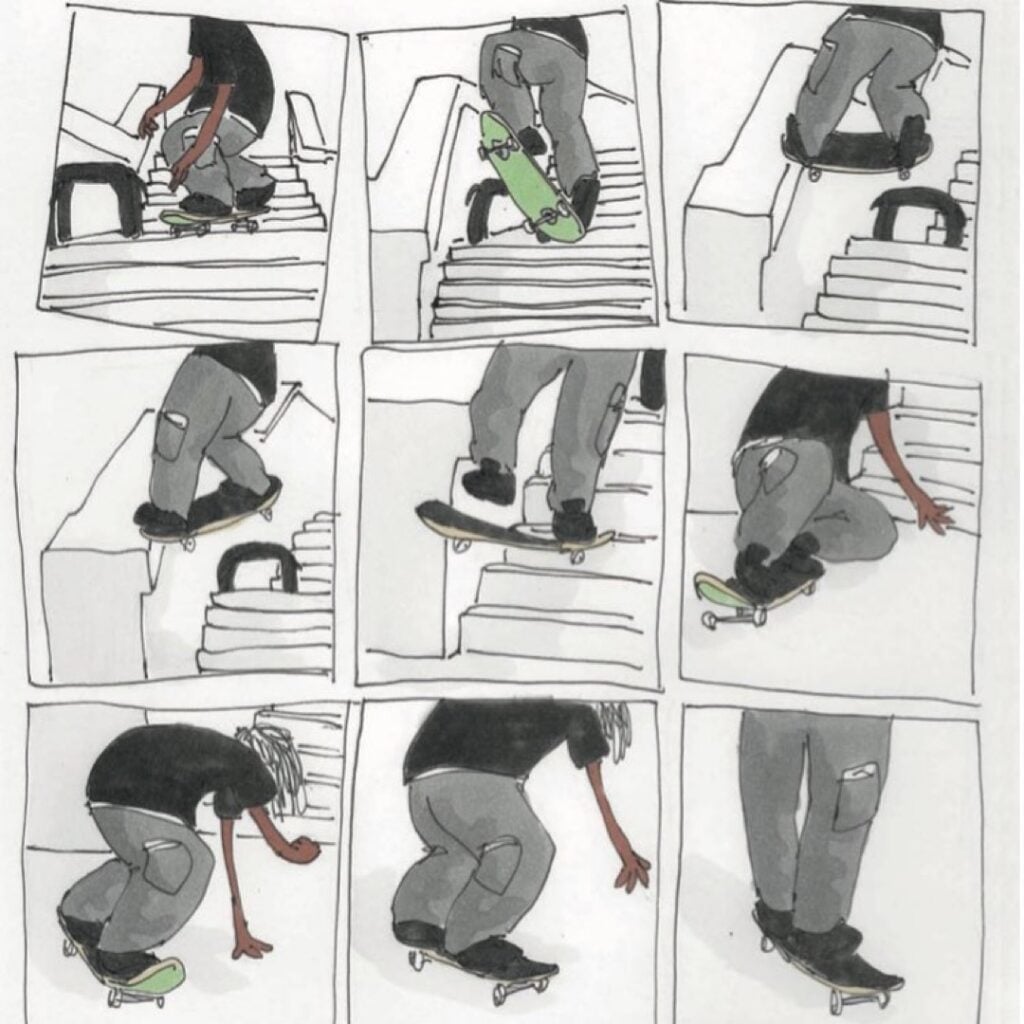
Karl, Hubba Hideout Illustration by Henry Jones
How did your Boardslide to Switch Front Blunt go down, and where did you film that?
That was in China. We were on an LRG trip. I had plantar fasciitis before and during the trip; I was battling a crazy injury. On the way to the airport, I went to see Greg Carroll, and he performed Reiki on me. I wasn’t fully a believer in any of that stuff, and he told me, “Hey, you’re going to the airport here; you’re passing by my house, stop here first”.
So I did that, and I was able to skate really decently on that trip. I got the Switch Backside Nosegrind down the rail. I got that Boardslide, the Switch Front Blunt, and some other things too. I couldn’t even walk, but I was able to skate. It was insane. I need to literally go do that, right now. I want to bring that back. I want to just come out back straight!
What’s your thought process behind trying something different?
It’s a necessity. Innovating within skateboarding is synonymous with growth. To me, if you love skateboarding, you’re going to try to offer something unique to the community. Anytime I was even considering something new, I was excited about it because I wanted the community to be excited about it, maybe they’re gonna like it, maybe not, and, yeah, pretty much getting my peers and the community stoked. I loved for them to see something for the first time and feel that, and I also understood that because of my own experiences when I saw something in the mag that I had never seen before, a trick that was new to me, it left a lasting impression. I always wanted to try to have, especially for ads, a new trick for an ad because I wanted it to be very memorable.
Why do you think creativity is important to skateboarding?
Creativity is innate to skateboarding because it’s at the base, the root. Just like a lot of other things, it is at the foundation of the creation of the skateboard. It was created out of necessity by the surfers, from my understanding, by the surfers who had no waves, but they wanted to continuously feel that feeling, you know?
And then some brilliant mind had the incredible idea to take the wheels off skates and put the wheels onto a piece of wood and then ride it. That is the most creative act, and I appreciate that person for even having that thought of inspiration. I mean, applying the inspiration to thought and then to action.
That is the foundation. Being innovative is the foundation of skateboarding as a whole. If you’re not being creative and you’re only following what you think is the right way to do things, you’re not fully expressing yourself as a skateboarder, I feel.
That’s because everybody has to do things their way, and it’s only right when you do it your way. That’s literally the message I really want to get out there: skateboarding is only right when you do it your way, and there’s no cookie-cutter way to do a trick. But yeah, there is a preferred way, and then there’s this whole taste thing too. But when it comes to it, you’ve got to do things your way. That’s the only way you add your flavour.
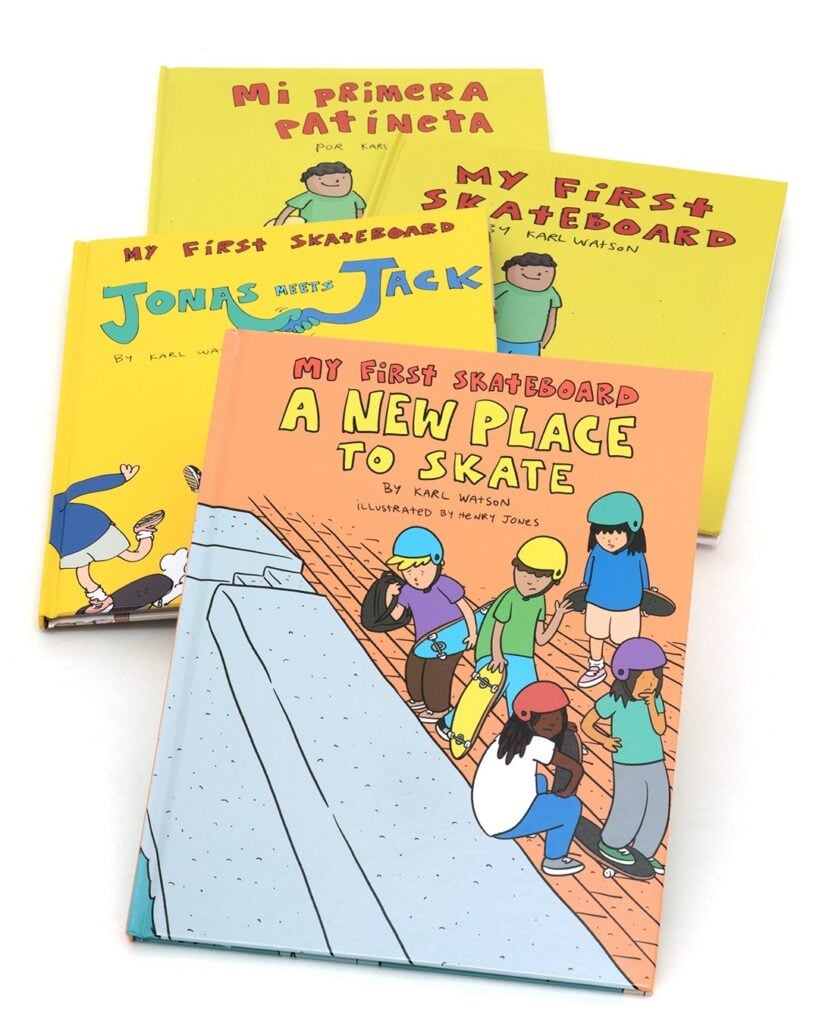
Creativity does get lost when you look at skating through the lens of being a contest or an Olympic sport, but you’ve taken your skills and imagination for skating in a completely different direction by making books about skating for kids. How did you come up with the idea of making the My First Skateboard book, meet Henry Jones, who illustrated it, and create that first book together?
This is a perfect segue, honestly, because the catalyst for creating My First Skateboard was skateboarding going into the Olympics, and I wanted to preserve the essence of the culture of skateboarding. That’s what was the catalyst for writing My First Skateboard; I didn’t want future generations of skaters to lose the special sauce that we have, and that’s why I showcased skaters of all different colours skating together.
To me, that’s very important. So it was because I wanted to preserve skateboarding and what was special about it.
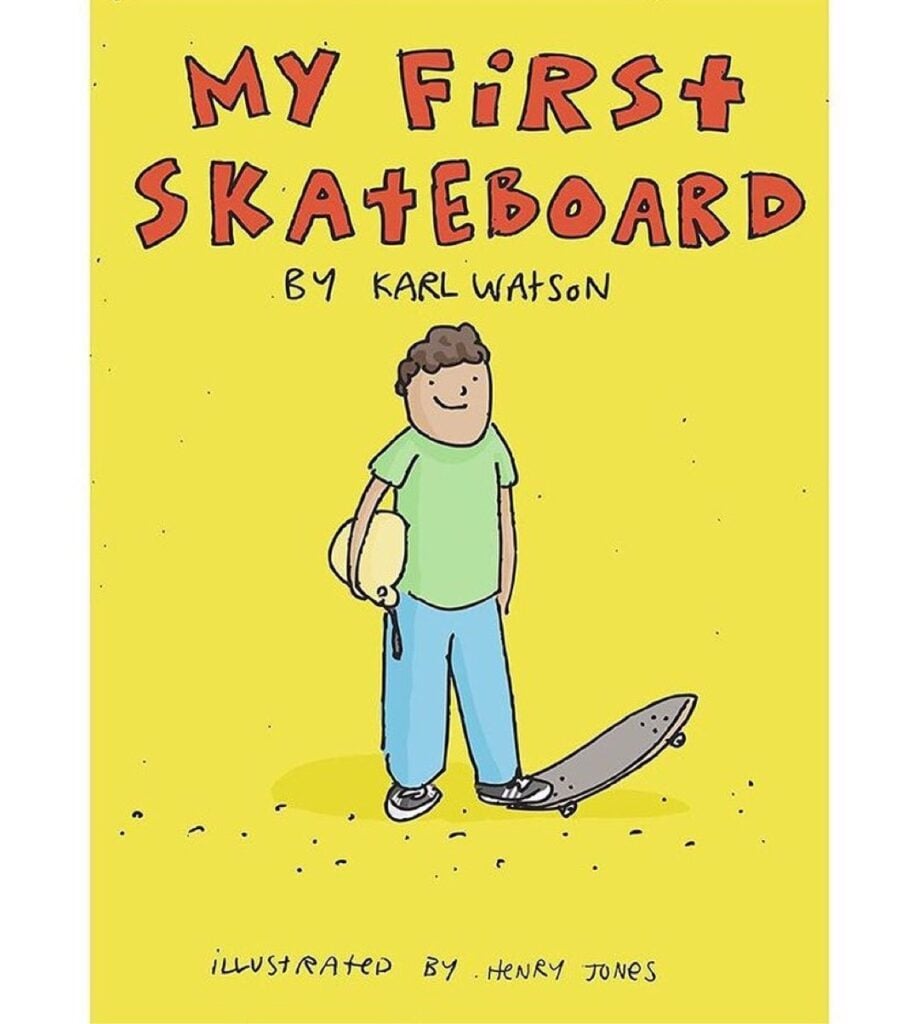
So did you connect with Henry from the get-go?
So I already had somebody under contract to illustrate my story, and it was a woman from the UK. I saw her work on Instagram, I really liked it, and then we had a contract in place. She hadn’t started the work, and then I saw an online story on Henry Jones, and I’m like, oh my God, his art is perfect for what I want. This is perfect. I contacted Henry to see if he’d be down, and it turned out he was.
Then I reached back out to that amazing lady in the UK who was so kind to let me pull out of the deal and work with Henry.
Sick. That’s really cool of her to recognise that Henry was a better fit and to step aside.
If I had not done the book with Henry Jones, my book would not have been such a success because Henry’s art brings my story to life. It embodies the essence of a true skateboarder depicting skateboarding. Every single image he draws that has a skateboarder doing a trick or talks about anything skateboard-related touches on the current zeitgeist of where skateboarding is at, or he deeply understands the psychology of a skateboarder. His message relates to us, and his visual elements resonate with us in a major way, too.
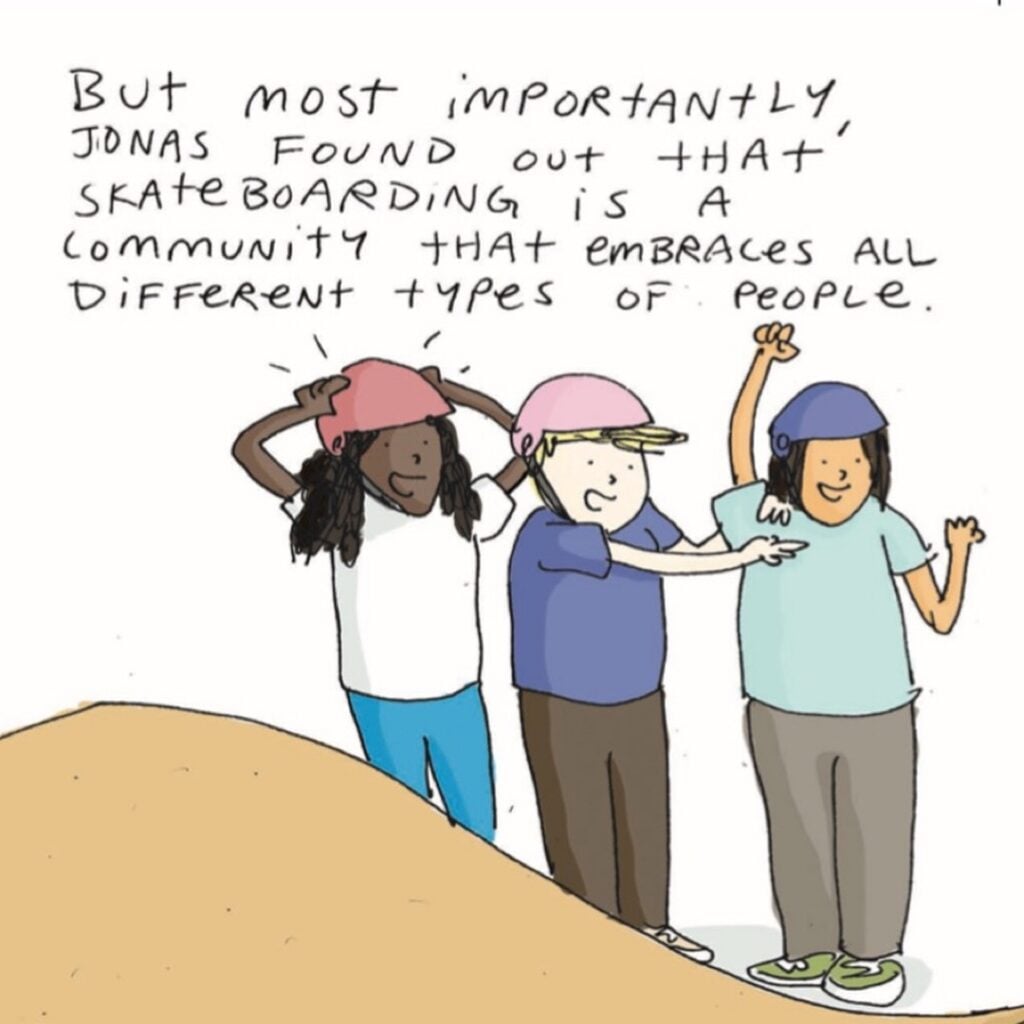
Henry’s art is always on point, and his captions are jokes too. How did it work out between you both? Would it be like you were scripting it out for him to draw? How did the flow work between you both?
We got to a point where I would write, where I sent over the book to be illustrated, I would have every scene described. I gave my best description of the scene and also the verbiage. I described that on the right page – the verbiage text- and on the left page is the scene, whatever it may be. But it took us a very long time to get to that point because when I first sent him my story, he sat on it for 4 months and then hit me back. He said, ” Hey, I can’t illustrate this; there’s too much dialogue, so I had to simplify the story at that point. I wrote a screenplay. It was pretty much a screenplay, but I had to simplify it.
Then I focused on all of the main attributes that I wanted to portray and then, simplified the book. It was not easy at first because I thought that I had a final product, and then for him to say, “No, I can’t illustrate this!” – that was a big turning point, it was like being told that I don’t bend my knees enough, and then I listened to that great criticism, and we ended up making something that was great.
Was there a moment you realised you were going to sell a lot of volumes before you’d released it?
Hell yeah, it was immediate. Just showing people the initial sketches, it was, oh, you have something here, and then, yeah, and just to fully answer your first question or your last question? Well, so he definitely, you know, we would go back and forth with certain things, not with colours, because that was his style, but yeah, certain colours – what colour is Jonas’ shirt gonna be? What colour is this person’s shirt? What’s the colour of the outside of the book?
What was the response like at release?
Well, this is crazy. Once we released it and did a pre-sale, people went crazy and supported it. The industry really appreciated it, and we were kind of on the fence about whether it was going to be accepted by core skaters or not. We went back and forth about putting helmets on the main characters and decided to do it because it was the right thing to do since we’re promoting a kids’ book. We thought we were throwing away our opportunity to be supported by core skaters, but to our surprise, they fully backed it no matter what.
How many did you sell at first?
It was crazy; we did a pre-order. We ordered 3,000 books, right off the bat. I was confident that I’d be able to sell those in a year. But we sold those within the first month. There was demand for it, so we had to order more books, and it was very profitable because when you order that many books at a time, they’re not as expensive as ordering a smaller amount. We were able to actually make a little bit of money and reinvest it into making more books.
Oh man, that’s amazing, but it was clearly a success as you went on to make the next one, Jonas Meets Jack. What was it that inspired the making of that book?
I wrote that story based on my memories and experiences of being at EMB and meeting people from different countries. So with that, I wanted to show kids how skateboarding brings us together despite our nationalities.
The storyline of that book is that Jonas meets Jack, and Jack is from Kazakhstan, and Jonas is from San Francisco and Jack comes there; he’s nervous, like I was saying, like how I mentioned earlier in the interview.
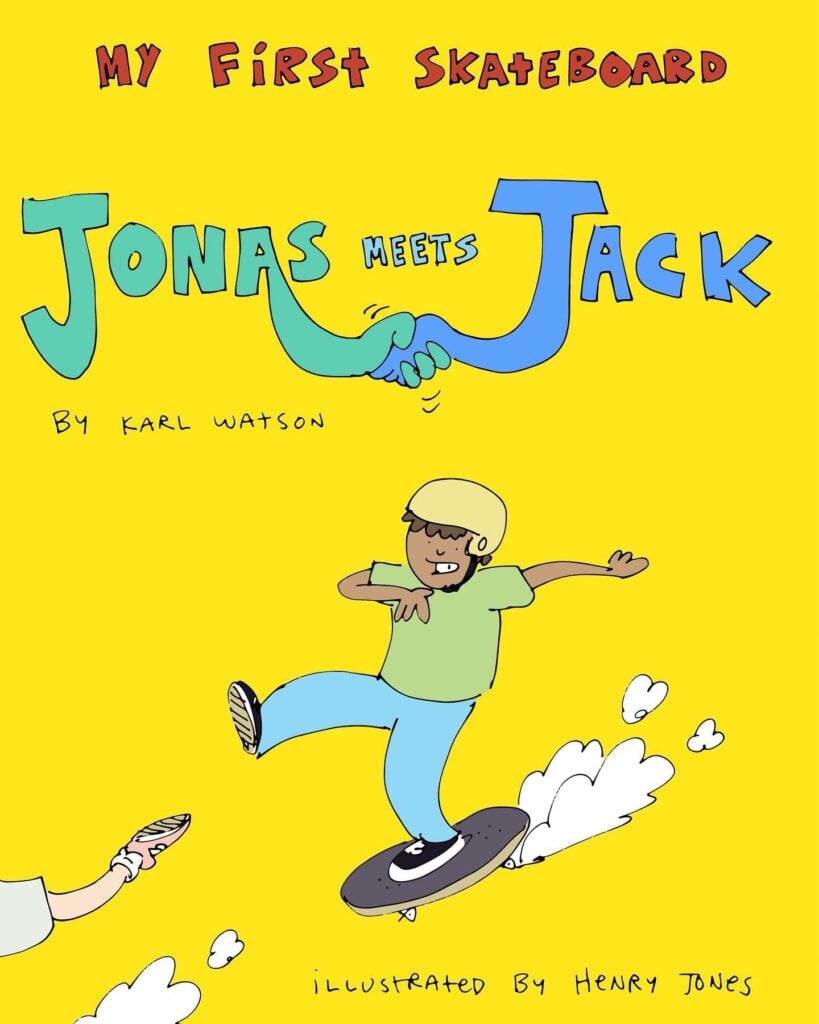
Then Jonas invites him in. He noticed that Jack was timid, similar to how I would be, and they took him around to show him spots, exactly like we would do.
They would come to EMB, and if we really liked each other, I would show them Brown Marble, Black Rock, Mini Hubba, Hubba Hideout, and our other spots that were adjacent to Embarcadero.
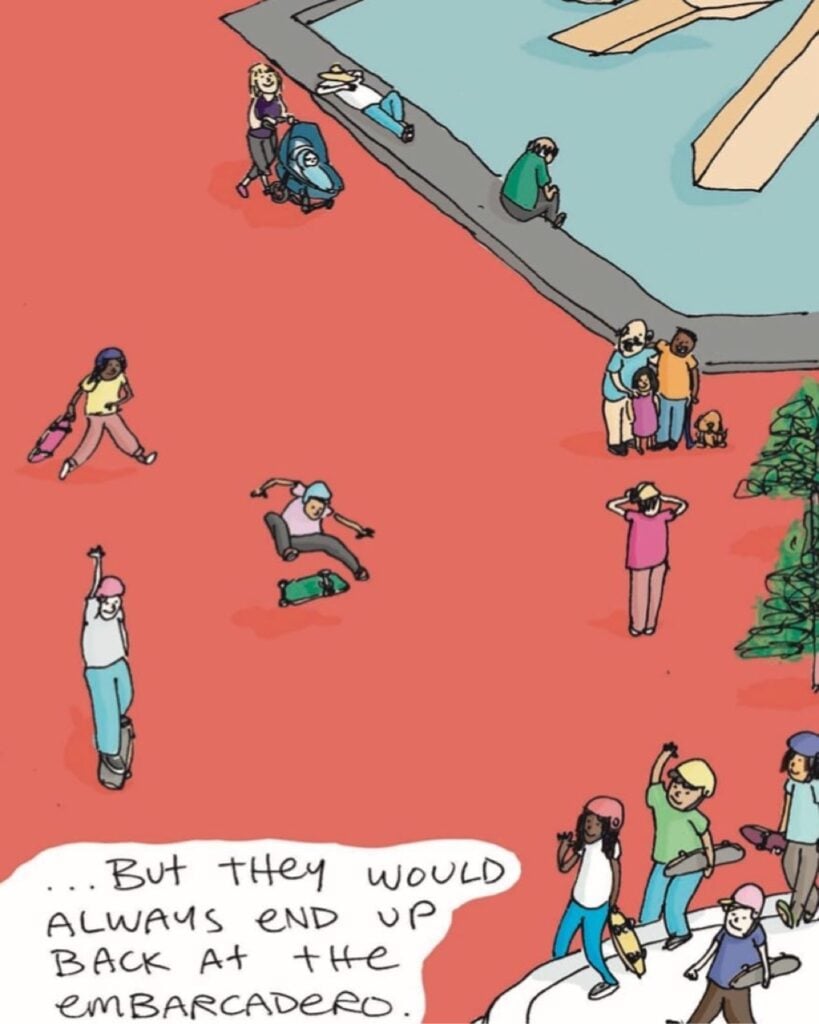
The third book we made, My First Skateboard: A New Place to Skate, is also based on my experiences from that era.
Do you make any art or drawings or paintings or anything else?
I do, actually. I’ve been an artist for about 28-29 years. My art journey started when I saw Shamil Randal one day; I saw him randomly draw a triangle on his grip tape, and that was the catalyst for me becoming an artist, and just like how I receive my inspiration, the evolution of my skating and introducing new tricks to the community was brought forth through being receptive to the inspiration in the he universal field, whatever. That’s exactly how I receive my inspiration for my art too.
My art is very unorthodox. It’s an expression of the divinity of the universe. Sometimes people like it, sometimes they are offended by it, and sometimes they’re in awe of it.
What kind of art do you make?
I do geometric work. I just showed this at a recent art show. This piece is called Supernal Triad, and it is definitely a journey. It’s a kind of breakthrough.
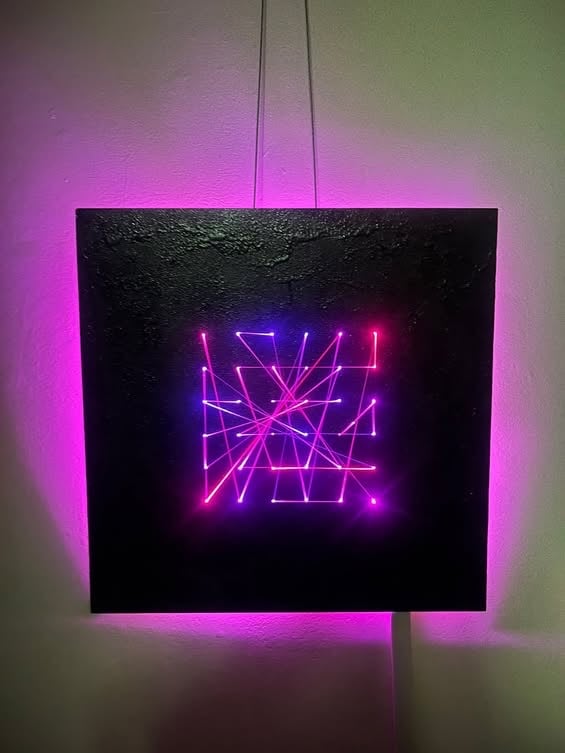
I’m really into mathematics, and this is a very important number sequence. I don’t really want to go into it too much here, but I could talk about it in person. It’s a very ancient and important number sequence that I graphed. I put those sequences on graph paper and drew lines from the center of every square to 1, 2, 3, all the way to 36, and this is what came out.
Ok the physical representation of a mathematical number
I truly deeply feel that my art will become popular posthumously and understood when I’m gone. So that’s why I’m not deterred from continuing. I feel like I might be a little ahead of my time. I feel like I’ve made some breakthroughs personally.
Your skating has made an impact, so it would be no surprise if other things you created were talked about for years to come. Thinking about that, was it like working with Anthony on Give Me My Money Chico?
Give Me My Money, Chico, yeah, I was really stoked on that- the name, the way the name came about, and stuff like that. We got to travel a lot for that one; it was amazing because we got to go to China, we got to go to all these different places, and I was really hyped on that. They used a song that I loved. I had the Front Nose to Frontside Tail that opened up my part. Yeah, I was really stoked on that and, yeah, that was definitely one of my favourite parts. I actually gotta watch that again. I haven’t watched it in a while.
Anthony is just the best dude. Anthony Claravall. I felt super comfortable filming with him, and he’s still at it. Like, Anthony’s still out there touring with different companies and just looking younger than ever. Super rad guy. But he’s definitely one of the greats for sure.
What’s your favourite trick that you filmed for Give Me All My Money, Chico?
Oh man, I think I need to watch that again. Yeah, I mean, I really am hyped on the Frontside Noseslide to Tail because I was trying a different trick for 2 hours. I was trying the Frontside Nosegrind Nollie cab out. On that same ledge, I was trying that for such a long time and didn’t land it. I rested, and during that time of resting, I thought I’ve been messing around with this stationary this whole trip. Let me just try to film one, and that was the very first one I landed.
Which of your video parts were you most stoked on to film?
My Expedition Alone part. Yeah, that was the one I was most stoked on. The reason why my Expedition Alone video part was one of my favourites is that I got to work very closely with Trevor Prescott, rest in peace. He and I were really tight. We were filming a bunch, and it made a huge difference because I felt so comfortable filming with him, you know what I mean?
What was your favourite trick in your Alone part?
Oh man, my favourite trick was probably the Nollie Inward Heel to Back 50-50 that I did. I love that trick. I love all the night clips that I got skating at Pier 7. I was really hyped on those, and yeah, I was just really hyped on that part, just the song and everything.
What’s the story behind your Nollie Inward Heelflip 50-50?
Yeah, that’s a classic story. It was the very first one I ever did on film, definitely, and it was on the low ledge at Third and Army. It was really short, it wasn’t really that cool, but I was just super hyped, and I didn’t like the way it came out, but I liked the trick. It was mind-boggling to me, and I really enjoyed the tricks off the ledge onto the barrier. I felt like I was peaking then in some kind of way, even though I went a little bit further with my creativity. But Switch Back Lips, Switch Back Smith 180 Out, all that stuff I was really hyped on, you know?
What about your Nose Manual to Switch Nose Manual? That was a wild one for the time, and now.
I love that one. That was a good one. There was a little gap there. So Nose Manual Nollie 180, even though it’s not a real Nollie 180. Nose Manual Nollie 180 to Switch Nose Manual.
Yeah, that’s when I was really tapping in. My part in Alone shows me coming into my adulthood and skating. That’s when my oldest son was probably 2 years old. I was uber motivated to create good stuff because I had a child. Now he’s 27 and living in LA. He was working for Huf for 2 years; now he’s over at this brand called Revolve. He’s engaged; it’s insane.
My other son also works in skating; he works at Supreme.
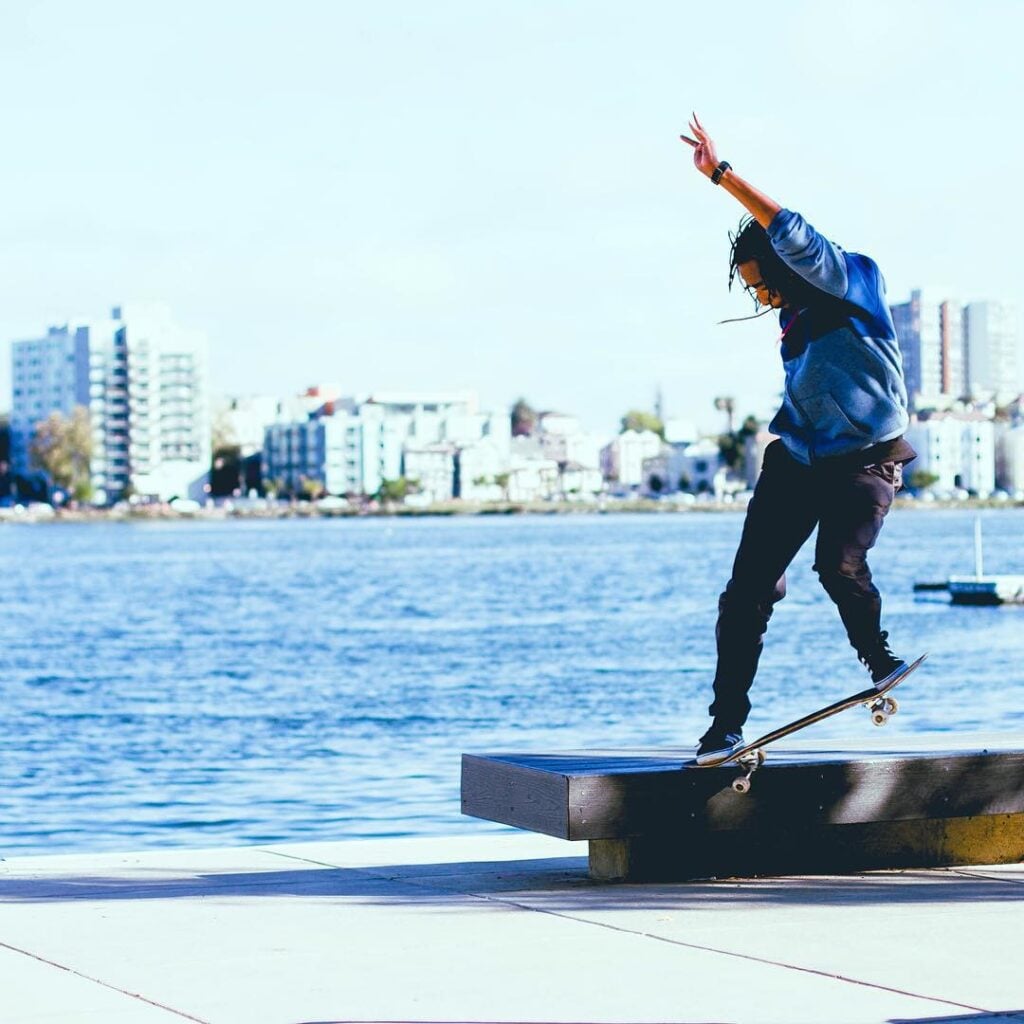
Karl: Shot by Elan Watson
It’s sick that both of your kids are working in the skate industry.
Yeah, it’s insane because I never put any pressure on my children to skate or even to do it in any other way besides how they wanted to express themselves.
Like, for example, my oldest son pushed mongo until he was 13. I was like, okay, and I didn’t want to, just because of who I am and how I deeply feel it’s important to do things the way you do them, and especially when it comes to skateboarding. I didn’t say anything about it; his friends had to, like, correct him on that, he didn’t learn how to push “regular” until he was 13.
They innately kind of found their way in the industry and without any nepotism too. Jaya, my second son, has just always been in the know. He’s always a great ability to know dope skaters, dope brands. He’s always had this in him, and when he said I think I’m gonna get a job at Supreme, it just made sense.
Speaking of dope things. Your Nose Manual 360 Pivot Nose Manual at Fort Miley has inspired so many other skaters to try that trick and others you’ve done. Brian Peacock. Dan Fisher. Chewy Cannon and countless others. Do you ever watch any of the tagged clips done by skaters influenced by you?
Hell yeah. When I see somebody do a trick that I brought into the universe, it feels so amazing, yeah, and then when they tag me, it means a lot because I never tooted my own horn,
I never did a trick and was like, name it ‘The Watson Flip’ or something, you know? So the fact that it’s happening organically, where people will kind of share the history, verbally, is awesome. It’s awesome to me.
What has been one of your favourite edits you’ve seen recently?
Well, I have to say, you’ve done a great job so far. I love what you guys do. You’re super consistent. Your content is always on point. Like, okay, that one guy you posted the other day, he was doing those really unique Manuals on the curb, off the sidewalk. To me, that is the epitome of street skateboarding. What’s his name?
Alex Hatfield
Yeah, Alex Hatfield thinks outside the box. Like, to me, that was such a breath of fresh air because that’s what skating’s all about. It’s finding your way to do it, you know?
His approach to the manual was brilliant, completely brilliant, because he used the forces of his body and just his general movement in a different way than I’ve seen others do.
Yeah, Alex has one of our favourite Manual styles. Speaking of, what’s your favourite skate video?
I really enjoyed Modus Operandi. I love the music and just the filming. I love the 16mm. That was a really good video. But it’s hard to say all-time, but that was a really good one, and The Reason; I really like The Reason too.
Who had your favourite part in Modus, and who had your favourite part in The Reason, do you think?
It wasn’t necessarily a part. It was like the whole piece was put together so well. I really just liked the montage sections; the music was a big part of it. It was the overall feeling I got from the videos that resonated with me and still kind of makes me remember them. Not like certain tricks; everything was groundbreaking in there. They had a really good bunch of people in there too.
Who’s your favourite skater of all time?
Marc Johnson, man, rest in peace.
Also Ray Barbee, for sure. Ray Barbee, so much style. His whole persona is something I always just wanted to emulate. He just stood out so much to me, everything about him, and I still, to this day, he’s somebody that I like to emulate.
He got pretty gnarly, man, for a while. Like Front Heels, really big front heels and stuff. I believe you might have even done one over a picnic table.
Who has your favourite style?
Tiago Lemos. Tiago, for sure, has this thing about him that every single clip he posts is just paramount, man. He’s a very dope skater. I’m a big fan of Tiago.
Same here. Where’s your favourite place to skate in the world?
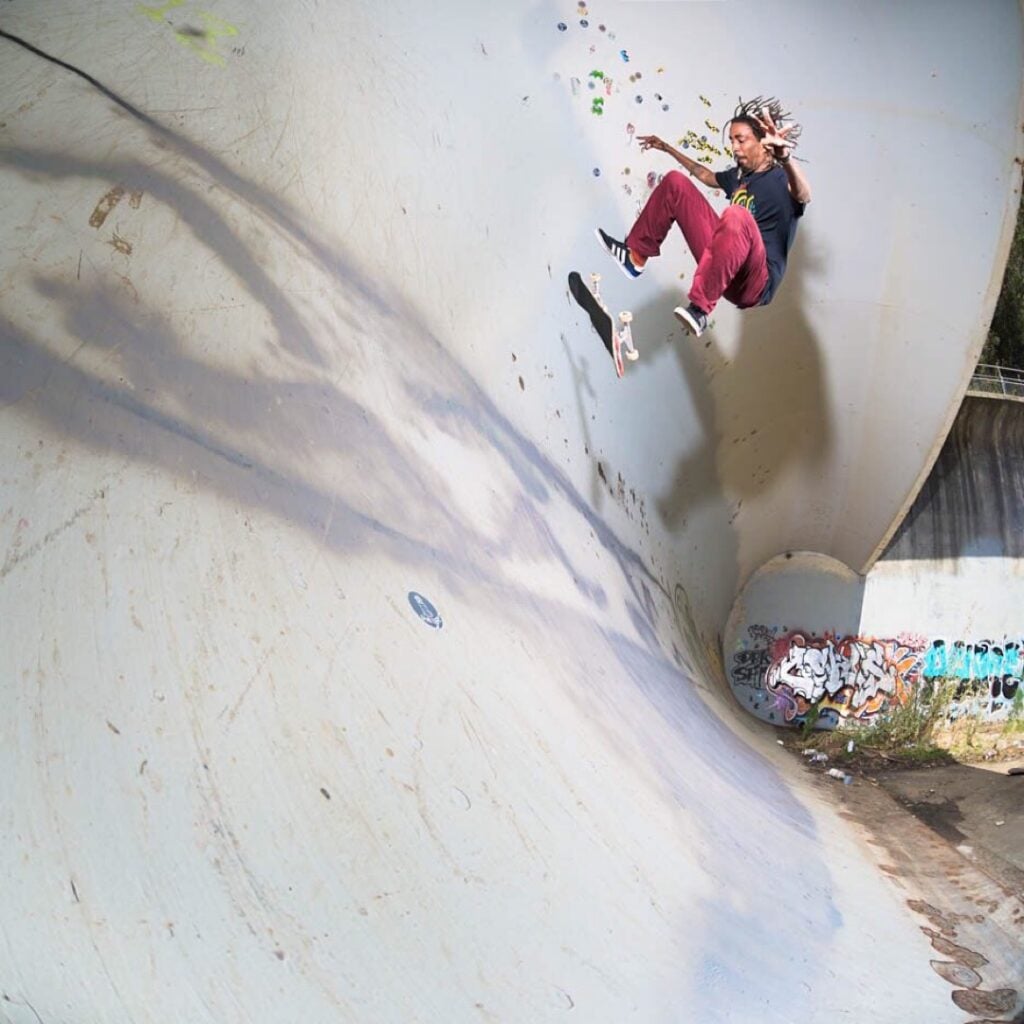
I really enjoyed skating in Japan. Not necessarily one spot there, but I loved just touring Japan, skating Japan. Those were the most memorable times of my life. I’ve been there 11 times, and I just love that country for skating. Even though now you can’t really skate there anymore because you get kicked out of everywhere!
Where’s your favourite spot in San Francisco?
Man, sheesh, that’s a tough one. Yeah, that’s what I’m saying. I guess I’ll have to say EMB because Embarcadero had everything
What’s your favourite thing about growing up skating in San Francisco?
Thinking back, that reminds me of something. That old neighbourhood in Oakland, I wanted to say that that one block neighbourhood that I lived on, it was so cool, so many people and the one thing that we all loved was the fact that, Too Short, the rapper he would, he would always pull up on that block because he was dating a girl there and he would pick this girl up that he was dating.
No way.
Oh my God, and then, another thing that just came to mind is Tony Vitello, right? So you know Thrasher, the whole story, Fausto Vitello passed away. So Tony, when he was really young, he was probably eight or nine or something, very young, and it was a cool party that was going on at Bryce Kanight’s ramp.
I ended up spending six hours with Tony that day, just because I was that other little kid there. I was probably 13-14 years old, and then after that, maybe I was riding for Think and Venture at the time. I went to Venture to get some trucks months later, and Fausto was like, Hey, hey, you, come here!
I came over to him, and he was in his office with some people. He was like, “You’re good for life; you’re good at this camp for life!
He said, “You’re the one; you got my son into skating. He was like, Tony didn’t like skateboarding!”.He didn’t like it because, you don’t want to do what your parents do, but Fausto was like, “You got him into it!”.
It’s all because I paid attention to him. That’s the reason why Tony got into it, and I can’t believe it, as he’s the Tony of today who’s running Thrasher and killing it and ripping, and that was a big moment for me because Fausto validated me, and it’s just a big deal to hear that from the boss of skateboarding. He was the most powerful man in skateboarding, in a way, and for him to say you’re good for life, that meant a lot.
For sure. Rad to know that. Any shoutouts you want to make Karl?
I’m gonna shout out all of the people that have helped me along my journey from the early years, from Dogtown, Red Dog, Think with Greg Carroll, and Keith Cochrane, over to Stereo with Dune, and just everybody that has helped me along my journey.
I really appreciate you, and if you ever want to reconnect with me, the door is always open, and I’m just here to show gratitude for everybody that has helped me along my path.
Any last words before I let you go?
Yeah, the final message I would like to share with everybody is something I already kind of touched on, and it’s the fact that skateboarding is about having fun. It’s about having fun in your own way. Like, doing a trick the way you do it is the right way to do it.
Yes, you can be inspired by others and, you ight want to do your Kickflip like this person or your Tre Flip like that person, but ultimately the way you do it is the best way, and that’s the way you’re going to get the most.
You’re going to be respected the most when you do things your way and you’re not trying to impress anybody else but yourself and you want to also enhance the community through being creative. Being creative is a key aspect of skating, and I just want to say, enjoy the dance, man, because skateboarding is like a dance. Enjoy the dance, and that’s all there is to it.


