Eli Gesner is a skater and artist whose creativity and hype for skateboarding played an instrumental role in founding Zoo York, SHUT Skateboards and Phat Farm.
His work in defining the aesthetic of those brands encompassed everything from their logos, graphics, clothing, ads and videos to music.
After learning more about his unique take on skating, art, design and music we were stoked to finally have a conversation with him about his journey from getting his first board to starting one of the most well-known skate brands of all-time and grab his perspective on what it took to make it happen and why the artistic influences, connections he made and experiences he had, still greatly inspire him today.
Find out how art found him as a kid, how a makeshift plywood quarterpipe went on to carve the rest of his life’s trajectory, Dream Wheels, getting on SMA, Dogtown and rolling for Z, meeting Russell Simmons, Phat Farm, his thoughts on creating Zoo York, Rodney Smith, hanging with Shawn Stüssy, his role in the return of The Brooklyn Banks, making Mixtape with R.B. Umali, directing the Roc Raida Mixtape intro, filming iconic freestyle rap footage of Busta Rhymes and Method Man and more.
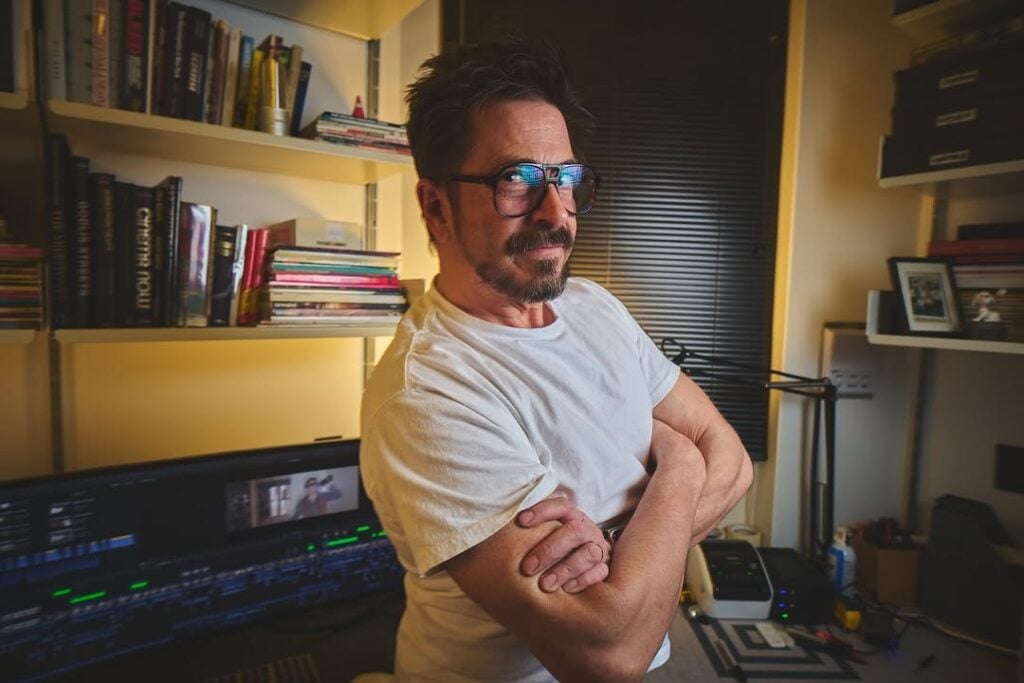
Eli at his Studio, Shot by: Giovanni Reda
What’s your full name, Eli?
It’s Eli Morgan Gesner, but the longer version is Eli Morgan Winslow Von Gesner. My legal name is Eli Morgan Gesner. People just want to shorten it. They just want to call me Eli Gesner, but I’m happy with the name my parents gave me.
Definitely. So, where did you grow up and where are you right now?
I’m right where I grew up. I was born and raised in Manhattan, New York City. We lived on the Upper West Side, and we also had a place where I am now in the West Village on Perry Street.
How did you first see skateboarding?
So I grew up on the west side of Manhattan. I was born in 1970, and one of the things that maybe a lot of younger generations can appreciate, but maybe don’t fully get, is that I’m 50. I just turned 54. So this is over 50 years ago. The world now, because of the Internet and cheap travel, is very much homogenised; wherever you go, you see things that exist everywhere else.
But when I was born, everything was very much like New York. That’s it. So anyone who was coming from another country, another state or even California might as well have been on Mars to me.
When I was a kid in New York, the only way I would see skateboarding was on early TV shows, such as Wonder Woman or Charlie’s Angels. You’d see little commercials; for example, Pepsi had a commercial with skateboarding, but all of it was always palm trees, skate parks, and blue skies.
I was always a sort of a maniac child. I was running around Central Park and climbing up buildings. We’d play roof tag on the tops of buildings, climb up stuff and get hurt. I was always in the emergency room. But skateboarding seemed really far away.
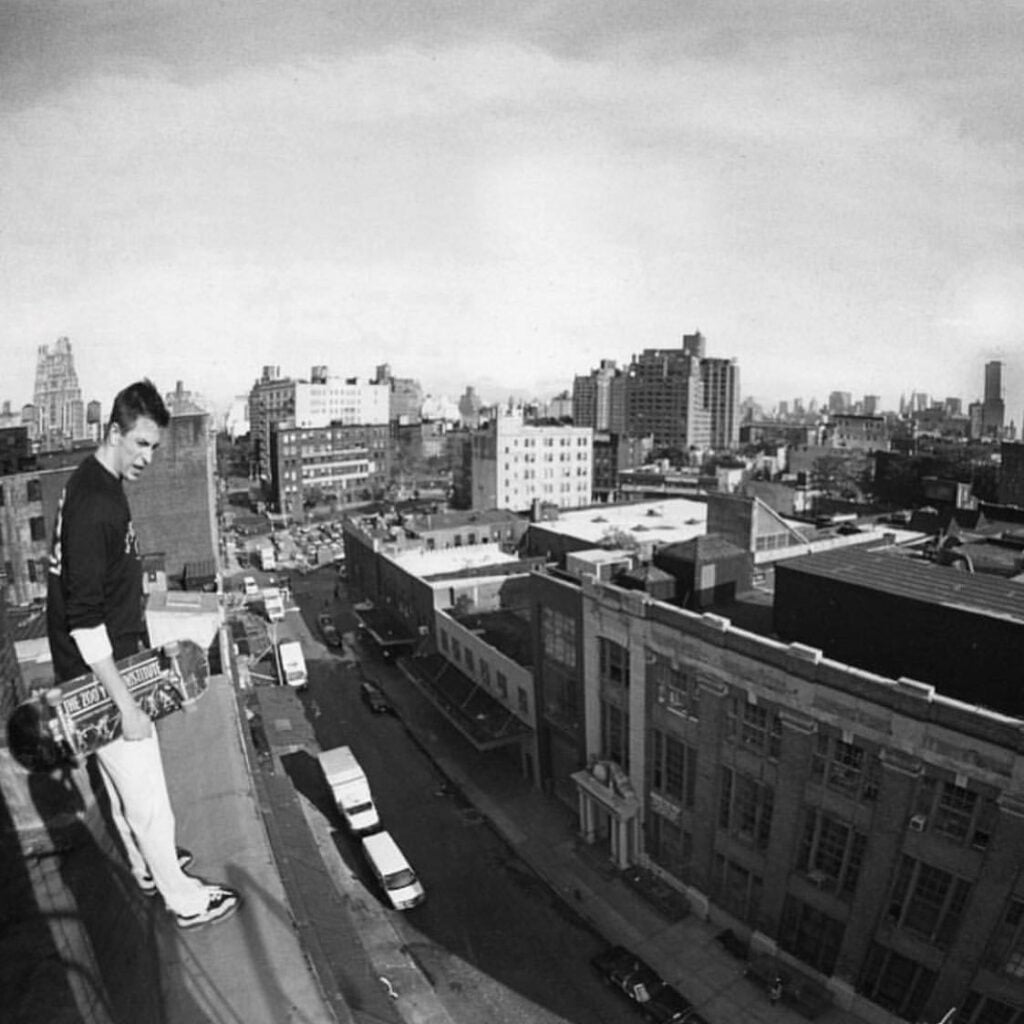
Eli, Peering off the Edge of a NY Rooftop: Shot by Ryan Gee
Who were the first people you saw skate?
Where we were living on the Upper West Side, there were a group of older kids who seemed like adults at the time, but they were just teenagers. They were this local gang of graffiti writers and skaters, they were: Futura 2000, Haze, Zephyr, Marc Edmonds aka ALI – who started the Soul Artists of Zoo York, Puppet Head, and Andy Kessler.
Those guys built a ramp. The city was redoing the West Side Highway, and they had put plywood walls up to keep people from going from the park into the highway. That crew just ripped the plywood down and made a quarterpipe with it, and it was right outside of the playground.

Eli, Frontside Air: Shot by Richard Henkels
Sick. So, how did you originally connect with that crew?
So I was five or six years old, and I was at the playground doing playground things. But my mom, was a young mom; she was 22 or 23. So all the other young moms said to her, “Oh, at the top of the hill, the kids built a skateboard ramp”. So they just took us to go watch.
Then I remember sitting there and watching these guys just do kickturns on the quarterpipe. But it was so foreign to me at the time. I didn’t really even understand what was going on. I was still such a kid. I was watching it, and I was like, “Is this the circus? Like, why is this allowed?”.
What I realised was that my mom was friendly with the girls and their crew. So, because I was a little baby, I just remember, “Oh, I’m going to the park”. This is when the local kids in New York would essentially either be an overt gang, like The Warriors movie, or just the kids in the neighbourhood type of gang.
Sick, so this is all happening in 1970s New York?
Right. So on my corner, there would always be the teenagers smoking and hanging out, and my mom would come down with my stroller, and all the little teenage girls would be like, “Oh, Eli’s so cute”. I just thought, “Oh, alright”. So these girls are with these skater guys, and they roll on this skateboard thing.
In one way, it’s magical and cosmic because things like skateboarding come into your life, and then they change the whole entire trajectory of your life; everything goes that way. But at the time, I was just more into the stunts and danger, jumping off of stuff. How high can you go on the swing? So I was taken with that.
If I wanted a bicycle, for example, right, my mom and my dad could facilitate that. They would say, “Okay, we’re taking you to the bicycle shop across the street”. Bicycles on 96th and Broadway. That’s where you’d go, and you’d pick out your bicycle, and everyone had a bicycle.
But this was so foreign that if I was like, “I want a skateboard”, I don’t even think they’d know where to get a real skateboard in New York back then. Or if they did, I would have gotten a crappy one.
These were such early days, it’s understandable. What was your first board?
I had a banana board, a plastic 70s board. No one knew what to do with it. I would lay on it and roll around, and they were like, “You’ve got to stand up”. I was like, “It’s too hard”. So that was my experience with skateboarding at that point.
Then I would say by the late 70s, around 79-80, graffiti started popping off. It was kind of another weird, formative thing because everybody in my family was all artists.
My dad was a dean at the School of Visual Arts, my mom was an art director, and my uncle was a playwright. All of our friends were art teachers, oil painters, or poets. All of their kids were like me. So if my mom took me to their friend’s house, and I was hanging out with the kids, they would just give us crayons or clay, and we’d just make stuff.
Yeah, you just were kind of thrown into making art
I grew up doing art stuff. I knew that it was an outsider lifestyle, from visiting and getting to know my grandparents, who were straight business people from the car industry in Detroit, and on my other side of my family, they were all very traditional people.
So I could see it; you’d hang out with your mom and her friends, and your dad, and they were smoking weed and playing guitars and making messes and doing paint. There were kids everywhere. So I knew, well, I’m probably not going to be a banker. I’m just gonna draw.
Then, when I started going to school, I was trying to fit in or find where I belonged. I was always good at drawing, so that was my reputation. Even from first, second and third grade, it would be like, “Eli is the best at drawing in this class”.
So I was like, “I’m gonna be an artist”. I joke that it’s the blessing and the curse because on the one hand, it’s almost like there never has been a choice!
So you were skateboarding before you started making art?
No. I’ve just always been an art guy. I was just aware of skateboarding, and that was my entry and exit from it.
So if I didn’t want to be an artist and wanted to go into finance, that would be easier than being a skateboarder because nobody knew about it. It was colloquial. It was a secret society, and unless you were lucky enough to be the younger brother of Haze or have Andy Kessler living across the street from you, there was no way that you could learn about this stuff.
There was no YouTube or the internet. There were no magazines, or if there were magazines, we wouldn’t know where to get them.
So it was just a fantasy; it’s like being an astronaut. How do you pull that off? You know? I started going to school, and as I was saying, people were saying, “Eli’s the best artist, the best in the class”.
At a certain point, you’re like, okay, so now I’ve got to go do homework. I gotta go write a book report. But then even the teachers would just start being like, “Oh, don’t worry about this. Yeah, you’re gonna be an artist!”
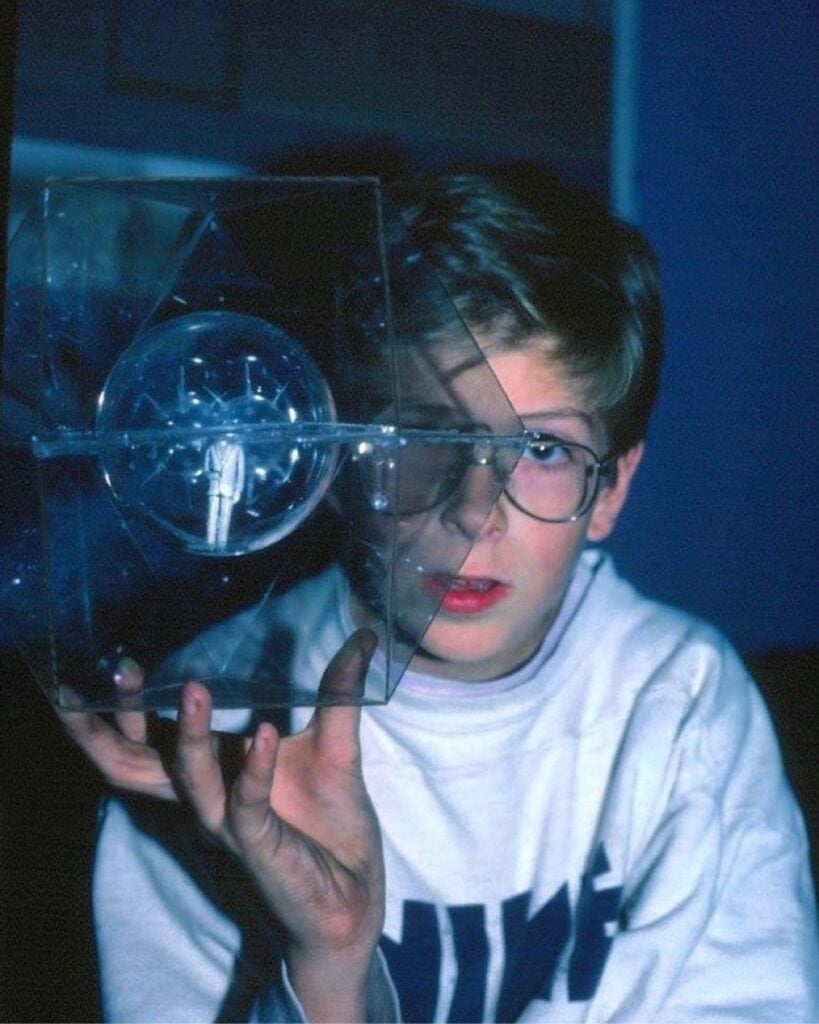
Young Eli with a Sculpture: Shot by JC Stiehl
That’s dope that they could see you had the skills at that age
I’m not trying to say I was so good that it was apparent to the teachers. It’s more like the teachers were experienced and knew, “Oh, you’re a creative type”, and that it doesn’t matter if you write the book report or do your math right?
That’s great to know that at least you knew your talent for art was being recognised.
Yeah, I suppose that is the ideal thing, right? To have other people see that, oh, this person’s good at that and nurture that.
But it is also, in a way, pigeonholing you and kind of dismissing you. So they were not like, “If you work hard, you could be the president!”. It was like them saying you’re not going to Harvard. You’re not going to do that”.
So, from seeing those ramp sessions, when did you finally get on board?
It’s a fucking long story. Because I was the guy who could draw at school, I started to notice how graffiti was becoming a big deal in New York. People were doing graffiti pieces on trains, on jackets, on piece books.
Older kids would come to me and say, “Oh, you can draw. Draw me a frog!”. So I would just draw that for them. I would do drawings sometimes, and the older kids would come and see them in my book and be like, “Oh, I’m taking that drawing”. I’m like, “Ah, alright, fine” because I was a little kid and I realised this is something I could do, and I can be good at it.
But I was too little, and it was too dangerous. However, I luckily met some of my graffiti heroes from the neighbourhood and started bothering them. But again, I was too young, I was just a child; these guys were in their early 20s, so they were encouraging me to hang with younger kids they knew. But I was kind of snobbish about my art. I thought, “I can’t hang out with this guy; he sucks” in my head.
Right, so who was the first person you met who was around your age at the time who pushed you creatively?
I met this one kid who wrote Midas. People didn’t really know him just yet, but when he started showing me his art, I saw that he was incredibly talented.
He was one of the most brilliant guys I’ve ever met. He was this soft-spoken wizard who had a different insight into the world. He was a black kid. He played the guitar, was smart, and was playing chess; everything he did was super involved. So I became his buddy, and he worked at the Thalia movie theatre, which is like a rerun house.
What’s a rerun house?
Before home video, there were movie theatres that showed new movies, but then they’d have rerun houses, and it would be like they would show a double feature of art movies or famous movies for two days and then swap them out, and that was on my block.
So when I was a kid, I wasn’t allowed to leave my block. You could just walk around the block. I’d go West End Avenue, 95th Street, Broadway, 94th Street. Just that, that was my thing. Luckily, there’s this movie theatre on my block, so I started, like, hanging out there, and they would know me. I used to hang out in the projection booth.
Okay, sounds like a cool hangout spot
Then one day, Midas – Blake was his actual name – he started working at the candy counter at the theatre. I was like, “You write graffiti?”. He was like, “Yeah”. Everybody usually was super braggadocious at that time and very hostile. Everyone had piece books, and it was really aggressive but he took a different approach.
He was like, “Oh, yeah, I can draw”, and I was like, “Oh, yeah?”. So then he took out his wallet, and there was a little square piece of paper. He unfolded it, and it was one of the most amazing pieces of art that I’ve ever seen! It was a graffiti piece with spray paint but that he actually painted.
There was a mushroom, surrounded by Midas lightning bolts, and it was done with a rapidograph, which are these super mechanical marker pens. It was just mind-blowing.
That’s such a sick visual trick
Immediately, I was thinking, “Oh, I want to learn from this guy!”. Then there was a lot of other psychological stuff that he taught me later, which was, if you go and meet somebody and they pull out a giant drawing book, you can sit there and go flipping through it.
But with that one, if you meet somebody and you’re like, “Oh, you write graffiti – what do you write?” and you go in your wallet and pull out a little piece of paper with the folds, and then you unfold this paint drawing, it implies that you’re so good that you’re cool with folding up this one little drawing to keep with you, you know? It implies, “Holy shit. What can this guy do if he really tries?”
So that was just one of the things that he taught me. So I’m, like, hanging out at the movie theatre with Midas and then his other friend, Ben, shows up, and they both skateboard.
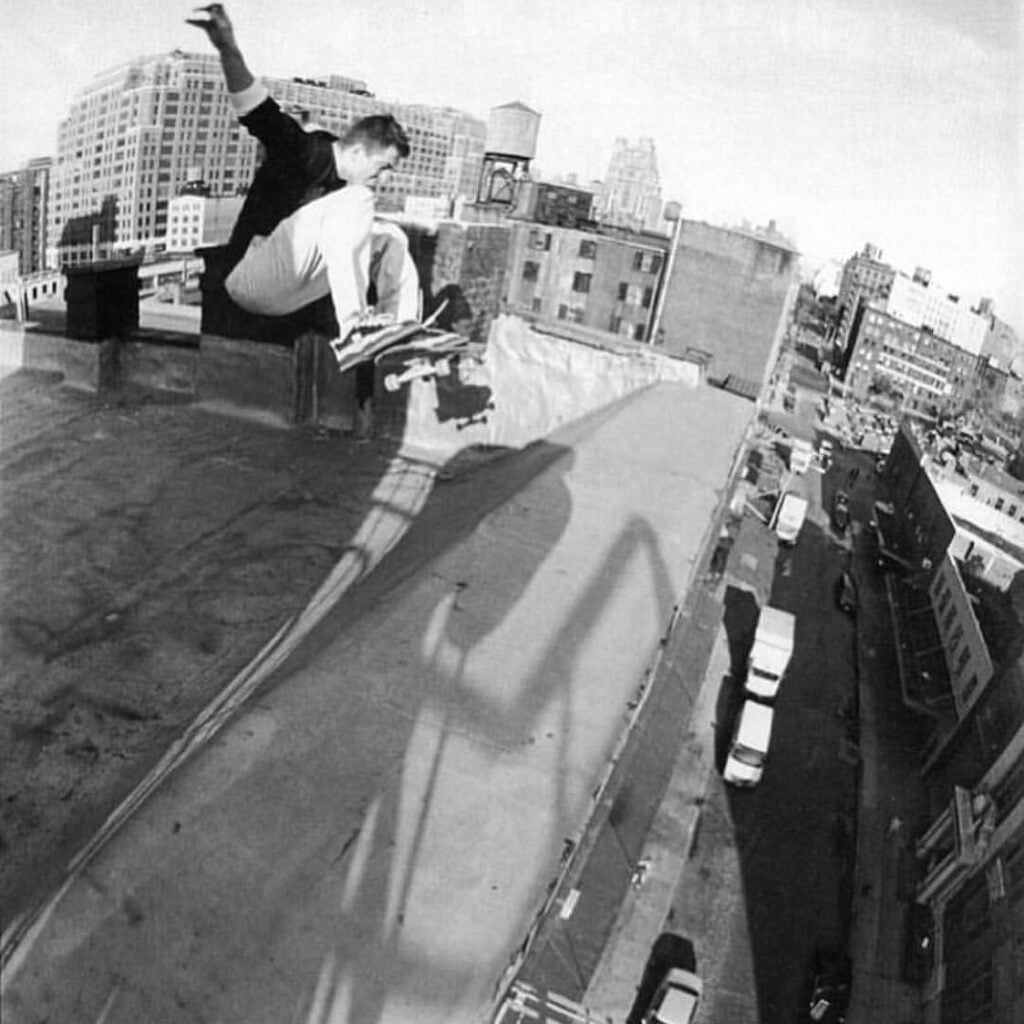
Eli, Frontside Ollie: Shot by Ryan Gee
Ok, so you started skating with the ramp locals through Blake?
He was my connection. But at that time, nobody really skateboarded. I hadn’t even seen it or thought about it in years.
But Blake had a skateboard, and he was also hanging out with this kid, Ben Alvarez. Ben had a halfpipe in his backyard in North Carolina, and his mom got divorced, so they moved to New York.
So this guy Ben, actually skated, he had a halfpipe and Thrasher magazines. So the three of us would all hang out.
Ben wasn’t really into writing graffiti or being an artist. He was just a skate punk. Midas wrote graffiti and skateboarded, and I was just hanging around them. But we would hang out at the movie theatre and they would let me try their boards.
What was the first trick that you learned on a skateboard?
The first thing I learned to do was just bomb a hill because the movie theatre was on a hill. I couldn’t skate their boards to the bottom, so they were like, “Don’t go straight down the hill. Just go across the street at an angle. You’ll go slower”.
So, I would just borrow their boards but eventually they would always say, “Oh, we’re gonna go skate, peace!” and take off. That’s when I was like, “Mom, I need to get a skateboard!”.
So you found yourself being drawn to skating and art through them. What was your first proper setup and where did you get it?
That’s another funny story. So I needed to get a skateboard. There was a kid at my school who had an old skateboard, and he was trying to get into it too. But these two worlds weren’t connected.
Ben and Midas were in my neighbourhood; I would see them, but they were a little bit older, so I’m sure they were going off to try and get beer or something but I had to go home.
So there was that kid in my class; I must have been 12 years old, and he had an old board and didn’t like the graphic. The ’80s were coming up, and all the big skateboard graphics were happening, but he had a Logan Earth Ski or something. It didn’t have a cool graphic. So he was like, “Can you come and graffiti paint my skateboard?”. I was like, “Yeah, man, totally”.
What did you end up painting on his board?
I went over to his house, I wrote his name and a bunny rabbit on a skateboard. It was a mad bunny rabbit with long ears. A white bunny rabbit with a machine gun, skating.
Then he came to school and he said that he went down to Dream Wheels in the village. It was the one skate shop in New York City that everyone used to hang out at. It was right next to Washington Square Park. So he went down there with the board, and he said that the guys who were there were blown away by the graphic that I did. They were like, “Who did this? This is crazy!” .
He came back and told me all this. He said the skate shop is called Dream Wheels. You can buy a good board there. That’s where you need to go. So this all just happened in a couple of months.
So I was like, “Mom, if I want to hang out with these guys, I’ve got to get a skateboard. I’ve saved up my money, and I’ve got to go to Dream Wheels. The guys will know who I am because I did that graphic”.
The bunny rabbit machine gun graphic
Yeah. So I go down there by myself at first, and at this point, I had learned the little trick from Midas. So I had three or four graffiti pieces that were folded up into little squares in my wallet. You know, the magic trick of art.
So I walked in, and I’m just like this fucking idiot kid, looking at the board graphics. They had the Alva graphic. They had the Powell graphics. The Gator just came out, Losi, a Boom Cat. It was amazing!
The smell of the place, the stickers; stickers were a thing that didn’t exist. Now there’s just too many stickers. But back then, getting a sticker was $5 to get a sticker in the 80s. So that’s like spending $20 on a sticker nowadays. Now you can get a hundred stickers for twenty bucks on the Internet. Everything was very special because there was less of it.
So I came in, U looked at the boards, and I was like, “Yeah, my friend came in here with a board I painted”. They were like, “Oh, The Machine Gun Rabbit”. I was like, “Yeah, I drew that!”. They’re like, “You!?” – because I was so young. I was like, “Yeah” and they were like, “Bullshit, there’s no fucking way!”.
As if they didn’t believe you
I went in my wallet and I gave them a little square, and then they opened it up. They’re like, “What the fuck, you did this?”. Then they were even taking me around, like, “Yo, this little kid drew this thing!”.
On the window of Dream Wheels, the paint markers had just come out, where you shake them up.
People were using them in creative ways. So, here and there, you would see people using paint markers. But no one would use a paint marker on an actual graffiti piece. You had to use spray paint.
But anyway, on Dream Wheels, they had this skateboarding graffiti piece. It said ‘Dream Wheels’ in a sort of Zephyr-esque, acid writers, Upper West Side, New York, graffiti style, but all done in paint markers on the window.
Sounds dope
I’d never seen anything like that before. I was like, “You can fucking paint on a window? Like, that’s just mind-blowing!” The drawing was good. I was like, “Man, this is my place, you know? I’m like, who did the graffiti piece on the window?” They’re like, “Oh, that’s this kid, Ian Frahm. He writes THOR IBM, and he’s the best skater in New York”.
I was like, “Oh, the best skater in New York writes graffiti. I’m here at the skate shop. I found my people, and this guy’s gonna love me, you know?” So all the guys in the skate shop are like, “Oh, wait ’til Ian meets you. This is gonna be crazy. You’re just such a good artist”.
I sat there, and they picked out the board, and they picked out the parts and the wheels. They told me I needed to get the Rat Bones, and they put the whole thing together for me as my first skateboard.
What was Ian like when you met him?
So Ian comes in, and it was Ian, Bruno Musso, Big Jim, Bosco, The Weasel; like, all these old New York City guys who were the established skate punk dudes in New York, and they all rolled in like a biker gang.
Then they were like, “Yo, Ian! Look, this kid did this artwork, and they’re showing him my thing, and he just fully dissed me”. He was just like, “Yeah, that’s cool, whatever”. I was like, “What!? I was like, you fucking dick!” I was so mad at him.
I had waited there for hours, hoping to make a connection, and he was just like, “Fuck you, little kid!” and then he took his skateboard, kicked the door to the skate shop open, and did a 360 Boneless out the door. I was just so mad. I was just so hurt.
Even the guys in the shop were like, “Yo, we’re sorry, man. I don’t know why he’s being such a jerk, because I’m just a little kid, and he’s just stepping on my dreams!” I was like, “Fuck you! I’m gonna get so good at skating, I’m gonna take you out! I’m so mad!”
Anybody can feel threatened by people who share a similar skill but that’s a funny story
He just walked out the door. He didn’t actually do the Boneless but it’s funny to remember it that way. But I definitely went outside right by 8th Street, right in front of the store, and watched them all skate after that.
I’d never seen anything like it; it was early street skating. So it’s all like Bonelesses and Bomb Drops. The Ollie hadn’t been invented for street skating as we know it today.
So, was this around 1983?
Yeah, 1982-1983. There was a little ledge. Actually, I bet you’ve seen it in a bunch of skate videos, the little set of stairs where Mark Gonzales does the first grind down a handrail. That was like one of the skate shop spots because it was across the street from the skate shop.
The building hated us because all the skaters came and skated in front of the building, and it was a kind of modern building. There were ledges and stairs, and a lot of skating at the time was skating up and jumping Bonelesses off the curb.
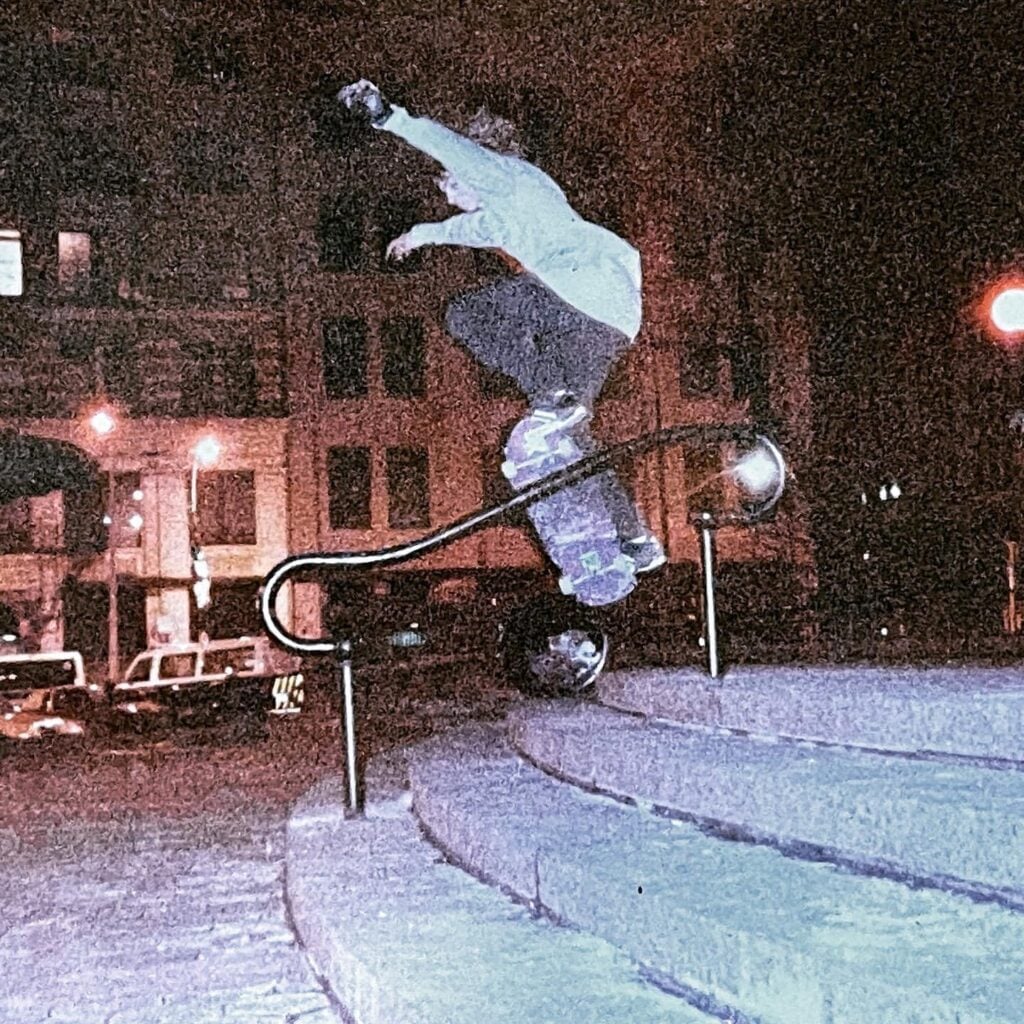
Eli, Backside Boardslide, 1987: Shot by Damany Beasley
What other tricks were people doing at the time?
Slappies are a big New York City thing. We have metal-edged curbs. If you were a good skater in New York in the ’80s, half of it was just Slappies, Powerslides and Bonelesses. Then those guys took off to go do their cool guy stuff. I just stayed with the guys who ran the shop all day.
They took me skateboarding and took me to this little drop and taught me how to just roll off it. I walk by it all the time. It’s right down the street from where my studio is now. Every time I walk by it, I’m just like, that’s the first place I started skateboarding, right there.
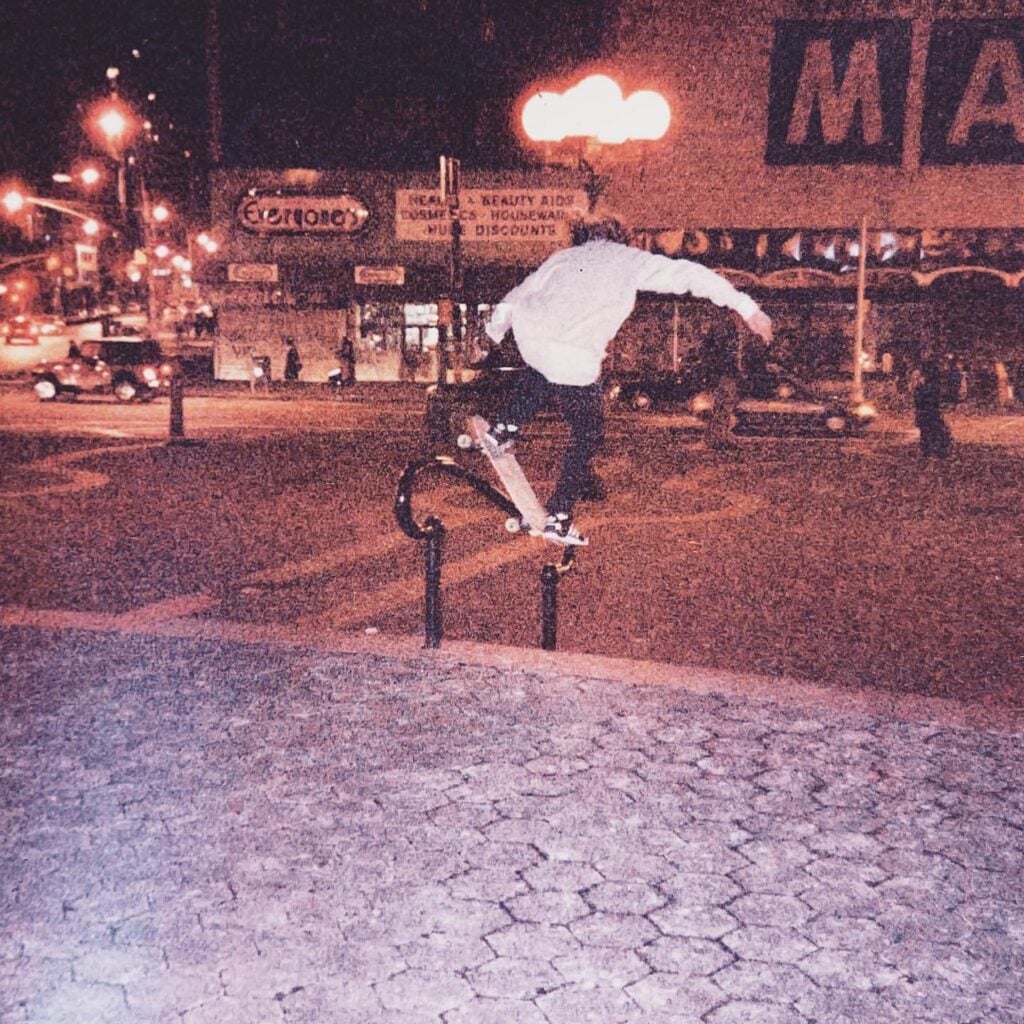
Eli, Backside Boardslide, Second Angle, 1987: Shot by Damany Beasley
Those places are so important. It’s dope you’ve still got that connection. So, who was your first sponsor?
The first people I skated for were Santa Monica Airlines. I got hooked up by Tony Converse, and then Hosoi gave me Hosoi Rocket Wheels. So I was on Santa Monica Airlines and Hosoi Rocket Wheels. That was years later, in 86-87.
Then whenever SMA kind of ended and World Industries started in 88-89, that’s when I got on Z. George Wilson sponsored me and flew me out to Los Angeles. That was my first trip to LA.
How did skating progress for you from that point?
By the end of the summer, Ian and I and all those guys were friends because there were so few skaters, and I didn’t know what I was doing, but I was spry.
I was willing to get hurt and do stuff and prove myself, so around that time, everyone would just meet at Washington Square Park, and there would be a gang of us. In New York City in the 80s, I’d say 30 to 40 kids altogether.
But we were usually just in little pockets of six to twelve of us who would randomly meet up at Washington Square Park or the Brooklyn Banks or Dream Wheels or sometimes even in Central Park.
The kids on the Upper West Side, we’d kind of skate together and then meet, go to skate with kids on the Upper East Side, and then we’d all go skate Midtown. It was a really great time.
For sure, what do you think about it, looking back?
It’s one of those things that you don’t realise how lucky you are until it’s gone, because the entire time all the skateboard videos and all the skate media are about Tony Hawk, Christian Hosoi, skate parks and ramps and people blasting airs. But we’re like, we are stuck in New York City, and we don’t have a ramp!
If we try to build a ramp, it gets torn down, so you’re just kind of skating around New York, not realising, like, oh, we’re inventing street skating. But we didn’t realise that; you’re just like, goddamn it! Man, wouldn’t it be great to go to California and learn how to skate vert?
But instead, you’re going around the city and learning how to Ollie, and then somebody’s like, oh, you could just Ollie up a curb. Yeah, how do you do that?
Then 360 Powerslides and Wallrides and, slappies, or Ollie to Tail on something, you realise you don’t have to Boneless to Tail, you can Ollie to Tail, and that was kind of what we were doing, thinking we were in a skate ghetto; that we don’t have anything to skate here. Fucking Brooklyn Bridge banks. This place sucks!
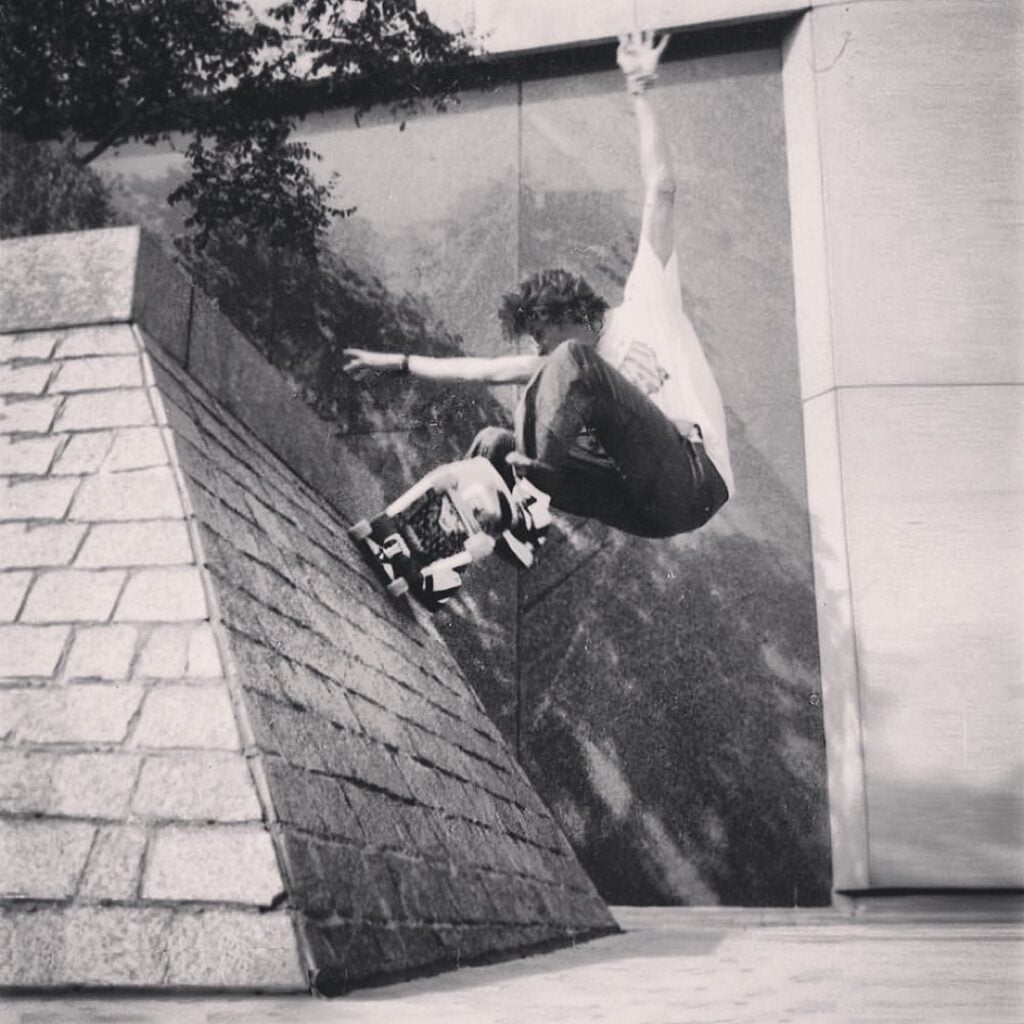
Eli, Frontside Wallride, Bell Telephone Building, 1987: Shot by Alyasha Owerka-Moore
But surely you must have rolled up to Brooklyn Banks and just thought this is perfect!
I’m being 110% honest, at least where my brain was at the time. In 1983 Ben Alvarez called me up on the phone. He said, I went with my mom down to City Hall today and there’s like a fucking skate park underneath the Brooklyn Bridge and we’re going there tomorrow. I was like… okay, but felt a little scared.
We went around there but he didn’t know exactly where it was. We were asking people, “Do you know where the ramps are under the bridge?”. They were like, “Get the fuck away from me!”. They had no idea of what we were talking about!
Then I asked, “Where were you with your mom?”. He said, “I was at this building”. I asked, “Where did you see them?”
He said, “Oh, we walked through here to the back and then we walked through”. I remember looking down this grassy hill to the Brooklyn Bridge banks, looking at them and not realising what they were, and then being like, “There it is!”.
I was just like, “Huh?” – because at the time, the biggest thing we had seen was like a 6ft high bank. This was so big in scope that it didn’t register, you know?
Right, so the Brooklyn Banks were even bigger than you’d first imagined?
So I remember just going down there and just thinking this thing is huge, and it was so big. Especially the big banks in the back. When you’re a kid, they’re double your height, three times your height. There was nobody down there. It was full of trash. It was kind of dangerous.
There was a homeless gang that lived down there, and they hated us, and the banks were so new or unused that the corners of the bricks were still sharp.
I guess we’re actually in the process of remaking the banks, like how Long Live Southbank did with Southbank. But we’re talking to the city. We got all the bricks. Hopefully, by next summer, we’ll have it all back in operation.
That’s amazing to hear the Big Banks are coming back. What was it like skating the original banks?
Back then, we were all skating hard wheels and the bricks were so new they had such a square edge.
So, a lot of times, you would do tricks, and the board would just stop. It’s only through the years and years of skating that the edges kind of wore down, and then it was easier to roll around on everything.
But even then, it was like, it’s not a ramp; it’s like you want to do an air and come back in. So the fact that the top of it went like that really kind of bummed us out. We even used to try to build little wooden things so we could try to yank Backside Airs in or build quarterpipes. But it was just what we had.

Eli, Backside Wallride
Skaters in your era broke that spot in for future generations
We made use of it, and yeah, I wouldn’t trade it for the world. You’d go down there, and no one would bother you.
We had no money. I’d get five bucks and buy two subway tokens, and I had a dollar to eat. It was before people sold water in bottles.
So the thought of that when we were starting to skate was insane. You’d pay money for water in a bottle, and we’d go to the grocery store, and at the bottom level of the grocery store, under the sodas, they had seltzer water for mixed drinks. You could get two of them for a buck, and they had flavours. I guess it’s literally like LaCroix now.
It’s hard to come by nowadays, you had it good!
But at that time, they just couldn’t get rid of it. So we would all go and get black cherry-flavoured seltzers from Schweppes, and they would come in a litre bottle. You’d get two of them, and that’s all the water you had. In the summertime in New York, it’s so hot.
We would just sit there and drink all this flavoured seltzer. We hated it. We were like, we can’t even afford a Coke. Now here we are in 2025, and that’s all kids want. They want White Claw.
When I think of New York, Brooklyn Banks is the first spot I think of. How long has it been unskateable for now?
Yeah. After 9/11, they closed it down, and then it sat dormant. I’d say around 2005, maybe before that, people started cutting holes in the fence and going back to skate it.
Then they kind of took it back, and then the city, I don’t know when, at a certain point they were just like, nope, and the cops started parking their cars there, and they ripped the bricks out. They were just like, no more skating, and then it just kind of sat around doing nothing. People didn’t even go down there.
Then this great woman, Rosa Chang — shout out to Rosa, and also Steve Rodriguez and the Skate Park Project, as well, if they’re reading this — Rosa started this thing called the Gotham Park Project. She is a community leader who was just like, listen, this is a very famous skate spot and it’s just being completely wasted!
The community doesn’t even have access to this place. There are basketball courts, places to grow gardens.
So she started working with the city to transform the underside of the Brooklyn Bridge in Manhattan, where the banks are, and she was not even a skater. The city was redoing the Brooklyn Bridge banks famous giant columns and ramps that support it all because they were falling apart.

Eli at The Brooklyn Banks: Photo by Gotham Park Project
Right.
So the city started dumping money into renovating the bank, as in the bridge itself.
Then she said, “Well, if you’re going to renovate the bridge, let’s turn the surrounding areas into a park”.
Then she started opening up all these closed-off giant atriums underneath the on-ramp to the Brooklyn Bridge where we used to skate. It’s the thing that’s behind everybody when they’re waiting to go skate: the banks.
It used to be open when I was a little kid. They had old wooden barn doors, and you could go inside. It was so old. They actually had horse-drawn carriages from the city with wooden wagon wheels.
But there were homeless guys living in there. That was their spot. So you’d walk in, and there were rats; it was so disgusting and creepy. You would never see anything like this nowadays.
Yeah, that sounds messed up
At a certain point, I would say by the early ’90s, the city had removed all the trash that was inside, and they ripped up the entrances so you couldn’t get inside.
But Rosa’s been going in there, and they found a speakeasy that was in there from the city hall, and there were remnants from some champagne company. They’re trying to open it up and make all these things into a shopping centre or tourist stuff.

The Brooklyn Banks: Photo by Gotham Park Project
What was it like going back to the banks on opening day?
We were all there for the ribbon-cutting ceremony. I was with Bruno, who’s one of the guys who started SHUT Skateboards.
We were sitting there with all the TV cameras reopening the Brooklyn Bridge banks. I’m like, how crazy is this? Jeff Pang was there too, and we’re all like, this is so insane.
We were all arrested and beaten up by the cops for skateboarding. The big thing is that the city had removed all the bricks. So, the banks were completely unskateable.
Then we proposed reopening the banks as a skate park as it was, and then the Department of Transit was like, “Well, we don’t have the money to go and put the bricks back, so we’ll just have to use asphalt”. But we were like, “No, it’s got to be bricks!”

The Brooklyn Banks Bricks: Photo by Gotham Park Project
Haha, that’s sick news. Glad to hear it.
But, yeah, it feels good. Hopefully, everything will work out. We hope that by next year or the year after, it’ll all start opening up and being available to the public.
One of the interesting things is the famous Ollie over the wall on the small banks. When we were kids, we would always do that. That was an active exit ramp for the bridge onto the highway. So you had to watch out for cars going 60 miles an hour coming to kill you at all times.
But since 9/11, that off-ramp leads directly under One Police Plaza, the headquarters of the New York City Police Department. So they’ve closed it. They’re like, we’re not opening this up to anybody who could come and try to cause problems. So now with the Ollie over the wall, no cars are ever going to come.
So at first, I was like, the city’s not going to allow us to Ollie over the wall in a public park. But Rosa’s like, no, it’s okay.
So we’re trying to figure out ways to make it even more skateable and possibly build steps you could sit on, so tourists could sit and watch everyone skate from a safe distance, but at the same time, you could probably Ollie over the stairs and use them as ledges and stuff like that. It’s an exciting time.
Sick. So, back to your skating. At what point did skateboarding become a career option for you?
Oh, it never was. I mean, in my time, if you were a pro skater, you were one of 30 people on the whole planet; you had to be a vert guy, and have some kind of contest records. Now that I’m older, I realise the California contest circuit was just Tony Hawk’s dad making something out of nothing.
Even the backyard ramp fad. I thought that was somehow run by giant corporations; it must be. How could a kid build a ramp? We didn’t have the space or the money when I was a kid to do that. So it all just seemed like a fantasy. I never in my life thought this is going to be my job. It was just, I like to skateboard. It’s my hobby, and I’m going to do it till I can’t!

Eli, Frontside Shifty Grab: Shot by Tony Converse
Right
Then there were a bunch of weird things that happened in succession. The first was that Rodney Smith and Bruno Musso started SHUT Skateboards in ’86, and me and the other local kids, we all did the graphics.
It was the first street skate company out of New York with graffiti graphics, and even though I did the crest sticker and some of their logos, I didn’t have the vision because, to me, it still was like, skateboarding is a California thing and we’re not there.
Right, it still felt like all the focus was on the West Coast
So even though I was at Shut, helping them make stuff, supporting the company, and riding their boards on occasion, a part of me in the back of my head was thinking, what are you doing? No one’s going to be interested in this. This is for us in New York City, and there are 30 of us, so I don’t know how you’re going to make a business out of it?
That goes to show how limited my vision was. Rodney and Bruno, those guys, came from working in skate shops; they understood skateboard distribution. They knew all the other skate shops; they had a network and they saw it as a broader thing. They saw how cool it was..
How do you mean?
It’s like if you were a surfer in Alaska. Can you do it? Sure. Are people into it? Probably not! It’s cool for an article in a surf magazine once every six years, but no one’s running up to Alaska to become a surfer.
I’m sure, having said that, there’s probably a rich and vibrant surf community in Alaska that I’m not aware of.
That kind of absurdity was what I thought skateboarding in New York was. I was like, I like to skate in New York, but I know I’m weird. I don’t think regular people are going to be into this.
Also, having said that, I’m the guy who grew up surfing in New York. I’ve been surfing in New York since 1987 at Rockaway Beach. Nobody was there. I was with four or five of my friends. There weren’t even lifeguards.
You had to be more concerned that the crackheads were going to steal your stuff on the beach. Now I can’t even go. I’ll drive my car to the same beach that I’ve been surfing at since I was a teenager. There are a hundred people in the water, and it’s infuriating to me because I feel you’re only here because I did this first; get off my wave!
Yeah, you were one of the pioneers
Yeah, but listen, me not being able to surf the waves that I grew up on is unimportant compared to the love and joy that a hundred people surfing in New York City experience and having a good time, that enriches a hundred people’s lives.
As opposed to me and my four friends grabbing a slice of pizza afterwards, like, yo, those barrels were sick, that no one else knew about except for us. It only affects us now. It’s been gifted to the world, and that’s important to me, especially because I’m getting older. I’m not going to be able to keep surfing.
But yeah, when those guys started SHUT, I was like, I’ll draw you graphics for free. No one got paid back then.
Right but you were getting involved
I was lucky enough to get boards from California, and then I went to film school. I was planning on going to go and make movies. That’s what I thought was going to happen, and I ended up working in nightclubs in the city to make money and had some success with that. I’ve always been open-minded in some way.
I didn’t have the imagination to understand what Shut was trying to do or trying to share skateboarding in New York City with the rest of the world; that didn’t work for me. But at the same time, I also have the ability to be like, well, even though I think this isn’t going to work, that doesn’t necessarily negate the opportunity to get the experience.
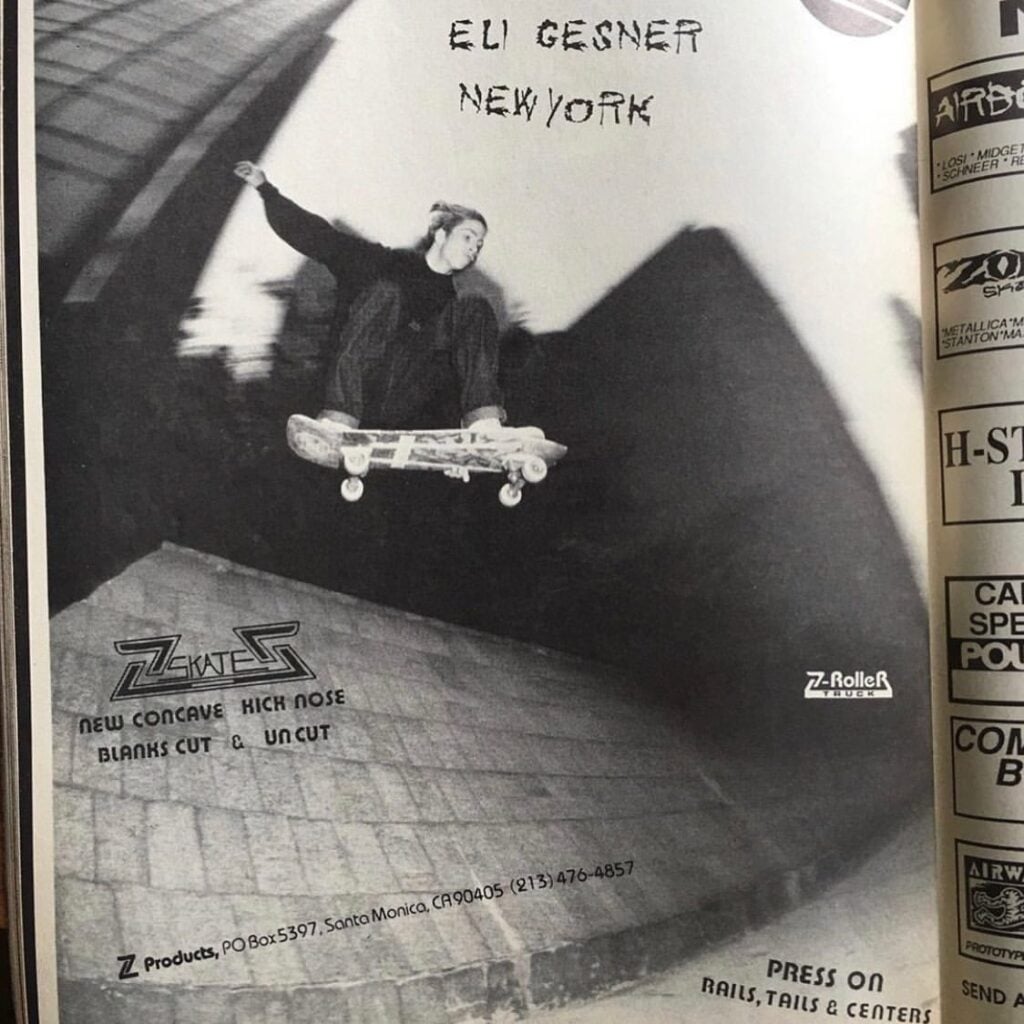
Eli, Backside Wallie Grab: Shot by Bill Thomas
So rather than being lucky or motivated, you always move towards projects with a good vibe and see what happens
One of the things that I’ve really liked about my wife’s family is that they call me Dr. Yes.
Why do they call you Dr. Yes?
Because it doesn’t matter what it is, like, oh, I gotta carry all the garbage to the dump, I’m like, let’s go.
I always don’t care what it is. I got one go-round on this earth, and I’m happy to do whatever you want.
So I have always been like, oh, that sounds interesting. I always find that the stuff I really know a lot about is difficult for me to engage with. For whatever reason, I have more luck when opportunities present themselves, and although I don’t know anything about it, I’m like, yeah, let’s give this a try. Let’s see what I can learn.

Eli, Tree Wallride Frontside Grab: Shot by Bryce Kanights
But now it’s so clear how well placed you were to launch a brand like Zoo York after founding Phat Farm
If there was no Phat Farm, there would have never been a Zoo York because I would not really have had the sensibility.
I skated for Stüssy before we started Phat Farm. So I knew Shawn Stüssy and Paul Middleman and those guys and would kind of watch what they were doing. You would see that there was a clothing thing going on.
There was Vision Street Wear, Stüssy, and even Powell-Peralta T-shirts and sweatshirts and stuff like that. I liked them and I owned those things, but it was not something that fascinated me to learn how a shirt was made or even how to sell these things.
I vividly remember going around with Shawn early on when he had a giant bag full of samples, and he was taking them out at Soho Skates and other spots. I remember him saying, “Oh, I have five of those and four of those!”. I was like, wow, you’re almost like a door-to-door salesman!
Going door to door selling Stüssy with Shawn must have been a fun learning experience back in the day
I personally think Stüssy is one of the greatest brands, period, and I was so stoked to skate for them and get free stuff from them and rock it. But again, I did not have the scope, grasp, or imagination to think everybody’s gonna love this as much as I do. I just thought I knew I was weird. I knew I didn’t fit in.
So if I loved something, it was probably a niche portion of the population; no one else is going to be into this, you know?
Even though I would wear Stüssy shirts and kids in New York would say, oh, I’ve seen that. What is that? Where do you get it?
I would say, oh, you know, I skate for them. But you can buy it at Bloomingdale’s or this skate shop. Because that’s how you had to find out things before the Internet. It was like that. You were just like, this is just one of these things.
Right, so how did you get involved in Phat Farm?
So when we started Phat Farm, I had faith Phat Farm could work because I knew that Hip Hop was awesome.
It was growing; people were still becoming aware of it, and the reason why the whole Phat Farm thing started was because of Russell… I’ll give you the abbreviated version.
Russell became aware of James Jebbia’s Union store and how kids were lining up to buy Stüssy stuff out of there, and his friend, who had a clothing store around the corner, said, you should do what Stüssy’s doing, but for Rap. That was it. If you own Def Jam Records, you can make Def Jam clothes.
That makes sense
I was like, oh, that seems like a really possible thing. Sign me up. Happy to help. Russell didn’t know what he was doing. Nobody did. There was no streetwear industry. There’s no one to go to, to learn how to do this, you know? So he hired me, Alyasha Owerka-Moore, and Paul Middleman to go make this clothing company.
Paul’s family owned a clothing store, and Alyasha’s mom did textile restorations for the museum, I think. So the two of them knew way more about making clothes than I did. I was just there because I could draw pictures and I knew how to use a computer, and I could make logos because of my computer knowledge.
So we were like, oh, yeah, this is a little dream team and I was just drawing pictures. Because we came from graffiti backgrounds, we’re just showing up to the office in the early days and just drawing graffiti characters.
What other creative stuff did you get up to in the early days of Phat Farm?
We would be like, Yo, wouldn’t this or that look dope with some Timberlands and a hoodie and we’re just drawing graffiti characters. Meeting up with Russell. Russell’s like, yeah, these are my guys. We’re starting a clothing company. So one day we’re hanging out with Russell. He’s like, we need to go get samples. I’m like, yeah, let’s go get samples.
We’re going on shopping sprees, and then, at a certain point, Russell’s like, we got a store. He bought a fucking store on Prince Street, and we’re building it out. We’re renovating it, and then he’s like, yeah, so how do we make this shit?
I’m like, I don’t know!? I’m a fucking graffiti writer. I don’t know how the fuck to do this. So we start hiring other people. This guy, Guido from Italy, who made leather jackets, was like, yeah, I can make this happen. So we start finding actual garmentos who know how to make stuff.
Sounds like everything is going good
So we’re making it work. It’s amazing anything got made really. What saved us is actually the first thing we did, it was so funny. This is the perfect example of you’re too dumb to know what not to do.
When you’re young, you’re like this is cool, you just get it done, and it has its own flavour. Then you get educated, and you’re like, don’t do that. So Alyasha and I, we were trying to think of what to make, and we were like, oh, we should make an M65 US military jacket. It’s a standard camo jacket that you can buy in an army navy store.
That’s all we really did was just rip off stuff from Polo, army navy stores, and college sports. That’s just what we did. We would buy the piece and make it ourselves.
But Guido is like, I have my friend, he goes to the garment centre, and he’s gonna make you the coats, and we’re like, okay, yeah, and we give him the M65 jacket, and he’s like, I’ll go get them working on a sample. We’re like, okay. We don’t even know what a fucking sample is, right? So we’re sitting there, Guido comes in, and he’s like, I got this M65 sample.
He takes it out, and it is undyed natural canvas in cream, just cloth, not even dyed, and it’s an M65 jacket in a heavier fabric, and me and Ollie were like, what the fuck, and we’re putting it on, we’re like this is the dopest shit ever.
Then he’s like, okay, but what colours and the fabric? We’re like, no, just this. He’s like, what? He’s like, this is the sample fabric. This is just for the fit, and we’re like, no! Now, this is gonna blow minds. No one’s seen this. Make it just like this.
So I’m on the phone listening to him try to explain to the manufacturer, no, they don’t want any colours. They want it in the sample fabric, in the canvas. They want this. No colours, and that was the first thing that we made.
Haha, that’s amazing
So we’re all very excited, and we pay the garmento in midtown to go make a run of these jackets. We probably made about 50 of them, and we’re literally thinking, oh, the jackets are done. We’re at the store, it’s still being built. It still needs a couple of months of work, but we’re getting there, and we’re gonna get our first piece, and Guido’s saying, yes, they put it on the truck, it’s on the way, and we’re sitting there waiting and waiting and it never shows up.
Then the next day, they hit us up saying, oh, we got robbed!
What happened?
I don’t know what the fuck happened. It literally fell off a truck. All these jackets, which we made for thousands of dollars, got stolen. The first things we ever made! Russell’s so mad. He was like, that’s because these motherfuckers knew it was me, and they’re holding them hostage. We don’t know what happened to them. They’re gone.
But we’re just sort of realising we’ve bitten off more than we can chew. Russell’s talking about how dope everything is, hyping it up. We’re young geniuses and going to change everything, and we don’t have anything to make.
Now we know even if we spend money and make shit, they’re going to steal it unless we’re paying. It was probably a message from the union, like from the mafia that was like, you need to pay to make sure shit doesn’t fall off the trucks.
Later on, when we were opening up the store one night, we’re sitting there hammering and painting at like 11 o’clock at night, these two Guido Mafia guys come in, filthy with cigars, and we’re like, can we help you?
They’re like, yeah, we’re your trash guys. Here’s your bill, and we’re like, what? We didn’t call you, and they’re like, nah, we do all the trash on Prince Street. You pay the bill every month, and we’ll pick up the trash.
I was like, we don’t have a say in it. He’s like, nah, have a nice day and walks out.
Oh shit.
That’s what happened. So me and Russell are sitting at this fancy, cool restaurant called Time Cafe, and Russell would sit there a lot, that’s his office.
He lived on the top floor of the building above this restaurant, and in the morning, he’d come downstairs, get a cup of coffee, and he had a flip cell phone, and he’d just sit there at a corner table and run his companies from this table at the restaurant. So you get a phone call every day. It’s Russell, get the fuck over here. I’m like, okay… So then we’d go see Russell.
Right
Then one day, he and I are sitting there having lunch, talking, and then these two well-dressed Jewish businessmen come over and they’re like, oh, hey, we don’t want to intrude, but we’re visiting from Canada and we’re fans. We love Def Jam, and we just wanted to say hi!
We’re like, oh, yeah, that’s cool, and they’re like, my brother and I have a clothing company in Canada called Roots, and we’re like, you have a clothing company?
Russell’s like, yeah, and he’s like, how big is it? He’s like, we’re the biggest Canadian clothing company there is. We’ve got factories. He’s like, you got factories?
Within five minutes, Russell’s like, we’re starting this company called Phat Farm. We don’t have any clothes. We don’t know what we’re doing, and they’re like, say no more, fam. They were like, call us tomorrow. We’ll fly you out to Toronto. We’ll make everything for you, and we were like, oh, this is how magic happens.
Then Russell picked us up in his bulletproof Rolls-Royce, drove us to the airport at 6 o’clock in the morning, and flew us to Toronto. We went and looked at the factories and met everybody.
They’re like, this is the pattern maker, and we’re like, what is a pattern maker? We didn’t know anything, and the lady, who was this beautiful French Canadian woman, she’s like, you take a drawing, and I measure it, then I cut the paper. I’m like, you cut things out on pieces of paper?
Then we just started going to Toronto, rushing to make an entire clothing line before the store opened, and then it opened, and then we had success.
What a series of fortunate events. So, how did Zoo York come into the picture?
At a certain point, I realised I’m just Russell’s employee. I helped make this company, did the logos, the whole concept, and now, if I get fired, this will keep going. I don’t have any stake in it, and it was at that point when Shut had gone out of business, right?
Rodney Smith decided to restart it but he was going to call it Zoo York, inspired by the old soul artists of Zoo York stuff.
That’s really where Rodney faced some hard times because Shut went out of business and he got evicted. I was lucky enough to have a spare room in my apartment, so he moved in with me.
So at what point did you start working on Zoo together?
So while I was working on Phat Farm, he was planning to get Zoo York going and recruit these skaters. At this point, I’m still skating, but I’m just skating for myself, you know? I’m not trying to do video parts.
One of the investors in Phat Farm was this guy named Larry Schatz, and his son Adam Schatz, came and took a job over the summer being the office manager for all of us at Phat Farm. Then it was sort of like Rodney, me, and Adam were hanging out, and Rodney was just like, it’s all about Zoo York.
So we’re gonna make Zoo York, and then Adam said, this sounds like a good idea. It’s a cool name. Skateboarding’s cool!
So that’s just really how it happened, where it was like, alright, so we don’t have any money. We’re gonna take what little money we got to go start Zoo York, and I’ll keep working at Phat Farm. So I’ll do the Phat Farm stuff when everyone’s watching, and then when everyone goes home, you guys come over, and we’ll do Zoo York stuff. So I was kind of piggybacking off of Russell, you know? That’s what you have to do to make stuff work.
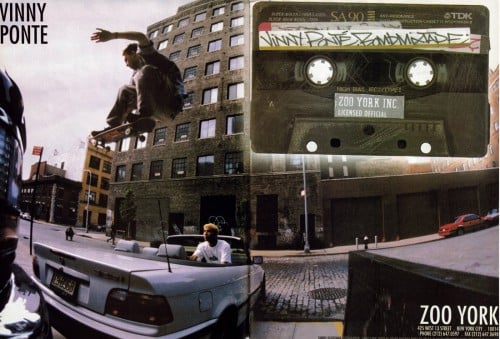
Vinnie Ponte, BMW Ollie Zoo York Ad: Shot by: Sammy Glucksman
Right. Do you have any advice for people wanting to start a brand?
If I could give kids or anybody who wants to do something some advice—a big part of it is don’t overthink it or think I can’t do this because we don’t have enough money or we’re gonna need more money—that is detrimental to getting anything done. As soon as you’re out there, making shit happen, you’ve got to get it done. The act of just doing and not thinking about it is the trick to success.
Zoo York ads always stood out and looked different. Sometimes the skate aspect of the ad would be the furthest thing from your mind when looking at them. How did you come up with new concepts for those?
First of all, Zoo York ads are one of the things that I cherish the most. I’m most proud of them.
I could talk about them for hours and hours because there was so much I was trying to do and prove because of the digital computer, Photoshop, and Illustrator revolution. There was a small group of us, the children of David Carson. We were all trying to re-visualise using computers, print, but now it’s basically gone.
No one really makes magazines anymore. But it was a really great, creative time. I was very much trying to differentiate ourselves from the standard, here’s a skateboarder doing a trick, and here’s our logo style ads, which I thought was lazy.
The other thing — and I’m saying this completely out of love for everybody who ever skated for Zoo York — is that a problem was if you have a skateboard company in California, San Francisco, San Diego, Los Angeles, you can skate all year-round. You can get photos whenever you need a photo. It’s always nice out.
In New York, it’s fucking cold and wet for half the year. So that really became sort of a problem where we were, guys, you need to get us some skate footage or get us a picture, and guys would go out and be like, it’s zero degrees out, you know?.
So I’m like, come back with something, and the photo they get is like a Frontside Tailslide. Frontside Noseslide. But you’re like, come on, another Frontside Boardslide… can’t you just do a hammer? Can’t you do a Kickflip down a 16 stair? And they’re like, no, because the ground is frozen. If I land, I’m gonna die. This is what you get, and that’s part of being in New York, and also that’s what Zoo York is.

Jeff Pang Backside Lipslide: Shot by Giovanni Reda
You had to deal with everything that comes with being on the East Coast
So as frustrating as that was, I would be like, alright, I got it. I can’t make the picture the focus of the ad because it’s not on par with people who live in California and their weather. But once we started making money, that also became part of the thing. We would be like, okay, go to California. We’ll pay for you to go to California for the winter to get pictures.
But then we started getting pictures back, and it was just not New York.
You know, there are a couple of ads where I would be like, oh, my God, this totally looks like some guy skating in Austin, Texas. He’s not skating in New York. So then it was, what can I do to make this extra New York? Look at this instead, so it was a fun and creative time.
But, yeah, I think I love difficulty and problems. I’m really attracted to doing things the hard way. I want to do it like that because it forces you to grow and become better. You know, if you just start doing the same thing all the time, it becomes a job. I don’t know. To this day, it’s how I do everything.

Jeff Pang Backside Lipslide, Second Angle: Shot by Giovanni Reda
I don’t think any other video has ever started off like Mixtape. How did making the intro go down?
We were so lucky to do that with Roc Raida. I really appreciate that. It’s one of my favourite things that I’ve ever done with R.B. Umali. It was just the three of us, and we met through some friends of ours, I think Stretch Armstrong and Bobbito.
We got Roc Raida to agree to do it. We drove up to his house in the Bronx, and it was literally in the basement. We had never met the guy, and we gave him a T-shirt, and then we were like, hey, we want to film you. He had these gold turntables from the world championships, and he was doing his routine.
We didn’t even think we were going to start the video this way. I just knew that I had R.B. and his camera, and I had Roc Raida, and I had this location. I think the first thing that struck me was, oh man, here’s the world championship DJ, and he basically lives in this small apartment
Really, that iconic intro was filmed in his apartment?
It was this very small studio space and I thought whether you’re a teenager who likes to draw, play video games, or make music, being alone in your room is basically where everything comes from. Every great book of the 20th century was probably just written in some guy’s living room or bedroom, and how many great songs are just written by someone with 10 roommates sitting there on a guitar, coming up with something?
So there was something about that, and I was thinking, how do we express that? So I was like, okay, how can we do this? We will have the room dark, and then he comes in and set everything up and plays the song, and he was like, ok, great. R.B. was in film school, and I basically just directed it. Like this is the shot. Shot. Let’s get another shot. That’s the shot, and I was really like, R.B., you know, shoot this, and then to Roc, you put the record here.
So all that was done on the fly. But it was done, from my observation, that you can go and make something great in your house, and it was originally sort of done just as, let’s just go shoot this and sit on it, because we don’t know how we’re gonna use it. We didn’t edit it. It was just, let’s make a little short film while we’re shooting this guy, and he did his routine, which features later on in the video.
Did Roc Raida pick the music from the intro?
During the filming, he was playing some song I didn’t like. I was like, I don’t know if I like that song, and he was like, oh, well, what do you want?
I was like, oh, you know what song I really like? He’s like, what song? I was like, you got JVC, Force, Strong Island? He was like, oh, yeah, I love that song, and so he got it out, and I was like, oh, yeah, that’s good, and then we all just started collaborating. What song should come next? Oh, Big Shout on The East Coast by Ultra Magnetic MCs, and we just made that up there in an afternoon. Not even in a whole afternoon, just a couple of hours.
But it was like he recorded it. I brought the little tape; he popped the tape in. I drew the little tape; that was something I pre-thought out. That’s the tape that we recorded his thing on, and then we started editing it, assembling it, and it seemed like once it was all edited together in the darkroom and then him coming in and putting the records on, it just lookeed like not what you would expect you would see in a skate video.

Mixtape VHS: Featured at the Museum of the Moving Image
It’s definitely a unique way to start things off, but why did you decide that was the right choice?
Usually, skate videos were boom, montage, all these hammers, and we’re just not going to be delivering you skateboarding. We’re going to let you know right off the bat that this is something that’s going to encompass more than just skateboarding and also is undeniably New York. This is something that California is not going to be able to deliver.
Although yes, of course, there are great DJs from California and great skateboarders from California. But for whatever reason, this is what it was. Just trying to keep it as New York as fuck.
The other thing was that this was really early on in digital video editing, so we couldn’t edit it straight through. We had to edit it for the system that was set up, which I think was a Media 100 system that we used for my friend Jamil Toure. It was maxed out, cost a fortune, and had a hard drive. But he did it for making music videos, so it was five minutes max.
After that, the hard drive was full, and it would crash. So the reason why the video is like that is because we were like, alright, let’s just do five minutes, and Roc Raida’s segment once we looked at it, we thought, that’s what we’re going to start with. So that’s how we did it.
We just assembled it that way. It was a real nightmare to make Mixtape but it was worth all the suffering. I hope after I’m dead, people will still watch Mixtape somehow.
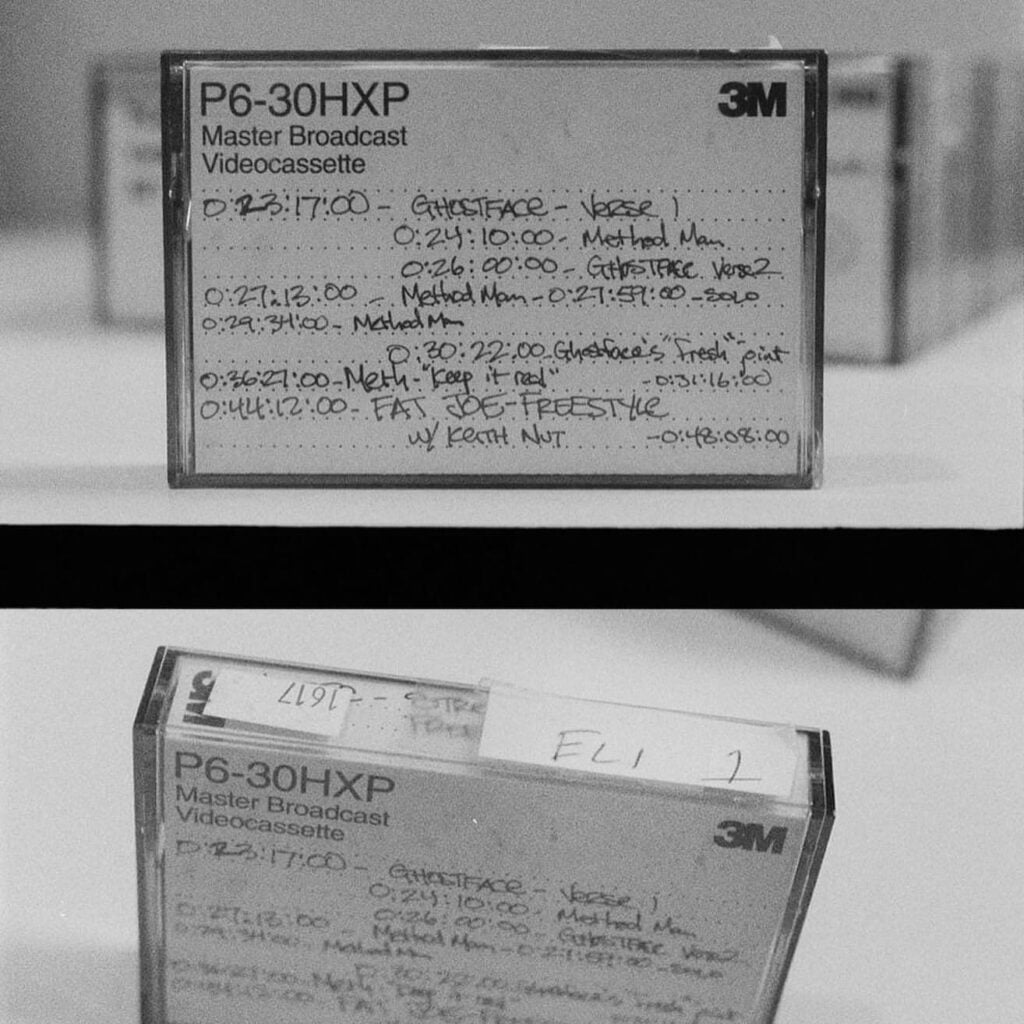
Mixtape Raw Stretch and Bobbito VHS Freestyle Tapes: Shot by Zander Taketomo for the Supreme All The Streets are Silent Book by Jeremy Elkin
When you were filming all the interludes with Method Man and Busta Rhymes and all these other legendary MCs for the Stretch & Bobbito show, did you think, yeah, I’ll cut this into a skate video one day?
Hell no. Honestly, I did that because filming stuff back then was intrusive. Now, there are people shooting everywhere 24/7, wherever you go, and no one has a problem with it.
But if you and your friends go out to a cool restaurant and you’re like, oh, this is great, and you take a picture of what you’re filming, nobody blinks an eye. Everyone’s completely unaffected. Even everybody behind you. If there’s a whole restaurant full of people, no one gives a fuck, you know?
But back then, in the late 80s-early 90s, cameras were huge, and if you took out a camera to film stuff, it would shut the room down. People would be like, what the fuck are you doing? People would leave. I’d get into fights. Even my friends who I was with would be upset that the camera was out.
So if you watch All The Streets Are Silent at the end, towards the end, Jeremy did a little montage of people kind of being like, Eli’s always filming me. Why are you filming?
Why weren’t people into you filming them?
Because it was intrusive. Back then, if anyone took a camera out, it would change the demeanor of the entire room. Filming was seen as offensive. Like you were spying on them. People would change their behavior when the camera came out. No one liked it. It was unnatural and annoying.
So at a certain point, I decided when I was in film school that I had to deliver film projects, and I was also doing nightclubs, and I was skating, and I was going to the Stretch & Bobbito show.
So there was almost a practicality aspect to it, which was like everybody else in my school is going to deliver what film school people would do. You know, a black and white short film of me making some tea with steam coming up in the lights, in the sun, and it was always the same dumb shit.
I was like, well, I know that I have access to stuff that no one else does, and I got the camera, so, you know, I can ask my friends, hey, is it okay if I film? It was like having a loaded gun.
I would get the camera from the school, and I would go to the nightclub, and I would go to our little office. I would put the camera down and hide it, and I would be like, alright, I have to pay attention for the right moment to bring the camera out, because I know it’s gonna turn people. People are gonna be like, what’s going on?

Eli’s Mixtape Hi8 Camera: Featured at the Museum of the Moving Image
Yeah.
So I had a whole way of holding the camera to make it more discreet. Stretch or Bobbito would call me up and be like, oh, Ghostface and Method Man are coming down. I’m like, I’m coming to film, and I just had tapes saved of it. I just knew someday this would work for something but I don’t know what.
What inspired you to keep all that archive footage?
My ex-girlfriend, Vanessa Contessa Salle – she’s now married to Tobin Yelland. But Vanessa’s mom – Roxanne – used to live right down the street from here, and she’s a famous and beloved behind-the-scenes fashion photographer. So she took black and white pictures from cool parties at Studio 54 to backstage at a Comme des Garçons show or photos of all the supermodels getting ready.
She passed away recently, but she was a doll and had a great career. When I was probably getting out of high school, like a senior in high school or going into college, I was hanging out with Vanessa.
I went to her mom’s house, and I knew her mom was big in the fashion industry. Her apartment was a loft, and there were these big filing cabinets.
I knew she was a photographer, but I didn’t understand what that meant. There was an entire wall of filing cabinets, and I wondered why she had all these. She said, it’s my photos, and she showed me her whole collection.
What was in it?
She said, here’s 1975, spring, fall, New York, 1976, and she’d pull it out; there’d be boxes. This is behind the scenes at the whoever show, the Louis Vuitton show, or here’s a party in 1980 at the Roxy with Mick Jagger, and it was all super organised.
She had books of all this stuff, and I was thinking, do people really care what happened at this party 15 years ago? She said, yeah, I’m the only one who has this stuff, and this is my treasure. I’m a dragon from Lord of the Rings, and this is all the treasure I’m sitting on, and I thought, okay, so there’s some value in that, you know?
For sure
My father also passed away when I was 10. So when I was a little kid, he was just gone at a certain point in my life, and I was just left with a shoebox full of photos of him. So there was this kind of compulsion to save stuff, and then also, after seeing Roxanne save and catalogue all this stuff, I thought, oh, yeah, maybe I should do that. But I could never take it to the level that she did.
She knew this was her job, and it was organised to a level that I just didn’t have the mental faculties to stay organised like that. So I knew if I filmed something, it was important. I usually would write, Method Man, don’t copy, don’t erase, on the tape and pull the little plastic pin out so you couldn’t erase it, and I just leave it on my shelf and let it sit there. Then it sat there until we did Mixtape, and it was like, what do we use for music?
I was like, why don’t we just use the Stretch and Bobbito show? They have all the dope songs. I’m like, wait a minute, I’ve got all the freestyles, and then I talked to them, and they talked to the rappers, and everyone said it was okay.
So we put together this magnum opus of analogue mixing. It’s insane that the thing even came out. Nowadays, even if you’re a DJ, how easy it is to edit and mix records. That’s why there are so many celebrity DJs now, because all you need is a little tiny flash card or a hard drive, and you’re ready to DJ.
When I was hanging out with Stretch Armstrong, Moby, and those guys, they had heavy-duty metal cases with vinyl records that weighed 60 pounds, and you had to carry at least two of these things, maybe three, to your gig. So it’s like if you wanted to be friends with a DJ, you knew you were going to have to carry heavy shit!
So, Method Man, Busta Rhymes and Fat Joe, all featured in Mixtape: How did you get all these famous rappers’ permission to use all the footage of them freestyling for Mixtape?
I mean, that’s a whole other story. So you might know that there’s no DVD of Mixtape. There are only VHS copies in PAL and NTSC. So that was the first thing we made, because it was a lot of money to make a DVD, and we didn’t know if people were going to respond.
So the cheapest way to do it was to make the VHS tape, and if it worked, we would make the DVD. So this all sort of happened really fast. We made the mix, talked to Bobby, talked to Stretch, and we were like, can you get us in touch with Busta Rhymes, Fat Joe, and Method Man? The position they took was kind of like, no, we’ll handle that.
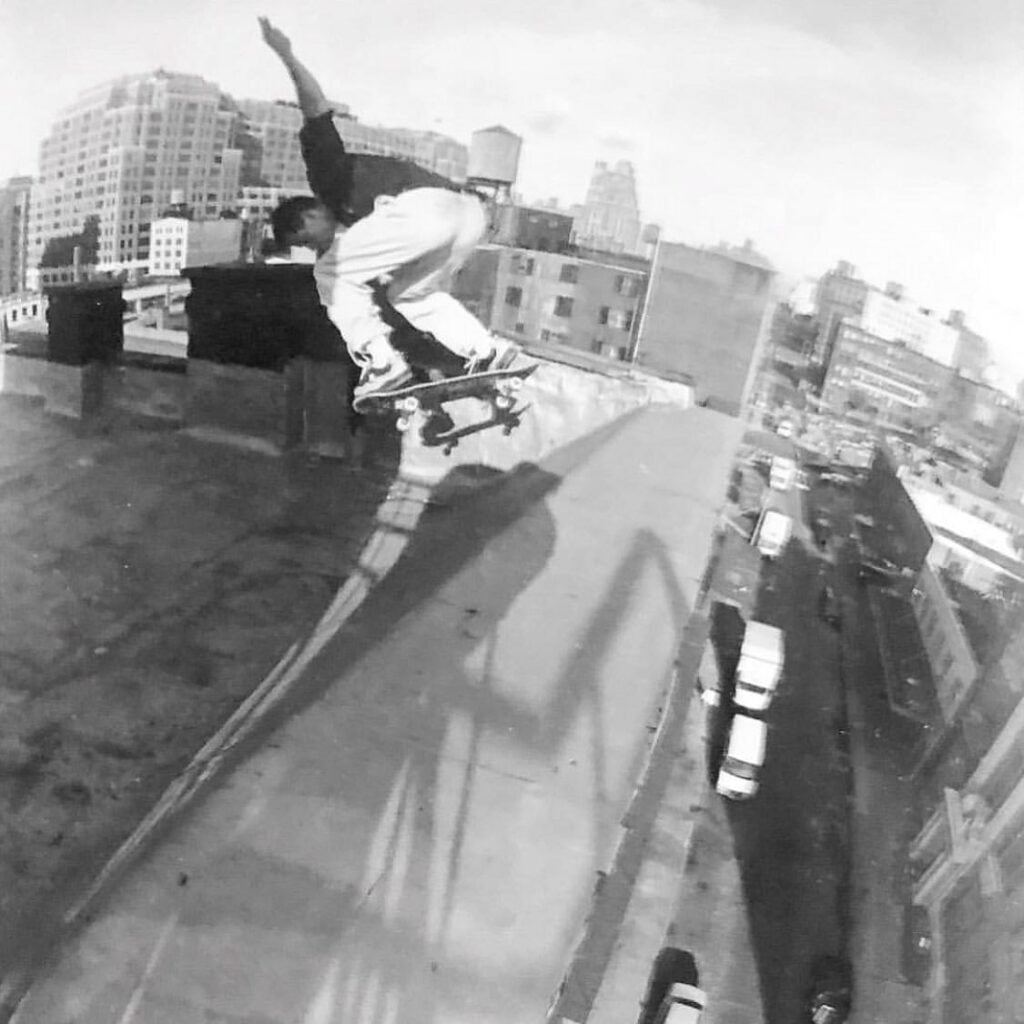
Eli, Backside Ollie: Shot by Ryan Gee
Right, that sounds too easy…
I was like, alright, cool. I guess part of me wanted to talk to them about it but they were kind of like, we’re not gonna give you Busta Rhymes’ number. We’ll call him, and I’m like, okay, whatever. Then I was like, did anyone say no? They were like, no, everyone said it is totally cool. So we were like, great, we’re holding you to this—that everyone said it’s cool. Then, at the end of Mixtape, we went out of our way to put everything that any of the rappers ever made on the credits.
All of their records are at the end, and where to buy them, so it’s like in the worst-case scenario, we would be covered. Like, Fat Joe’s a for-real gangster, and even if he shows up, we at least want to be like, look, at the end, we’re trying to get people to buy your stuff! So that’s what it was, and we were like, oh, that’s great.
But what did they think when it started to get really popular, was there any backlash?
We had a real surge of success at Zoo based on that video, and then the film KIDS came out and we were doing really good, and we started getting meaningful money and then we were like, yeah, we’re gonna put out the DVD. But with the meaningful money came bigger lawyers because now there’s more money at stake. The people who are giving us the money want to make sure we’re not assholes. Because we definitely were assholes with money in the past, so everything’s much more going through with a fine-tooth comb. So we’re like, yeah, we’re gonna put out a mixtape on DVD right in time for Christmas.
I think I might have mocked up the box, and then our new lawyers and also all of our family—Adam’s family are lawyers, my wife’s family, they’re all lawyers—they were usually like ah, you’re just a bunch of kids. But suddenly, you’re in Bloomingdale’s; you’re a real company. You have business cards, you know?
Right, you were fully launched as a business
So we were like, yeah, we’re gonna put it on DVD, and we sent Mixtape to our entertainment law firm to review it before we made the DVDs. Before they even finished watching it, they said, you can’t put this out, and we’re like, it’s too late. It’s already out. People love it. They said, you need to get all of this shit back. What do you mean? We talked to Stretch Armstrong, who talked to Busta Rhymes, and they said that it’s okay.
The lawyers said, first of all, that’s a game of telephone. Secondly, what are they rapping over? And I’m thinking, oh, well, I don’t know. I guess they’re rapping over the instrumental from A Tribe Called Quest. Yeah. Did you talk to A Tribe Called Quest? Also, who sampled the A Tribe Called Quest sample? Because their music is in your thing, and we’re thinking, oh, my God, and he was like, this is a potential massive lawsuit for every frame.
Oh, shit
The sampled music, the instrumental records, the rappers, we were like, okay…So after that, you might have noticed after Mixtape, once we started doing Peep This and EST and a lot of the other Zoo York videos, we started doing all the music in-house. We were like, if we’re gonna have music, we’ll make the music. We’ll own the rights, we’ll sell the music and we’ll pay the rappers.

Eli, Frontside Ollie: Shot by Peter Bici
So, under the threat of a potential lawsuit, you were forced to become more creative?
Yeah. So that became basically how I learned how to make music.
I said I’ll do it. I’ll just make the music. So I made most of the music for all the other videos after that.