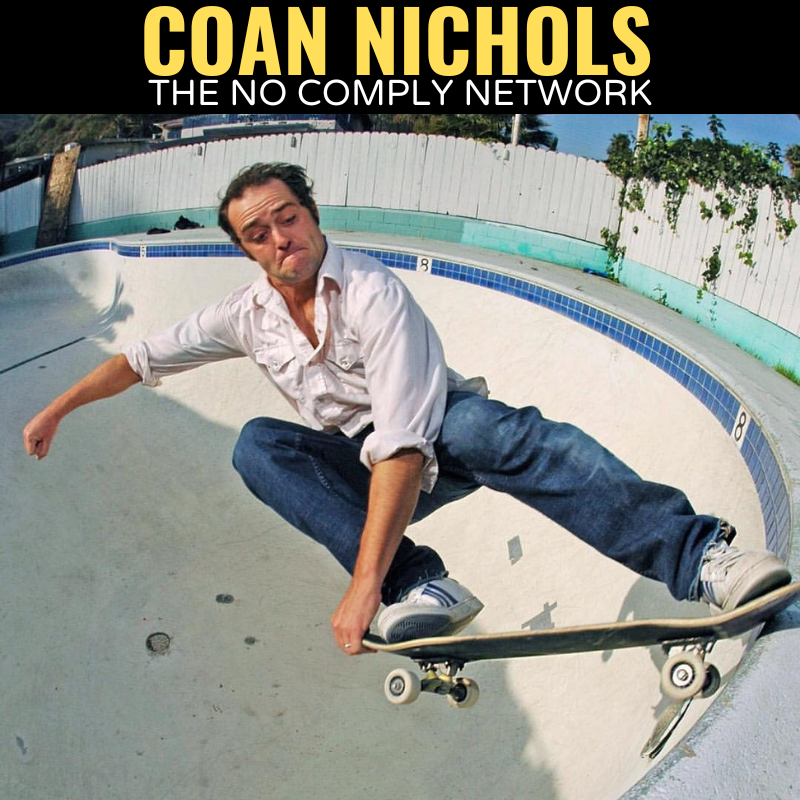
Coan ‘Buddy’ Nichols is a skater and filmmaker, who alongside Rick Charnoski, founded Six Stair productions after creating their breakout backyard pool Super 8 film The Fruit of the Vine, Antihero’s Australian road trip video Tent City and kept it rolling not only to produce a series of other epic flicks for The 18 and Jeff Grosso’s icon-focused Love Letters to Skateboarding show but a series of other well-shot standout must-see skate documentaries.
So after being long-time fans of his work and hitting him up to see if he wanted to join The No Comply Network, we were stoked to hear he was down and keen to have a chat about skateboarding, the library of skate films that he’s created with Rick, and independently and his behind-the-scenes stories that went into putting them all together.
Looking over his filmography, it’s clear Buddy’s seen a lot of gnarly skating go down through his lens, but after we chatted, we realised it’s not just the sick tricks and narratives that he and Rick carved that made their filming and editing stand out. It is their shared passion to skate and document dope things they witness in equal measure that really continues to push them to produce as many high-quality, interesting video projects as they have done.
Hear how he first got into skating and filmmaking, growing up on the east and west coast, hanging out with Jake Phelps as kids, discovering punk, skating ramps, connecting with Rick, making Fruit of the Vine, Six Stair, shooting films for Antihero, Tent City, working with Julien Stranger, John Cardiel, directing Deathbowl to Downtown, Chloë Sevigny, Eli Gesner, producing Jeff Grosso’s Love Letters show, his favourite episodes, his thoughts on skateboarding’s innovations and transitions and how his work has captured that over the years, his mini doc for Trust Records – Intense Energy, and his favourite skaters, styles, videos, filmmakers, photographers and spots of all-time and lots more.
Read Buddy’s interview below to find it all out for yourself.

Buddy: Shot by Geoff Graham
So Coan, is “Buddy” your middle name?
No, my middle name is actually Esbenshade!
Right, so how did you get your nickname Buddy?
When I was in seventh grade, in 1982, everybody in my middle school called me that. I was living in Boston on the East Coast. That’s when about 10 or 15 kids in my middle school got into punk rock and skating, all in the same couple of weeks. We found Minor Threat and skateboarding.
So, at that time, I dyed my hair blonde, and it was a big scandal in my middle school because nobody had dyed their hair. All the kids started calling me Butterhead because my hair was yellow. In Boston, the accent makes “butter” sound like “Butta”, so everybody called me Butter, and then it changed to Buddy. That’s how I got my nickname when I was 12 years old.
That’s sick. So you’re from Boston, and that’s where you started skateboarding?
Basically, yeah, until I was 15. Then I moved to the West Coast with my family to Oregon, to Portland, Oregon. So I got to grow up in two different places because I always went back to Boston because of family and friends. So I continued going back there, but, yeah, it made it. That’s where I started skating and going to punk shows, and all that was in Boston as a kid in the early 80s.
Yeah. It must have been a big transition for you. So you were skating in Boston for a year or two, and then you moved to Portland?
Yeah, three years? I mean, I could skate ramps and do Frontside Airs and Backside Airs and shit.
So by the time I moved, I was kind of established in terms of being able to skate and do Bonelesses on banks, I had enough chops where I could go to the skate shop and find the kids, and everybody would be stoked because, they would be like oh, there’s one more guy that can actually do a couple little tricks, you know what I mean? A real skater, in other words.
You could hold your own. You could do some tricks.
Yeah, and at that time, in the mid-80s, it was as if someone moved to town who was a great skater, someone who thought about it and did it every day; that was a big bonus to the scene, and it definitely made the transition way easier. It only took me a few months to find the crew when I moved, so that was cool. I always liked that.
Sick. That’s really good, and you got to experience both coasts in the ’80s. But before I ask you about what that was like, what was it that first inspired you to pick up a skateboard? Was it through punk music?
Well, my brother had been into it, and so we always had boards. I would go to the skate parks in the late 70s with my brother when I was 7-9 years old.
So I had carved skate park bowls and gone down snake runs, and stuff like that, and then kind of put it away for a couple of years. Then, when this thing swept through my middle school, it really did like a wildfire. It came through, and it was just like, whoa, all the coolest kids are getting into this thing.
So I was like, oh, I got a board. I already had a board, and most of those kids who were getting into it didn’t have boards.
So I was like, Oh, I show up to school with a board already, and I got in!
My brother had already been getting me into new wave music or some form of punk, like the Clash and stuff like that. So I was already kind of into edgier music as a kid, so it fit. I fit right in.
Then, a few months later, most of the kids had dropped it because you got made fun of everywhere, and kids tried to beat you up or whatever. So the kids that weren’t really into it were like, Oh, I’m out! This sucks! It comes with the whole cultural baggage. You can’t just like the music. You’ve got to be an outsider. You’ve got to be a weirdo, and I like that part of it. That was one of the main things that attracted me to being a skater, being into different music and stuff, was because I wanted to be an outsider. I wanted people to think of me as different, so that wasn’t a problem for me. It was a benefit. It was an added bonus, I was like Oh, cool, I’m different now. I’m not seen as part of the mainstream scene. So I was attracted right away and wanted to be set apart from everybody.
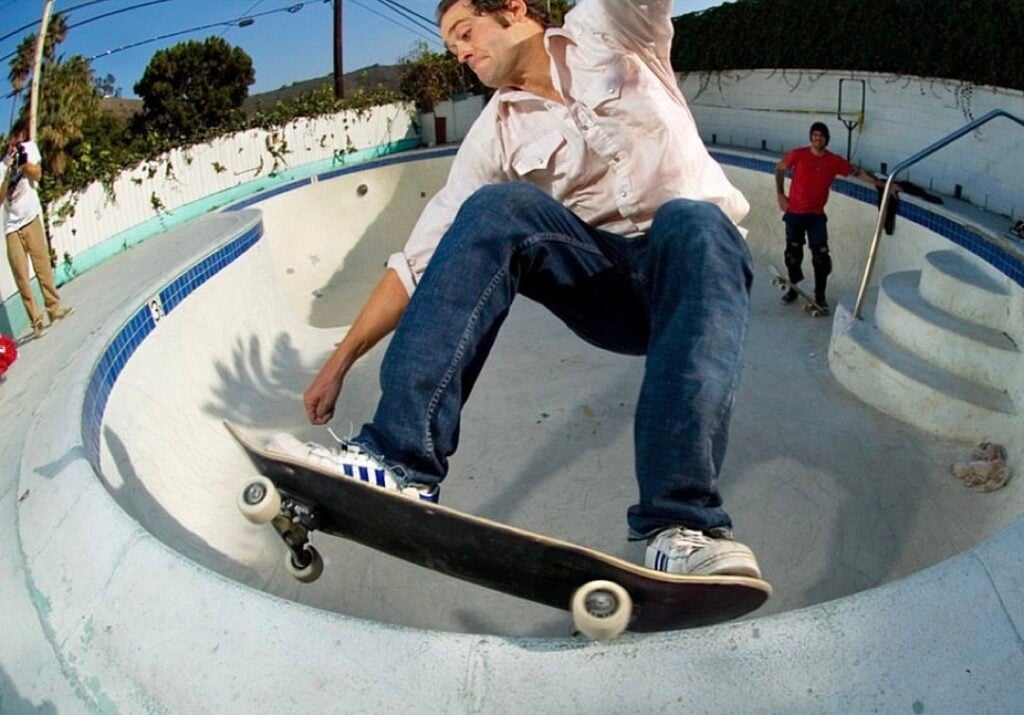
Buddy, Frontside 5-0: Shot by Geoff Graham
For sure. So what videos were you watching at the time?
Well, I mean, we had a couple of skate shops in Boston. Boston had a decent skate lineage. There always had from the 70s, been skaters there, and they were still there, some of them, and that’s where Jake Phelps lived, when I was a little kid.
So, we would see Phelps around, and he was sort of what we thought of as the prototypical, oh, that’s what a skate punk is – you gotta look like that guy, because he had weird hair and he wore Dickies and dressed in a very specific way, and we were like, oh, that’s what it is! We just sort of copied. We would just look from afar at guys like Phelps and be like, that’s what you got to do to be a skater, you just look like that?
So we were just little copycats, little posers until we were actually legit. We just faked it until we became it.
For a lot of people Jake was the epitome of skate punk attitude
I know and it’s funny, when I think back to being a little kid, he wasn’t in a band. He wasn’t the best skater or anything at the time. There were others, Fred Smith…there were guys that were good skaters, way better than Jake. But for some reason, he was in our minds. We made up our minds that he was the coolest guy, he just looked the coolest. I don’t know what it was about him. He didn’t care. He didn’t seem to give a shit about anything or care what anybody thought. He just seemed confident.
I guess that’s what so many people are attracted to, not just in skating or whatever else, you’re attracted to that confidence, and that’s what we wanted. We were little kids, we wanted to be like badasses and fight with people about it, because Boston was such a violent culture.
We would see Jake fighting jocks with his friends, and that, to us – skating, fighting and going to punk shows, those were the ultimate things that you could do. Fight not just to start fights but to respond when other people started fights. We were never about starting fights but in Boston, and I don’t know how it is now, but in the 80s it was like that.
You never walked away from a fight. We would fight grown men when we were 14. Like it wasn’t weird for grown men to fight little kids. I don’t know, that seems crazy to me now, but I distinctly remember my friend Davey getting his nose broken by a 30-year-old man when we were 14!
Where in Boston was this?
Well, we grew up in a town called Brookline, which is a smaller town inside Boston. The city had grown around it, but it was its own town, so we were lucky. We had really good schools and stuff like that, but we were closer than most people in Boston to downtown. It’s trippy how that town’s set up, so we were always in town. There were places where the punkers would all stay together, like Kenmore Square, Harvard Square, or Newbury Street. Since there weren’t phones or modes of communication, you had to go to one place, and that was like skate spots. You’d meet up, and there would be kids there all the time.
There were places to skate in Cambridge, across the river, so we would be in Cambridge a lot, just cruising around. Me and my friends were never attracted to kids that started fights. We only attracted people that finished them, but never started them. That was a thing the skinheads did or like jocks.
As a skater, there were no skaters I ever saw who started fights. I was too busy skating. When people would start with you, it’s like, oh, okay, we’re gonna take it to the limit and finish it off. It was a funny thing. It wasn’t something I remember complaining about too much; it was just sort of like, oh, that’s the way it is. By the time I moved away to Oregon, it was not that way at all. I was very happy not to have to involve myself in that stuff because fighting’s scary. It’s not fun, not for me. It wasn’t something that I ever enjoyed or sought out; I don’t like it. It makes me more upset than anything.
So moving to Portland, how did that impact you and how you saw skating?
At that time, especially in the Northwest, up there by Portland and Seattle, it was much more of a situation where people who moved out there, I think, moved to get away from the East Coast and people being in your business all the time and so it was much more of a “I won’t bother you if you don’t bother me” type of thing, just being here to be left alone and not be up in everybody’s business.
So it was much more like that. I always felt people weren’t as honest, but it could have been just because I was older. Maybe people notice packs of 13-year-old kids running around with skateboards more than they notice 16-year-old kids. It looks more normal, so it’s not like, “Hey, what are these guys doing?” So that also could have just been age too. But I liked both places a lot, and I still do.
Coincidentally, Portland, Oregon, was supposed to be named Boston. But it was a coin toss. The guy from Portland, Maine, and a guy from Boston were trying to name it, and one wanted Boston, the other one wanted Portland. So they flipped a coin, and Portland, Maine won. So they named it after Portland, Maine.
Rad. So alongside skating that you were doing, you were reading Thrasher and Skateboarder?
Yeah, I mean, obviously you would get that stuff, and it was a little more, finding out what was happening with the big-time people because we all had our heroes, like Neil Blender and Christian Hosoi and the standouts.
But a big thing me and my friends were into, was making skate zines. There was a great circuit back then where you could mail away and get trade zines, and pretty much everybody who you sent a zine to would send you one back if they had one.
Like who?
So you even had big guys from the magazines like GSD – Garry Scott Davis. I still have zines that Steve Caballero sent me that I traded with him in 1984 or 1985. I didn’t know him. He traded with anybody, it wasn’t special. Literally anybody that sent him one, he would send one back. Cab’s one was called Skate Punk. So we would trade with people from all over the country. I still have probably 70-80 zines from around the country, and that was why you would try and make your zine better because you were going to send it out and you knew kids in, wherever, fucking Kentucky or Nebraska or somewhere would see it.
Then, when you went on the road, as you got older, you’d run into people, who’re like, hey, I got your zine, we traded zines back in, ’86 and we’d be like, no way! I remember your zine, you guys had a cool scene!
So it was the same as having a website or a blog. It was just that version of having something to talk about your scene. Now everybody has an Instagram page. So it’s sort of manifested from that, making Xerox copies into having an Instagram page. It’s like we knew what everybody was doing once a month, because we would get a zine in the mail.
Yeah, there was a big zine scene in England as well. Are there any other legends who send you their zine?
Todd Swank, who was a photographer who had a board on Skull, had a zine, and GSD – Gary Davis, who wrote for Transworld, also had a zine called Skate Fate. Skate Fate was kind of the biggest of the zines in the States, and so we were super into that dude. Some of my favourites were by Neil Blender, just because he was weird. Lance Mountain, because he was kind of weird. Cab, obviously, because he was into music and art and making zines, and he just seemed cool, and he had a ramp. Not that I ever skated it, but you’d see it and be like Oh, these guys got ramps. They’re just normal fucking people, and we were stoked on guys like Kasai or maybe not Hawk so much, just because that was so unapproachable. Hawk was already, even in the 80s, a superstar. It was like you’ll never meet that dude or know that guy, but there were a lot of other skaters. Jesse Martinez was a big one for us in Portland as kids because he would come up to Oregon. Maybe he knew somebody up there, but he was the first dude I ever saw do a Kickflip, in ’87 or so.
We identified with that Venice Beach vibe. When I was in Oregon, I was growing up with Danny Sargent, who would become a pretty big skater in his own right. He graduated high school a little before me, and through him, we would go and stay with him in San Francisco, and that’s where we met Tommy Guerrero. We would get to meet these fucking superstars in skating, it was pretty cool.
What other skaters from the Venice scene in the 80s stand out to you?
I’m like, dude, there’s Tim Jackson. Scott Oster.
Sick, what was it like seeing skating progress so fast at the time?
Yeah, I mean, it’s funny, I think. So handrails. I think my buddy Adam did a handrail because he saw Danny Sargent do it, who was one of the first people to ever grind a handrail. I think Gonz may have been the first guy to do a Frontside 50-50, but Danny might have been one of the first people to get a sequence in a mag grinding a Frontside 50-50 down a handrail. It was early, and I remember he had been so stoked he got the sequence. I think it was shot by Tobin Yelland, and he sent it to us in the mail, and so we had a sequence of Danny doing a Frontside 50-50, and Julien doing a Frontside Boardslide down the same rail in San Francisco.
So when we saw that, Danny, all the way up to Front 50-50 down a rail, we were just like, oh, man, this is everything. This was maybe 1987 or early-88-Late 87, I want to say. We were just like, okay, so now handrails are like curbs. This is nuts. It’s all different now. Because the Kickflip had come out around the same time. People started doing them kind of regularly. I remember we were like, dude, someday someone’s gonna do a Kickflip to 50-50 down a handrail, and then it’s over!
It was like, these two things are going to get combined. The Kickflip and the grind down a rail, and I remember just thinking, dude, it’s gonna happen!
We debated it, like what’s gonna be the craziest thing that ever happens. But yeah, just opening up that plane, that sort of plane of being able to grind on things that didn’t exist as surfaces for skateboarding. You just think about it when the handrail got opened up to be a normal thing, that’s a whole game changer, like a whole part of the city just became a skate spot that didn’t exist before!
I think Ed Templeton had the first published ad of a handrail 50-50, Gonz had one on video, but who did it first is still a mystery.
It’s happening simultaneously. If one person can do it, it becomes obvious. That’s the thing I love about the brain; it’s the most important part of any sort of physical activity.
Obviously, physical ability is crucial. But the brain, just knowing that something’s possible, is the main barrier, I think, to any progress.
What’s the famous story about a guy running a four-minute mile?
It didn’t happen in all of human history until the 1950s or something, right?
It took that long for somebody to break that barrier, and then two months later, someone beat it. It took 10,000 years for somebody to do it, and then it took two weeks for somebody to do it faster.
What still gets you stoked on skating, creativity or innovation?
The thing that, for me being just an older person, still being psyched on skating so much, what makes me really excited to see, even more than innovation, which is awesome and really cool, to me what is even more interesting and exciting, is different kinds of people that, when I was a kid, were never considered able to join skateboarding, becoming rad skaters, like larger people, who have larger bodies, or queer kids or trans kids.
Not that being those things has anything to do with your ability. But the thing that is cool to me is that when I was a kid, those kinds of people, so many kinds of people, weren’t accepted as athletes, considered athletic, and considered to be skateboarding. We just never thought about those kinds of people. We didn’t think about girls and women skating very much; it was just a dude-based thing.
So what’s so exciting to me is to see different kinds of people finding this thing and applying their own radicalness to it, and being like, I don’t care that I look this way, I don’t care that I don’t fit the mould, because that’s exactly what we were doing. We wanted to be athletic and burn all this energy, the energy that we have, but in a non-conventional way.
I think that, to me, is the most innovative thing: different people getting that same spark and getting interested in this thing. To me, it shows that skateboarding really is that cool thing that it really was. It lives up to its promise as being the refuge for the weirdos and the outcasts, and people that don’t feel like they belong in the team sport or with the coach or the fans watching and weirdo shit like that. That shit to me is weird – team sports and whatnot, going out on your own and getting to the skate park early because you don’t want other people to see you, that to me makes so much more sense, and I love seeing new people get into it. It’s really fucking cool.
Skateboarding is a melting pot of interesting people. So, at what point did filming and making films on skateboarding come into the picture? Was it like you started doing some photography, or did you straight up just pick up a video camera and start filming skateboarding and then thought, like, actually there’s more of a narrative to this, and I want to do something a little bit more?
Well, it’s funny, when I first got interested in films, I was older, maybe 24, because I had finished college, and all the moves I had made up to that point in my life were based around where I could skate more and I still wanted to make those kinds of decisions based on skating, right?
But it was getting kind of sad because my skating ability is fair – I can have fun and have a good time. But it was like, alright, you’re a little old to be chasing this dream. I never wanted to be a pro skater. I never thought I was good enough to be anything like that.
So that never hindered me. I just always wanted to chase the feeling of skating because it felt so good, and I had such a good time doing it with my friends and everything.
So by the time I was in my mid-20s, I was like, man, I need to have another reason to be out here doing this. Because it ain’t just for skating. I moved to Atlanta with my wife, and I met Thomas Taylor, who’s Grant Taylor’s dad, and we became really good friends really quickly, and I was telling him, I want to start filming skating.
He had a skate shop called Stratosphere, and he’s like, dude, I want to make a skate shop video. He’s like, I’m gonna go buy you a camera, and you can start filming, and I was like, hell yeah, that would be so cool!
So he bought a camera, not for me, for the shop. But he’s like, here, you use it, and pretty much the first thing I ever shot was Grant’s dad, Thomas, on his 30th birthday, doing a Frontside 50-50 on the Marta rail in Atlanta, and that was really the first thing I ever filmed. I didn’t know where to stand. He ran into me because I stood at the bottom of the rail, because I thought that would be the cool place to be, not thinking that’s where he was going to come off!
You can see in the video for the company they had at that time called Torque, and you can see he lands, and the camera just goes dark because he runs right into the camera.
But that’s how it started, with Tom, and that’s why I’ve known Grant since he was a little kid.
But yeah, he hooked it up, and Thomas was a cool guy. He had confidence in people; he was just stoked, he was a cool dude.
Right, sounds like you were having a blast there, so why did you leave Atlanta?
So I left Atlanta after only being there for eight months, and I moved to New York and started working in TV, being around real cameras and working in news, and making little videos.
Pretty quick, I reconnected with Rick, who was my partner forever in Six Stair, and once we connected, we were both stoked on making videos, and we were like, let’s make a project together, and that’s when we made our film, Fruit of the Vine.
We combined forces because we wanted to shoot film, and we sort of needed someone to do sound and someone to hold the camera, and we wanted to skate.
We were both super into skating, so we didn’t want to go out on our own and film a skate video because then we could never skate. So it was as if we did it together, then we could hand the camera off to each other. One of us could skate, and one of us would film, and then when one person got tired of filming, we’d be like, hey, you film, and I’ll skate. Don’t get me wrong – We weren’t filming each other. We were just skating in the sessions that we were documenting, and that was one of the main reasons we started filming together, just so that we could skate half the time.
What kinds of news and TV shows did you work on?
Well, here in the States, there are these big news programs, like the evening news, for the national news, world news, World News Tonight, the Today Show, which is the morning show, or Good Morning America, these shows that are national.
I would work on those kinds of shows, sometimes ESPN, doing sports, and I would either be shooting or doing sound, because sound was an easy way to get your foot in the door, since everybody wanted to shoot.
But if you did sound, you could be on the job and get paid almost exactly the same. I didn’t mind; I would shoot on my own, I was shooting plenty of skating, so I thought, I’ll go out and do sound. So, yeah, I would do both whenever they came up, and I was in the unions, just doing any kind of work that would come around. Still filming, so it was good.
So how did you meet Rick? You said you reconnected with him in New York
So Rick Charnoski and I met originally on a skate trip in 1990. At that point, 1990, we were skating vert ramps pretty exclusively, and so in the wintertime, people would travel around the country to skate indoor ramps and we landed in Dallas, Texas, at the same time to skate the same ramp at the Jeff Phillips Skatepark.
So that’s how we originally met, just going there in the winter, because he was from Philly on the east coast, at that time I was living in Oregon, and it’s, like every winter, you’d get out and go somewhere warmer and skate if you could. But we didn’t see each other for probably 5 or 6 years.
Then we both ended up in New York in the mid-90s, and that’s how we reconnected, and separately, we had both gotten into filming stuff for kind of the same reason, in a way. We both wanted to still be out skating all the time, but we needed more of an excuse to be out there doing it.
Would you be shooting more? Would Rick be doing more of the editing? How did it work?
It’s funny, we didn’t focus on one thing over the other. It’s not like the Maysles brothers, where Albert always shot, and David Maysles always did editing and sound. I might have it backwards – but one of them always did one thing, and the other always did the other thing.
But no, we would literally shoot half the time, and then in the edit room, we would just trade off.
We developed the style, so we’d always be working on little short pieces, like little clips. Every film would be made up of a bunch of different clips, and so I’d be working on one, and then we’d switch.
Back in the day, we only had one computer, so one person would be rolling joints, and the other person would be editing, and then we’d pass it back and forth. Then the next, you’d be like, come up and edit for half an hour, and sit back and be like, dude, is that edit right?
Maybe we’d argue once in a while, but we’d settle on something.
When we finally got a bigger studio, we got two computers, so sometimes we would edit separately and come together. We’d merge the two timelines, and it’d be sick, and then we’d work together for a while. Slowly, we would develop it like for Love Letters.
After the first season or so, we would just be like, okay, I’m gonna do this one. You do that one. So we’d have two going at the same time. Rick would be editing. We’d both shoot them together. We’d always be on the interviews together. But it would be like, hey, you do this one, I’ll do this one, so that way we could finish them quicker because there was no reason for us to be working together on one episode, and by then, we had been working together probably 10 years, and we both were equally as good at doing the whole process.
Did you not have anybody else working on those episodes, or was it just you two together?
So it was like we each had an assistant, and we would just trade it. Towards the end, I’d be like, hey, will you finish this? Because you’ll probably catch stuff that I didn’t see, because you haven’t been looking at it, and then he would do the same. I would take his and do the same thing. The process just grew sort of naturally.
That sounds good, that’s a proper partnership.
Yeah. As we got better at it, there was no need to be working next to each other all the time, and then eventually it would be, like oh, I’m going to take this whole project and do this solo, and he’d have another project.
So it just kept going like that, but now we don’t really work together. We don’t have Six Stair anymore. Rick is in Mexico writing a film, and I’m still in L.A. So now, unless there’s a project we would do together because it was based on something we worked on together like, hey, somebody make a Love Letters film or something, we’d probably work on it together. But other than that, we don’t really work on the same projects anymore.
That sounds like a strong dynamic, it’s sick you both had your hands in the pot, and both were kind of cooking it all up. So, going back to Fruit of the Vine, what inspired that project? Was it that you wanted to shoot with film or make something about pools?
It was sort of both. I think we started Fruit of the Vine in late ’98 or early ’99, and at that time, the general vibe in skating was, like oh, skating’s cool again. Everybody doing it is kind of out there. That’s when there were the first kind of tours where people were going around in nice buses, DC and people like that, people had money.
SuperTours. D3s. 900s. On the cusp of that pre-00s blowup.
But we were like, man, skating’s still super underground, and it’s like we’re kind of too old, right? By the time we made Fruit of the Vine, we were already 30, and it’s like, that’s not really our scene, we’re sort of still more about this underground thing and there’s a space that’s wide open, nobody’s talking about this part of skateboarding.
It’s like, why don’t we make a film about this thing that we both really like?
We both really want to go out and skate pools and have an excuse to ride a bunch of pools, because that’s what we’re really into and we thought, how can we combine all these things?
We want to shoot film because it’s weird, and it kind of fits this idea of, like, the backyard. The heyday of America, the American dream, was, in the 60s, and that was the format that people were shooting, the home format was Super 8 film and all these pools are sort of the result of that idea kind of going away in a sense, and so let’s shoot that same nostalgic medium, but show what happened to all these pools, now they’re in these maybe slightly more decrepit neighbourhoods, or, there was a fire or something, and so the house is gone and just use that same medium, showcase empty pools instead of full ones, and so it was sort of that mindset, and that was it.
\
What was the most memorable thing that you learned while making Fruit of the Vine or that you were surprised by after putting it together?
I can tell you something that blew my mind out of that whole process.
When Rick and I were making Fruit of the Vine, it was like, alright, we’re gonna put this on our credit cards. As I said, we were working, so we took a few months off, and I think we spent $45,000, and we’re right at the limit of what we could afford together, just the two of us.
So we put down just over 20 grand each, and we just wanted to make this thing because we thought it was cool – that was the only reason and we were like, yeah, hopefully we’ll make a few hundred, maybe.
This was VHS days, so it’s like, oh, we’ll make a few hundred and put them on VHS and pass them around to our friends and maybe we’ll ask people to pay 50 bucks each for them, so that we can make a little bit of money back and we’ll go on a tour, show it, and maybe we’ll charge 10 bucks to get in or something and make a little bit of money that way but what we were really surprised about was this thing that we thought was super out of it and would have no place in skateboard culture or whatever you want to call it, the skateboard scene, we were totally wrong.
Why do you think that is?
I guess maybe because there wasn’t anything about pool skating or transition skating even at the time. It was like everybody was fiending that stuff, everybody that did that stuff and, that was just a smaller pond than what was happening in all of skating, but everyone in the pond wanted a part of it!
So we would do screenings and 300 people would show up, and we’d make $2500 in a screening!
We ended up selling out of the first run of 5,000 VHS tapes in less than a month or something crazy, and then we had to make another run and then we sold 10,000-15,000 VHS tapes, we were like, holy shit!
Then, maybe three or four months after it came out, the magazine Rolling Stone did an issue on the Jackass dudes. So they had some skate adjacent type stuff and they did a three-quarter page on Fruit of the Vine and then we got a call from Blue Torch TV, which was an action sports TV channel in the States, like, hey, you want to do a trip? Like, that Fruit of the Vine, and, we’ll put it on our channel and we’ll pay you for it?
We were like, holy shit! Like, how’d that happen? So I think that was the thing that we learned about it was how we underestimated what the reaction would be, because we were just seeing what was out there and what was cool, and, we just considered everything else to be uncool.
Even though we thought it was cool, we just didn’t think anybody else would think that too so, yeah, that was a shocker for sure.
We paid off our credit cards in about three months. We couldn’t fucking believe it. We thought it would take us two years, maybe three years to pay it off. But we paid them off pretty fucking quick. We were really surprised but I mean, we went back to doing our regular jobs. We didn’t stop working. We didn’t start doing the films full-time until 2003, and that’s when we moved out here to LA from New York, because we were living in New York all that time.
What was the next project that you went on to make after Fruit of the Vine? Was that when you started Death Bowl?
No, we didn’t start Deathbowl to Downtown until 2007 and that came out in 2009. We did Tent City before, that came out in 2004.
But we also did another Super 8 film shortly after Fruit of the Vine, released in 2002. It was called Northwest.
With Northwest, we were able to get a little bit of money upfront, based on Fruit of the Vine. Not much, but maybe 10 grand. We had gotten some funding from Adidas and a couple of other companies, so maybe altogether we had 10 grand, and it was a smaller project.
We ended up probably putting up maybe 15 grand of our own money into that one, and it didn’t sell as much as Fruit of the Vine, but it was super fun.
That one was about our buddies, Monk and Red, and those guys building skater-built skate parks in the northwest of the U.S.
Like I said, we had a couple of projects with the Action Sports TV channel and then in 2003, we got this job working with Tylenol, which is the aspirin, pain reliever company. They started an ad campaign of, like, hey, get radical, and if you get hurt, take aspirin, fuck it! Trying to change the idea of pain relief from being old and crusty to being young and active and using a pain reliever to help your active lifestyle. You know what I mean?
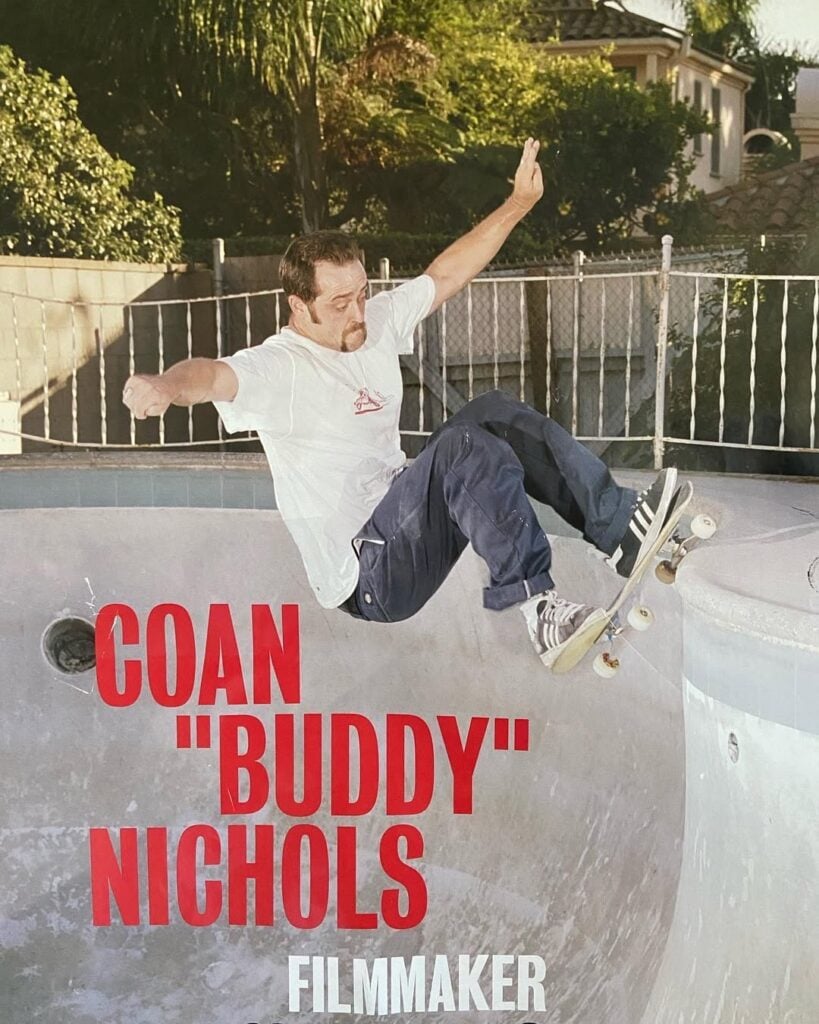
Buddy, Slash Grind: Shot by Tobin Yelland
The film was called 9 Lives. Tony Trujillo was the skater. Joel Tudor was the surfer. There was a snowboarder, Travis Rice. Tobin Yelland was the photographer in it.
So it was all cool people we were stoked on, and we were getting paid just to be ourselves, and we were getting paid to make the film projects for it, so that’s why we had the money to move out to California.
While we were doing that, we met Julien Stranger through Peter Hewitt, and he proposed that we go to Australia for a month and make a film, sort of like Fruit of the Vine.
He really liked Fruit of the Vine, and he was like, we want to do something on film with talking, storytelling, something different to a regular skate video, and we’re like, hell, yeah!
Same thing happened with the band Pearl Jam. They approached us to make a road film with them, which we did, it was called – Vote for Change? 2004. So, between 2003-2004, we did a few pretty big projects.
Tent City. Same thing. It was like Fruit of the Vine in the sense that the guys at Deluxe didn’t expect it to be an art project, and I don’t think they really expected much out of it and didn’t put much money into it.
I think we fronted all the film for Tent City, and they were like, oh, you get it back on the backend, which was fair enough. They were going to sell DVDs, and I don’t even know if they made a VHS. Yeah, they just made DVDs of it, and we were like, yeah, that makes sense. You guys will sell a lot of DVDs because Antihero is a big company, so we’re like, okay, that’s cool. Same thing. They sold a lot more of those Tent City DVDs than they anticipated. So that worked out pretty well.
What was that experience like making Tent City? Had you been to Australia before?
Yeah, we’d never been to Australia, and we’d never really made a film for another company. That was our first time fitting our style into someone else’s style, because obviously Antihero has such a defined sort of trip. They present themselves in a way that’s so rad, and it was the one company that we thought, dude, this is the dream, if we were ever going to make a video for a skate company. We couldn’t even imagine it would be with these guys.
Both Rick and I were just like this is the top. If you asked us, hey, what skate company would you want to make a skate video for? Antihero would be one of the only ones that we would have said.
So when that happened, we were just so fucking stoked, hanging out with the guys. They’re so legendary at that point. Obviously, we knew Trujillo a little bit through the Tylenol thing, we knew Peter Hewitt just from around the way because we skated with him, but all the other guys we didn’t really know.
We didn’t know Julien, Frank Gerwer. We knew Steve Bailey, who came on the trip, but we didn’t really know John Cardiel or many of the other guys. So it was really fucking cool to go on a trip and meet all these people and every day have so much source material. With all the skaters, it was just nonstop, so we were like wow! All we had to do was point the camera!
Really, it was one of the easiest things in the world because all you had to do was not fuck up.
When we go on a trip or start a film, we’d have such a clear idea of what we wanted to do. We’d always say, oh, the film’s already done. We just gotta make it and it’s a wrap. We got all the people here, we got all the cameras, we know what we gotta do. All we gotta do is do it!
Was there a trick you filmed on that trip that still stands out to you?
I mean, anything in that big pipe thing was so incredible because that was the biggest thing I’d ever seen, actually skated. To this day, I have never seen anything that big. I’m not sure if we conveyed the size of it, but I would say, if it was a half-pipe, that full-pipe would have been 17-foot transitions.
It was massive, it was like 32-34ft tall. So when Pete’s up there, Trujillo or Cardiel, they’re basically going over vert. They’re probably like 17-18ft up that thing.
You couldn’t run out. You can run down a vert ramp if you just want to jump out and don’t want a knee slide, you can run out. But in that pipe, it’s like jumping off your board on a downhill when you got too much speed and you can’t run out. You would take a couple of steps and then you would slam, or whatever.
That was huge and being around Cardiel at that time and Trujillo…they would get each other going, and being around those two was just like magic. It was really fucking cool to see those guys and Matt Rodriguez – dude was like a magician. Steve Bailey too, just the way he skates is so cool. Really great crew.
So you were just following them spontaneously and capturing what was happening at the time?
Those guys had been there before, Julien and Cardiel, those guys are seasoned travellers.
Even at that point, they had been around the world several times. They knew what was where and what was rad, so somebody had a plan. I certainly didn’t. I didn’t know anything about anything. I was just shooting, same with Rick. We were both just like, yeah, whatever happens today, we’re ready. We didn’t ask too many questions, looked at the map once in a while, and sometimes, they called everybody together and were like, hey do we want to go this way or that way. I think there were only two or three demos.
So, the idea mostly was to come out of it with a documentary that said, skating’s important. But, Julien says it right at the intro. It’s like, skating is really important. But if you don’t combine skating with these other things – going on the road, meeting new people, going to new places, understanding the world around you, then you kind of failed at being a skateboarder.
Why do you think that?
Because a skateboarder is someone who uses a skateboard to be this kind of person. Right? Someone who skates, goes to their local skate park and doesn’t do anything else, and they skate, and they’re rad, and that’s cool. But a skateboarder is just someone who uses the skateboard as a tool to have a larger life, dedicated to the pursuit of learning about the world and being a different person, the kind of person that’s open to new experiences and meeting new people and going to new places and being an explorer.
Right
That was the sort of point. If Julien gave us any direction, that was the direction. He was like dude I want people to watch this and come away with the idea that this is what it means to us. This is what we think of in terms of Antihero, and this is the message we want skaters to take away from this film: that skating is not just about tricks. It’s about getting on a plane, getting in a car, travelling with your friends, meeting new people, and so on.
So it was on this trip Cardiel had his infamous accident. What was the mood like after that and how were you processing that when you were editing the video?
Yeah, I mean, we were definitely processing it, and those dudes, the reason that people don’t know much about that situation is because Julien and John and those guys are pretty private, and so is Antihero in general.
Those guys don’t talk about their stuff, and so I don’t talk about their shit either, and Rick doesn’t either. When you work with those guys and go along with them, that’s sort of part of their deal. That’s our deal. So I just maintain, where any of that stuff, if people want to know, they can ask John or try and get it out of Julien if they want, but it’s like I ain’t gonna be the one talking about that kind of stuff, because they don’t really talk about it, so I certainly ain’t gonna fucking talk about.
I get what you mean, what I’m trying to say is that you made this epic film, with a poignant moment in his career and skating. How did that affect the final film?
Yeah, no, I mean, the whole film was informed by that absolutely, and the idea of not addressing it in the film was 100% intentional, you know what I mean? It was as I said, those guys are very private. They’re not putting their shit on blast; they don’t talk about their personal lives. So it was like Julien and John were just like, no, man, that wasn’t what the trip was about; the trip was about this, and this thing just happened. But yeah, I mean, we thought about it every day and thought about John every day, and the whole thing was trying to be, in a lot of ways, a tribute to his radicalness and his ideas and all their ideas on skateboarding.
Yeah, definitely. It comes through, it’s an inspiring film to watch. So you had made Fruit of the Vine, you’d produced Tent City. How did you end up meeting Chloë Sevigny to get her to narrate Deathbowl to Downtown. That film was really ahead of its time.
Yeah, that came out of trying to tell the history of skating from another perspective, from a more outsider perspective, like kids growing up in the city, maybe non-white suburban kids, that sort of get most of the credit for the history of skating, you know what I mean…and just put it on its ear a little bit, so that was our interest at that time too.
This is before Love Letters, but it was putting a thumb in the eye of convention, like people who would say, this is the way skateboarding was and we were saying well, that’s the way skateboarding was to people in California, but it’s not the way skateboarding was to people in England, or New York, Oregon, or Boston, like all of us, it’s like we made it ourselves, and to show the contributions of kids in New York that never got near a surfboard. It’s just as valid as anybody else’s experience. So that’s where that came from.
Was there anything that was special about producing that film for you?
I mean, I think learning how to put together a long-form archival piece, because we were beating our heads against the wall forever, trying to make that make sense, and make the case that New York City was as important as Venice Beach or whatever place you choose, because it has always been, probably not for current skaters, but for our older generation, New York had been seen as sort of a backwater.
New York was not seen as making an important contribution to skating, and I was like, well, that’s not true. Skateboarding didn’t spread to the rest of the country because of blonde-haired surfer kids in California. It didn’t become a thing for everybody all over the country until you got kids into street skating.
Yeah, for sure. Street skating, democratised skating, where it was like, you don’t need to have a backyard ramp. You don’t need to go to a skate park or have one near to you.
Exactly.
So, in between work for Antihero and Deathbowl you and Rick started Six Stair. What projects were you making and what led to you becoming the production company behind Grosso’s Love Letters to skateboarding show?
Honestly, I think we had a year where we were pretty slim. We only did a couple of little projects. I know we did a couple of things for TV. We did a thing called Route 66, where we travelled around with a crew and made a little half-hour film for Fuel TV.
We did a couple of music things for that same channel, Fuel TV, and smaller projects that are still super rad.
It was cool because there were a couple of guys at Vans when they were starting up something. They were stoked. They were super stoked on Grosso, and they had done something small with Grosso where they interviewed him.
They were like, hey, this guy is actually funny on camera and he can talk really well. These guys had seen Death Bowl and thought, whoa, these guys have got something different. What if we put these guys together with Jeff Grosso? It was just super random. We didn’t ask. We didn’t know Grosso, and it was just a full blind date. They were like, hey, you guys, go meet up with Grosso and see if you can get him to do something because we’ve asked him, and he said no. So we did. We met up with him, and he’s like, oh, I really like Tent City, I think he watched Deathbowl to Downtown when they told him to meet with us. He had done some homework, and he was like, I want to do a show, but more like a skate history thing. We were like, hell yeah, that sounds super cool. Vans had pitched to him a talk show, like Nine Club?
Yeah, yeah.
But he was just like, nah, I don’t want to do that. That sounds kind of lame, but let’s try to do something else. We had done this thing with Lance Mountain, a show called Firsthand, where it was a look back on some pro skater’s career or whatever that was going on this TV channel. Lance was writing letters to his heroes, his childhood skate heroes, and Lance wanted it to be like, hey, let’s make a show based on me writing letters to my childhood heroes from the 70s, and I’ll get the letters back, and we’ll go interview the people. That takes super long, right? He was actually writing letters and sending them in the mail and waiting for a reply. So it didn’t really work out. We just ended up doing a conventional look back at Lance’s career type of thing.
Right.
But it was always an idea that Lance liked – the Love Letters that he was writing to these people.
So when we talked with Grosso, we said, hey, that’s a good idea. But Lance Mountain wanted to do that same thing. So we kind of had a powwow. We were like, let’s all meet with Lance and see if we could do it, and see if he minded. Lance was like, yeah, I’ll never do it. I’m too much of a weirdo. I can’t wrap my brain around it. So you guys should do it. We said, okay, and we’re gonna call it Love Letters. Is that alright? He’s like, yeah, it’s cool. So that’s how we ended up doing it.
What was your favourite thing about working with Grosso to create the Love Letters show?
I think the main thing was that he was funny. Grosso was super funny and he had his irreverent sort of style. I think the thing that Grosso liked about working with us so much was that, left to his own devices, especially early on, he wasn’t polished in the way that he was towards the end. He got way better at it, and so did we. We all did.
When I say that, Grosso would say a lot of things. We would interview him for an hour and a half and cut it into four minutes. We cut out all the nonsense, and he was so psyched on that. It made him listen to what people responded to, and he’d be like, oh, yeah, okay. People liked him having an opinion.
Even if it was wrong, they just like someone saying shit with conviction and he would admit that he was wrong. He wasn’t afraid to go, yeah, I’m an idiot, I don’t know what I’m talking about and it was cool to see him be so open.
We’d call him sometimes, like, hey, we got this thing in the edit. But it kind of makes you look like an idiot. He’s like it’s alright. I don’t care!
Or we’d even say, hey, you say something in this. I think it makes you sound like an asshole, did you really mean it? Then he’d be like, yeah, man, I meant it. I hate that dude, or whatever, he’d be like, I don’t care what anybody thinks.
Do you think that’s true or do you think he was just hiding it?
Like, he really didn’t but I mean, in some ways he did. He cared deeply about what people thought, but not. He didn’t care so much what people thought; he was not gonna hide what he thought. But he absolutely did care what people thought about what he said. Like, he would get criticised, and sometimes he would be upset for days, but it didn’t stop him. I don’t know. That’s a funny contradiction. Like, he wanted people to like him and not think he was an asshole. But then he would turn around and be an asshole.
No one is ever always going to say things that everybody agrees with
Yeah. Well, I think it’s also important that to understand the Love Letters and to understand Grosso, you really have to understand Craig Stecyk, Mofo, Kevin Thatcher, and these people who breathed life into the inanimate object.
The skateboard isn’t any cooler than a BMX bike, a pogo stick, a hula hoop, or a jump rope from some people’s perspective, it’s the same exact thing. Right, and it’s, like well, okay, if that’s true, why is skateboarding cool?
Skateboarding is cool because Craig Stecyk said it was cool, and he articulated the reasons why it was cool, because kids on their skateboards are part of the street culture.
What is street culture? Low rider cars, graffiti, gang bangers, and all this stuff. Stecyk knew that inherently; he just saw it. Why are they part of that stuff… Because skaters are out on the street all day, they’re just a part of the fabric of what’s happening on the street, and Stecyk was writing articles like that in 1976. He created this mythology, and that was one of our taglines: Love Letters is the mythology of skateboarding. Grosso and all of us were really intent on maintaining that mythology because that’s the kind of thing that, whether you are good at skating or bad at skating, you can still buy into the mythology, the idea of what it means to be a skateboarder, not just to ride a skateboard.
There’s nothing wrong with someone who just decides to ride a skateboard and doesn’t want to be a part of skate culture; that’s fine. They’re totally open and able to do that. But the people who take on the mythology, the ethos, whatever you want to call it, buy in, and that’s what Love Letters was about. If you’re into this part of it, if you’re into this lifestyle of skateboarding, here’s where it comes from.
Here’s why skateboarding is like this, here’s why you have to do a trick a certain way. Nobody argues in ballet when they say you have to be all the way up on your toes to make it a real en pointe move; that’s just the way it is because that’s the way it’s supposed to be done. It’s the same thing with skating. You can do it another way or even like it that other way, but it doesn’t make it right. There’s still a certain way you have to do things because the people who created these things wanted them to be done this way, and they were cool.
But that’s the way it’s going to be cool, until someone comes along who’s just cooler and does it a different way and you’re like, oh, my God, they’re so cool that it’s now it’s cool to do it that way.
Yeah, that style and influence and the way that people can approach things, it shows skaters how they can redefine it and create new things.
Absolutely. The idea is that it’s so much better to break the rules when you know what the rules are. If you’re just coming into something and doing it your own way, it’s fun, obviously, but if you know why it’s wrong to do it the way you’re doing it, then that feels even better.
I always use the analogy of me and my friends. We would say at the start that we invented the Boneless when we were 13 years old. Boneless had been around already for over a year. But to us, we invented it because we never saw it done, and we thought we were the first ones to ever grab your board around with your Frontside Air hand, take your foot off, and whatever. That’s the beauty of skating. Every kid that comes into it, you see it with women, different groups of kids, kids in other countries, queer kids, whoever, they come in and say, nah, skateboarding isn’t all that. It’s this!
The only connection they have for doing that goes back all the way to Stecyk. Someone like Stecyk laid the template. Yes, the reason you’re connected to skateboarding, even though you say you’re the opposite, is because you’re an outsider and you got into this thing that accepts outsiders, and that’s the template that was laid down.
You’re being so weird and different, but actually, skateboarding has maintained itself waiting for you to join, it’s been there and been cradled and coddled and kept the light on for you, like, so that you come and say that you invented it. That’s the beauty of it.
What was your favourite Love Letters episode?
I think the Freaks and Geeks episode was sort of one of the first ones where we were laying it down that it’s not about a trick. It’s more about the experience. I really liked that one. That was fun to do. I liked the series we did, maybe four of them, called Rant and Rave, where Grosso goes off or gets angry about stuff. I thought those were funny.
Rick did a lot of the editing on those, and Rick’s funny. He’s a really funny editor. He’s got great comic timing, and so those were really cool, and so I really liked his approach to a lot of that stuff.
I liked the last one, the LGBTQ episode. I call it Queer Skaters because it’s easier to say, and that’s what all those kids said. But I really liked that one a lot because to me, that was one where I saw Grosso’s brain sort of break, where he’s like, oh shit, he totally had this realisation. He put it together, what I just said to you about the light of skating being here exactly for these kinds of kids to get into it, and far from being offended when a kid from that scene rejects skateboarding that came before them and says, oh, we’re recreating it, and smash this, and whatever else. It’s like, no, I’m not offended. That’s the point. That’s why we’ve all kept it going, and that’s the exciting part about it. Grosso really embraced that in that episode. He went from being kind of skeptical, being like, I don’t know man, I feel weird because I think these kids are gonna think I’m a phony for doing this.
Why do you think that was?
I think he felt like that, not because he didn’t want to do it or because he didn’t like it. He loved it, but he thought, oh, I’m gonna look like an idiot because I’m not that.
So that’s one of the reasons he doesn’t really talk in that episode; he just sort of sits there and listens to what those kids are saying because he didn’t know what to say. He was really stoked at the end when it was done. We finished it right before he passed away, and he was just really psyched on it. So that one, to me, always feels good, just because of the timing of it when it came out and whatnot.
I really liked the Love Letters to Skateboarding Japan episode. What was it like travelling around the world and making the show?
I love those, too. I’m glad you mentioned them. I just got sucked into the Japanese episode a couple of weeks ago, and I was like, Jesus Christ. This one is so fucking in-depth. I don’t expect anybody to watch those start to finish. You know what I mean? We never did.
We’re just like, it’s all here as an encyclopedia. If anybody ever wondered what happened in skateboarding in Japan in 1988, here you go. It’s there. You don’t have to watch the whole thing. But we were just like, we have to get these documents down because Rick and I, one of the things we always noticed in our career, making skate stuff, was that we were really just most of the time making films that nobody else was making.
It wasn’t like we ever had any real competition. Now, it’s funny you say that about Love Letters; there’s tons of stuff like that, but when we started, there was nobody doing that, and not because we’re some geniuses or whatever. It’s just people didn’t. It takes a lot of time and money, and we were just lucky that we were getting funded by Vans. Who else would have money to make that? It doesn’t make sense. Those things were gnarly.
How long would an individual episode take to make, because I remember them coming out nearly every week at one point?
Yeah, every couple of weeks they would come out. We would make eight of them at a time; that’s the deal we made with Vans. It’s like, hey, you have to give us eight to ten of these at a time, just to make it somewhat worthwhile, because they were so gnarly to do.
So they did, and we would get four of them done before we would put any of them out. So doing four of them would usually take us about four months. A month each.
Some less though. We always throw in one or two simple ones so that we can do them. So we could spend more time on other gnarlier ones. Yeah, especially in the last season, where we did the Japanese one and the Brazilian one. Yeah, we did all those in one season. We did Japan, France, Brazil, Canada, all at one time, and if Grosso hadn’t passed, we would have done England, Spain and Australia. We had a bunch to do. So it sucks we didn’t get to do them, because those were fun. A lot of work, but fun.
Was there much back and forth between you and Vans? Were they just basically giving you the go-ahead, and then you would just go out and shoot them and then send it over to see if they were happy with it?
Yeah. It was just legal stuff. I remember one episode where Grosso really wanted to go after somebody, Rob Dyrdek or something. Not after him, but just something that he said about him.
In what way?
It was in an interview, he wanted to use it to make fun of him, and Vans would be like, no, no. How about we don’t make fun of people, let’s keep it positive…So it wasn’t so much that they were telling us what to do. It was more like, Why do you guys want to make fun of people?
We would be like Okay, that’s fair, whatever. So you could tell this wasn’t coming from the CEO. This was just coming from somebody above us, who worked on the skate side, just like, hey, let’s keep it chill.
Yeah, I get that.
That was the only time they would give us any direction. That wasn’t even like a hard or fast rule like you have to do this. It was like, think about it, don’t make it too negative.
That’s the only thing I remember, that and maybe once or twice be like, hey, you can’t use the Olympics and sometimes we’d have to go through a legal review or whatever.
What’s your lasting memory of working with Grosso and knowing him?
I mean, you can imagine. Just hearing about him passing away, it was in the middle of all the madness, Covid, the pandemic. So it’s already, like, oh, man, we can’t work.
We were supposed to go on a big trip, and so when anybody passed away, somebody that you’re that close to, it was immediately such a bummer, with all the what-ifs.
But I mean, in terms of favourite things about Grosso, whenever you’re lucky enough to be around people that inspire you to be a more authentic version of yourself, because we all have ourselves, and then there’s the other public self, but when someone inspires you to be yourself, be the self that you’re comfortable with and that you can go to sleep easiest knowing that you were acting like. I mean you weren’t expending all this energy to be a different version, a faker version of yourself, because that takes so much energy. You have to be every minute of every day. You have to keep up that persona, that false part of yourself. It’s hard, and so definitely, Grosso was inspiring in the sense of, just being who you are, and if people don’t like it, that’s alright, because somebody else might like it, and you don’t need to have a million people think you’re cool.
Because what is the main thing that’s attractive? Like I said at the beginning, when we started talking when I was a little kid, what attracted me the most in skating was Jake Phelps. He wasn’t the best skater, wasn’t the coolest dude, but he had a confidence that was like, I want to be that confident. I want to feel the way it looks like that guy’s feeling right now, comfortable and just doing my own thing and not giving a fuck what other people think? So I definitely got that from Grosso a lot, that he was being himself. So, I don’t know.
Have you worked with Rick much since Love Letters?
I think right before Grosso passed, we worked on the movie Warm Blood that Rick wrote?
We travelled around with that; it was mostly Rick’s thing, but we did it together and produced it together, which was really rad.
Since then, we haven’t done any big mega projects. A bunch of music video stuff, work-for-hire type stuff. Every year, I work with the Skateboarding Hall of Fame and make all the inductee videos, which is super fun. It’s a fun history thing that totally grows out of Grosso’s love for skating. I would never do those if I didn’t work with Grosso and make all the Love Letters because that was something he was so into, was the hall of fame stuff.
For sure, it’s always interesting to think of the skaters and tricks they’ve done that have inspired you the most. So on that note, who’s your favourite skater of all time and why?
If it’s easier, I mean, it’s funny because I’ve learned about stuff through making skate films that I never had any idea about, like skaters from the 70s or just really interesting people. But I would say by far, my favourite person who has impacted skateboarding the most is, hands down, Craig Stecyk and he barely ever skated.
But if you know Craig’s backstory or even just what he did in skating, he really is the one responsible for laying out the template for skateboarding not being a sport, for skateboarding being a lifestyle. That was his idea. That didn’t happen by accident. This idea that skateboarding has remained cool for 50+ years. That did it. That’s not a mistake. That came from somewhere. That came from a guy named Craig Stecyk. He said, this is what skateboarding is. This is what it means to be a skateboarder. It’s a political statement. It’s not just a thing. It’s a fish swimming upstream. It’s a fuck you to society. It’s a political statement. It’s skating a set of stairs and the cops are coming and chasing you and you’re coming back the next day. It’s your responsibility, and he was saying that in 1976.
If you read that article in the second issue of Skateboarder magazine called Aspects of the Downhill Slide, and he uses a pen name, he writes as Carlos Izan – That’s his pen name.
But if you look up that article and you read it, you’ll be like, holy shit. Someone could have written this last week, and it would be the same. It sounds like a manifesto that somebody would write at any time.
But then he goes and he creates the Z-Boys. He creates the Bones Brigade. He was a big dude at Thrasher Magazine, he’s the guy who wrote the trash section of Thrasher. That’s him. All the gossip shit, all the funny, weird things through the 80s and into the 90s, and he still probably contributes today. He’s 75 or so. He’s the original skate artist, I mean, all these things. There are a million people that are the reason skateboarding is cool, but he is at the genesis if you had to go to the head of the pin, and every other skater is cool because of him, in my opinion.
He’s one of the first guys to spray graffiti around Los Angeles. I mean, the guy’s so fucking deep, it’s insane. He came up with the term Dogtown in a cross. These are things that people take for granted and think always existed. But so many of them go back to the same person, and they’re still cool.
What’s insane is that what he was doing back then was so cool that 50 years later it’s still cool. People try to cancel them. I saw that dude Kyle Beachy one time wrote an article trying to cancel Craig Stecyk. Get out of here, dude. You have no idea what you’re talking about. I got his phone number and called him, and told him he was a complete fucking chode.
Agreed. So, who have been your favourite skaters from the 80s to now?
Say if I just had to throw out my Mount Rushmore of skateboarding it would be Neil Blender, Mark Gonzales, Sean Sheffey and Cardiel.
Mike Carroll and other skaters like him that showcase skateboarding to me, in the best, most stylish way, or epitomise what it means to be a skater, people like Julien Stranger and Peter Hewitt.
But also, Red, the guy that started Burnside, who I grew up with, people like that and then for more modern skaters Rowan Zorilla and I really like Elijah Berle.
I really like people that are around me too. Grant Taylor, obviously, is top five of all-time to me, and Grant’s dad, Thomas, was a fucking amazing skater. He was an incredible skater and super fun to skate with, but, yeah, I mean, it’s all over the place. There’s so many skaters that I’m into.
Right. What’s your favourite skate video of all-time?
I’m gonna have to say Fucktards, all those early Antihero videos were just so raw, and they made me really look at skating differently. Even though it happened before, with the H-Street videos, Shackle Me Not and others. But the reason I thought Fucktards was cool was because it was literally all the guys skating, filming each other. There wasn’t a main filmer, it was just Julien filming Frank and Frank filming Pete and Pete filming Trujillo or whoever was there, they were just on their own, an insular crew, and they didn’t even need a filmer, they didn’t want a filmer around, so it was just their trip.So I would say, if I had to pick one, to me, that would be the main one in terms of influencing me and my brain.
Who’s your favourite skate photographer?
God, that’s such a tough one because there are people that I really like. I mean, Fred Mortagne – French Fred, is a great photographer, even though he’s a video guy. I really like his photography.
Mike O’Meally, who’s a really good friend. I always really liked his photography with his landscapes, he always had so much information in it, and to me, he embodied what he tried to capture so often. I think he was not the first, but one of the guys that really worked hard at it before a lot of other people, capturing that scene of what it means to be a skateboarder out in the environment, in the natural environment. I think O’Meally always did a really good job. I don’t know if O’Meally gets enough credit. I really think he’s one of the best skate photographers, for real.
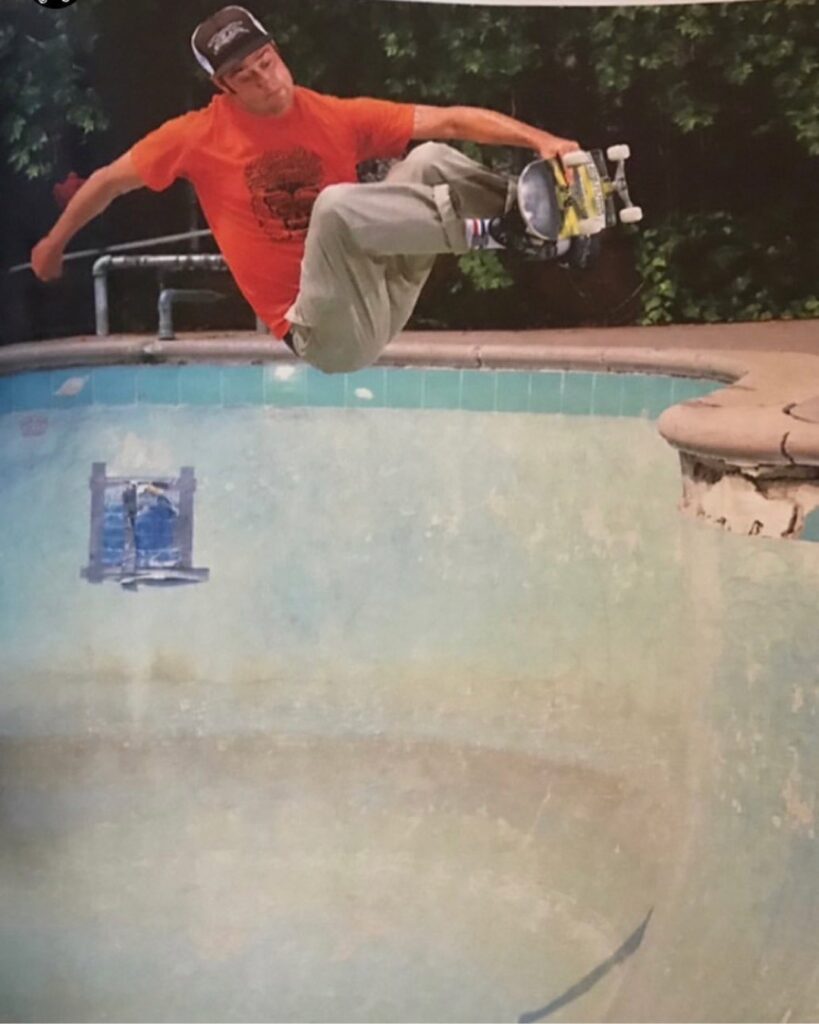
Buddy, Frontside Air: Shot by Mike O’Meally
I’d love for him to do a book, and I know he’s talked about it and thought about it. Because I think his work is great. There are so many great skate photographers. Mofo, Kevin Thatcher, I mean, there are so many good ones there, even going back to the 70s.
Who’s your favourite skate filmmaker?
In terms of putting together videos that are really interesting and bring out the artistic side and which I think have been copied so much and had such a huge impact. I think Greg Hunt is definitely up there.
I think, still, to this day, he’s trying to do original cool stuff, like the projects he does with Dill. Like that thing where he put out a video with all those photos and xeroxed photos. He spent so much time making things look cool, and I know people make fun of that sometimes now, but it goes back to that idea of what skateboarding is, when you watch a skate video, if a filmmaker is trying to sort of tickle other parts of your brain besides the jock part, I think there’s two.
It’s always been there. That genre of skating that wants to focus on the jock progression and all that, which is awesome. But I think that’s only a third of it and maybe not even the most important part. I mean, people have different opinions about what it is. But anyway, going back, I think Greg has always walked a really good line of showcasing artistic elements and great filming.
Jon Miner is actually up there too for favourite skate filmmakers, for sure. I think Miner’s always done an insane job making videos that I can’t fathom ever doing the stuff that he’s filming and I feel it.
I love Beagle too, man. I think those Baker videos showcase so much of what it means to be a skater and part of a skate crew. Those are just three of ten people I could mention. In their own unique ways, Miner is great for being such a fantastic follow filmer and really putting people right in the action.
Then Beagle for such an old school idea of the crew and the hijinks, and Hunt for elevating the artistic and technical parts of a video. You can go on and on. Skate filmmaking is awesome. There are so many good filmers.
Yeah, I can’t imagine watching Antwuan’s Baker part without footage that was filmed by Beagle. But completely differently, you’ve got Jake Harris Atlantic Drift edits which are totally different but sick too
Yeah, those are amazing. Dude. Atlantic Drift is incredible. Skate filmmaking still captures my interest, like the way people do it.
GX1000, Atlantic Drift – That’s a really good contemporary one for sure that I feel like is in that same spirit, of the ones that I’ve been naming because you can see when people get it, like Josh Stewart.
Skate filmers who really get it – the good ones, they just understand what it is and what they want to portray. Skate filmers and skate photographers are such a big reason why skating stays cool because they present it in such a good way.
They’re so good and so creative. I mean, Ty Evans, like, dude, that shit is too rad for me almost, it’s like, okay, you need to be making a car commercial, or something that’s higher production value. But the fact that he lends that eye to skateboarding, that’s insane, it’s so cool.
French Fred and everybody, there are so many people doing cool shit and lending their eye to something and not being able to get away from it, still coming back to skateboarding.
Another one that I got to mention is Yuri Murai; the girl in Japan that made those Joy and Sorrow video series. For like 15-20 years, she’s been making skate videos in Japan of just women. Like, how fucking rad is that? That’s the coolest shit ever. I’m sure there’s really amazing female filmers now. I can’t wait for the first all-shot by and featured female skate video. I’m just so stoked on that idea, because that’s skating being reinvented in a different way and seen completely through a different lens.
Which skater out there has your favourite style?
I would add Antwuan Dixon because you already mentioned him. But even now, even what he just puts out on Instagram. I’m just like, dude, it doesn’t get any cooler than that guy. The way he looks and the way, as you said, he lands the most difficult tricks just standing still. How did he come up with that? How the hell did you do that? I’ve always been a fan. If he were a baseball player, I’d be a fan. You know what I mean? It’s just aesthetically what he does and what he did when he was younger is mind-blowing to me. But anyway. Okay, next one after style.
What’s your favourite type of spot to skate?
Easy. Backyard pools. That’s what still fascinates me, and that’s what I’ll skate as long as I can because I think it’s the coolest thing.
What’s your documentary Intense Energy about?
It’s about the connection between skateboarding and music, and it’s got a lot of insane interviews in it.
I just finished interviewing Zack De La Rocha from Rage Against the Machine, who was a skater. He skated contest in the seventies. The shit he says in it is insane, and Steve Caballero is in it, Ian MacKaye, Henry Rollins, Glenn Friedman, Beatrice Domond, Ray Barbee, and so many people. It’s super fucking cool and, it’s all jammed into 23 minutes.
That sounds rad. Is that for Vans?
Vans put in money, but it’s for a record label called Trust Records, and they’re a historical preservation of American punk and hardcore. That’s their thing, and they want to do something on skate rock. I said, well, let’s expand it. Let’s go all the way through to hip hop and so we did. Eli Gesner‘s in it. Dante Ross, who’s an old hip hop producer from New York and also was a skater, a ton of people are in it. It’s been fun. I’m super stoked on it.
Any shout outs you want to make?
My main shout-out would be to Rick Charnoski, my partner, in all these films. The films we made wouldn’t be what they are without him. He was as much involved in any of those as I was. I’m just the one talking right now. So, yeah, that’s my main and only shout out. Because, without him, I wouldn’t even be talking to you right now.
Right. Any last words or advice for skaters reading this?
Dude, my 55th birthday is tomorrow. I’m turning 55 tomorrow. I have kids, one’s 19, the other’s 17, so I think about trying to inspire kids a lot.
I mean, all I could say and what I think about is that real happiness comes from being open-minded and open not only to different people but different ideas, staying interested and engaged, and wanting to learn.
Realising that people way younger than you have interesting and important things to say. People older than you, people of different backgrounds, people of different belief systems, all have potentially, not necessarily, but potentially interesting things to say and to learn from.
If you’re truly interested and engaged in the world, then you’ll learn from anybody and not ever close yourself off from the opportunity to learn from anyone. So that would be it.
Always stay open and waiting for the opportunity not only to try and inspire someone, but to be inspired.